Refgrunt for an evening
You can't find Mitch Albom's The Five People You Meet In Heaven on the shelf because all our copies are checked out. Would you like to be on the hold list? Audiobook or printed edition? (Patron was looking at audiobook catalog record but wanted printed copy.)
Telephone call: Do we have The Circadian Prescription, by Sidney MacDonald? No, but other libraries in the network do. Would you like to place a hold?
Teen Summer Reading Program Chaos! Four teenagers simultaneously descend on reference desk with reading lists to collect prizes, raffle tickets, etc. Parent and daughter seem not to understand restriction of one grand-prize raffle ticket per participant.
ChattyGuy stops by to discuss his latest intelligence coup.
Parent of two teenagers suggests that I should flee to the juvenile area the next time her brood stops by.
ChattyGuy stops by to discuss the Khmer Republic embassy and UPS.
Series-Reader says he remembers a series where all the books are named after states. It's Wagons West!, by Dana Fuller Ross, pseud. Noel Gerson. Thank goodness for my gluttonous and indiscriminate habit of reading my parents' discarded paperbacks back in the 1980s. He seems satisfied with the description in Sequels : an annotated guide to novels in series.
Public typewriter is out of correction tape. No one knows where it can be found.
Elderly lady wants an ID card. Not a library card. "They said on the radio I could get one at the library." Doesn't remember which radio program or station. Refer her to the local office of the Secretary of State.
Circulation staff has located typewriter correction tape. I eventually figure out how to install it without benefit of instructions.
"If I print something, how do I know it printed the whole thing?"
Typewriter is broken again. No printing ribbon. No one can find spares.
Yes, we have Coming to America.
Teen Summer Reading Program raffle tickets.
ChattyGuy approaches desk happily smiling, carefully enunciates the name of this organization, grins, chuckles, and goes back to his computer. He seems to think I know why this is funny.
"Where do I return books?"
"Where's the restroom?"
ChattyGuy: "How much is IBM going for?" The answer inspires him to chat some more.
Swiss Family Robinson on video? It's checked out. Place a hold?
Telephone caller wants to critique library website. Refer her to webmaster's mailto link.
Bone, by Jeff Smith. But he wants Book 9. Sorry.
Two girls want to check out local history materials for a school report. One of them has a history of a nearby city in hand and expresses great interest in the subject. I get warm fuzzy feeling that it's all worth while after all.
Warm fuzzy feeling is disrupted by loud, staticky burst of sound from young-adult area as someone figures out how to activate speakers on public internet terminal.
Dragonball Z, volume 4.
"Where's the bathroom?"
Teen Summer Reading Program raffle tickets.
Princess Mononoke? The DVD is checked out. Would you like to put it on hold? Meanwhile, we have a book about the movie.... Querent is appreciative. Warm fuzzy feeling returns.
Querent wants CD set of Great Ideas of Philosophy. (Bully for him!)
Turn off computers, turn off lights. Goodnight, goodnight, goodnight.
Late update: Woman in parking lot intercepts departing library staff and asks them if they can retrieve a very important document she accidentally left near one of the internet terminals. Return to building. Turn off burglar alarm. Walk through dark building to internet terminals. Retrieve very important document, which appears to be a shopping list. Turn on burglar alarm, leave building, deliver important document to its rightful owner, who is duly appreciative. And so to bed. (Or at least toward the general vicinity of same, twenty miles away.)
Thursday, July 15, 2004
Tuesday, July 13, 2004
Presenting.... Bookaeipathy!
My sister-in-law, the commenter-formerly-known-as-S., has contracted the blogging virus. (Sorry, Steph....)
Read all about it here. If anyone has an opinion about Howard Zinn's A People's History of the United States, this would be a good time to speak!
My sister-in-law, the commenter-formerly-known-as-S., has contracted the blogging virus. (Sorry, Steph....)
Read all about it here. If anyone has an opinion about Howard Zinn's A People's History of the United States, this would be a good time to speak!
Monday, July 12, 2004
Sometimes I scare myself...
... and other times, the Bush Administration does it for me. Some time ago, I wrote a rather scathing post for this blog which I chose not to publish because the last line seemed too paranoid for even this venue of shiny-hatted speculation. That last line was as follows: "This administration is the only one that has ever made me wonder, not about the outcome of the next election, but whether there will be an election at all."
Well, well. From this morning's headlines: Officials discuss how to delay Election Day. (More coverage here, here, here, here. Newsweek, cited as a source by many of these articles, seems to be suddenly unavailable on the web -- perhaps due to many people trying to retrieve the story. Or perhaps not?)
The article I wrote back in May, and chose not to post at the time, follows. How the Bush administration manages to portray itself as "conservative", rather than as an aspiring banana-republic junta, is simply beyond my comprehension at this point.
... and other times, the Bush Administration does it for me. Some time ago, I wrote a rather scathing post for this blog which I chose not to publish because the last line seemed too paranoid for even this venue of shiny-hatted speculation. That last line was as follows: "This administration is the only one that has ever made me wonder, not about the outcome of the next election, but whether there will be an election at all."
Well, well. From this morning's headlines: Officials discuss how to delay Election Day. (More coverage here, here, here, here. Newsweek, cited as a source by many of these articles, seems to be suddenly unavailable on the web -- perhaps due to many people trying to retrieve the story. Or perhaps not?)
The article I wrote back in May, and chose not to post at the time, follows. How the Bush administration manages to portray itself as "conservative", rather than as an aspiring banana-republic junta, is simply beyond my comprehension at this point.
"Criminal" representation
The most disturbing article from the June issue of Reason is not, it turns out, Declan McCullagh's strangely upbeat "Database Nation". It's Jarett Decker's "Criminal Representation", which discusses a legal theory recently put forth by the Bush Administration's "Department of Justice", based on a little-noted section of the so-called "PATRIOT ACT".
The intent is quite, quite crystal clear. The intent is to effectively strip anyone unilaterally labelled by the Bush as a "terrorist" of all rights to legal representation by threatening to prosecute any attorney who represents them. And, as you may recall, the Bush Administration asserts that it has the unilateral power to declare anybody, at any time, to be a "terrorist" or "enemy combatant" without so much as a court hearing.
Once again, we see the religion, the God, the whole of the political philosophy of the Bush administration: Power by any means necessary. Raw power, rammed down the throat of anyone who disagrees at the point of a gun or the brandishing of a secret Presidential decree. No rights. No representation. Constitution? Bill of Rights? Never heard of 'em. Rip 'em up. Use 'em for toilet paper.
If that's the kind of world you want, by all means vote for Bush. If you want something else -- like, say, that much-heralded democracy that we're supposedly exporting to the Middle East at the point of a gun -- vote to throw the bums out before they do any more damage. And then pray that the votes actually get counted, and that the War Party doesn't concoct an "October Surprise" to sway the election or even cancel it.
This administration is the only one that has ever made me wonder, not about the outcome of the next election, but whether there will be an election at all.
The most disturbing article from the June issue of Reason is not, it turns out, Declan McCullagh's strangely upbeat "Database Nation". It's Jarett Decker's "Criminal Representation", which discusses a legal theory recently put forth by the Bush Administration's "Department of Justice", based on a little-noted section of the so-called "PATRIOT ACT".
One provision that passed without scrutiny was Section 805(a)(2), which expanded the definition of "material support" to foreign terrorist organizations. Under the AEDPA, "material support" already included financing, weapons and explosives, lethal substances, training, personnel, facilities, lodging, safe houses, communications equipment, transportation, and "other physical assets." The PATRIOT Act added a new item to the litany of the banned: "expert advice and assistance." There is no legislative history to explain why the addition was necessary, or what the Justice Department draftsmen had in mind. That would not become clear until the prosecution of Lynne Stewart.
In a June 2003 hearing in Stewart’s case, Assistant U.S. Attorney Christopher Morvillo acknowledged that Stewart could not be charged under the PATRIOT Act with providing "expert advice and assistance" to the Islamic Group because her conduct predated the law. But Morvillo stressed that the "expert advice and assistance" banned by the PATRIOT Act includes legal representation. Then, in a remarkable June 27, 2003, letter to the presiding judge, Assistant U.S. Attorney Robin Baker explained that under the Justice Department’s interpretation, an attorney could be convicted of a crime for representing a client allegedly associated with a foreign terrorist organization "IF the foreign terrorist organization has been designated as such by the Secretary of State -- and IF the government could prove that the attorney was acting under the direction and control of the foreign terror organization" -- even if the attorney did nothing but provide "bona fide legal services."
The intent is quite, quite crystal clear. The intent is to effectively strip anyone unilaterally labelled by the Bush as a "terrorist" of all rights to legal representation by threatening to prosecute any attorney who represents them. And, as you may recall, the Bush Administration asserts that it has the unilateral power to declare anybody, at any time, to be a "terrorist" or "enemy combatant" without so much as a court hearing.
Once again, we see the religion, the God, the whole of the political philosophy of the Bush administration: Power by any means necessary. Raw power, rammed down the throat of anyone who disagrees at the point of a gun or the brandishing of a secret Presidential decree. No rights. No representation. Constitution? Bill of Rights? Never heard of 'em. Rip 'em up. Use 'em for toilet paper.
If that's the kind of world you want, by all means vote for Bush. If you want something else -- like, say, that much-heralded democracy that we're supposedly exporting to the Middle East at the point of a gun -- vote to throw the bums out before they do any more damage. And then pray that the votes actually get counted, and that the War Party doesn't concoct an "October Surprise" to sway the election or even cancel it.
This administration is the only one that has ever made me wonder, not about the outcome of the next election, but whether there will be an election at all.
Manor House
To the amazement of certain members of my family who do not think such things are possible, I have managed to survive nine months without a television. However, I have cheated a little, by using library video equipment to view certain programs that I have a particular interest in seeing. I consider this to be qualitatively very different than just passively viewing whatever happens to beamed into my living room -- at least it involves making a conscious choice and some directed effort!
One of the most recent such choices was PBS's Manor House, courtesy of Suburban Public Library and the local library network.
Like the other "House" programs (1900 House; Frontier House; Colonial House), it's a sort of historically-literate reality show which places a gaggle of modern-day volunteers into a recreation of the lifestyle of a bygone era and then documents their efforts to adjust to it and successfully meet its demands. The results can be enlightening and excruciating, and, occasionally, funny. In this case, the historical milieu is a very posh English "country house" circa 1905, at the height of the extravagant Edwardian era. And the obstacles are not things like lack of food or exposure to wintry winds, but the antiquated social mores and rigid class system of that era.
Some of the participants seem to have no trouble adjusting to their new lives. The volunteer chosen to live the life of the wealthy landowner takes to his new life of shooting parties, fishing, extravagant multiple-course dinners, and being waited on hand-and-foot with a disturbingly somnolent alacrity. The youngest son of his family seems to enjoy being doted upon and opines, at one point, that he wishes modern-day families had servants, because it's so "efficient". After all, when he wants something done, he just has to tell somebody to do it!
Servants, you say? Ah yes. Not everybody has life quite so easy....
The majority of the volunteers are assigned roles as servants in the great house, ranging in rank from the butler, who is responsible for managing the enterprise and acting as the sole means of officially-countenanced contact between upstairs and downstairs, through various ranks of housekeepers, cooks, footmen, maids, and finally the hallboy, who doesn't even get to have a private bed, but sleeps in a pull-down cot in the middle of the servants' hallway. And it's here, among the servants, that the real drama of the series takes place, as modern-day people accustomed to modern-day employment practices awkwardly try to adjust to the practices of an era in which employers' books of rules prescribed backbreaking predawn-to-dusk schedules with no allowance for personal time, relationships, entertainment, or "democratic" management. At first things go swimmingly, but before long, the footmen are hung over; the temperamental French chef is cursing sulfurously as he clashes pots and pans furiously over a cranky, coal-burning stove; one scullery maid after another flees the house weeping in exhausted despair, and the hallboy begins plotting rebellion in a very Steerpikish manner. (It's easy to see where Mervyn Peake got his inspiration for the ossified social structures of Gormenghast!)
Meanwhile, women both upstairs and downstairs are becoming frustrated with the Edwardian limitations on their lives. The unmarried sister of the upper-class family chafes at her second-class status, and starts going quietly bonkers from sheer boredom; those servants who have husbands or boyfriends, or choose to pursue such relationships among the other servants, must do so at the risk of being instantly fired if they are discovered. The lady of the house, meanwhile, becomes almost comically obsessed with the very Gormenghastian minutia of rituals and rank.
It's worth seeing, especially for anyone who enjoyed The Remains of the Day or either version of Gormenghast, even if a number of the volunteers do "cheat" by introducing some modern attitudes toward the end.
To the amazement of certain members of my family who do not think such things are possible, I have managed to survive nine months without a television. However, I have cheated a little, by using library video equipment to view certain programs that I have a particular interest in seeing. I consider this to be qualitatively very different than just passively viewing whatever happens to beamed into my living room -- at least it involves making a conscious choice and some directed effort!
One of the most recent such choices was PBS's Manor House, courtesy of Suburban Public Library and the local library network.
Like the other "House" programs (1900 House; Frontier House; Colonial House), it's a sort of historically-literate reality show which places a gaggle of modern-day volunteers into a recreation of the lifestyle of a bygone era and then documents their efforts to adjust to it and successfully meet its demands. The results can be enlightening and excruciating, and, occasionally, funny. In this case, the historical milieu is a very posh English "country house" circa 1905, at the height of the extravagant Edwardian era. And the obstacles are not things like lack of food or exposure to wintry winds, but the antiquated social mores and rigid class system of that era.
Some of the participants seem to have no trouble adjusting to their new lives. The volunteer chosen to live the life of the wealthy landowner takes to his new life of shooting parties, fishing, extravagant multiple-course dinners, and being waited on hand-and-foot with a disturbingly somnolent alacrity. The youngest son of his family seems to enjoy being doted upon and opines, at one point, that he wishes modern-day families had servants, because it's so "efficient". After all, when he wants something done, he just has to tell somebody to do it!
Servants, you say? Ah yes. Not everybody has life quite so easy....
The majority of the volunteers are assigned roles as servants in the great house, ranging in rank from the butler, who is responsible for managing the enterprise and acting as the sole means of officially-countenanced contact between upstairs and downstairs, through various ranks of housekeepers, cooks, footmen, maids, and finally the hallboy, who doesn't even get to have a private bed, but sleeps in a pull-down cot in the middle of the servants' hallway. And it's here, among the servants, that the real drama of the series takes place, as modern-day people accustomed to modern-day employment practices awkwardly try to adjust to the practices of an era in which employers' books of rules prescribed backbreaking predawn-to-dusk schedules with no allowance for personal time, relationships, entertainment, or "democratic" management. At first things go swimmingly, but before long, the footmen are hung over; the temperamental French chef is cursing sulfurously as he clashes pots and pans furiously over a cranky, coal-burning stove; one scullery maid after another flees the house weeping in exhausted despair, and the hallboy begins plotting rebellion in a very Steerpikish manner. (It's easy to see where Mervyn Peake got his inspiration for the ossified social structures of Gormenghast!)
Meanwhile, women both upstairs and downstairs are becoming frustrated with the Edwardian limitations on their lives. The unmarried sister of the upper-class family chafes at her second-class status, and starts going quietly bonkers from sheer boredom; those servants who have husbands or boyfriends, or choose to pursue such relationships among the other servants, must do so at the risk of being instantly fired if they are discovered. The lady of the house, meanwhile, becomes almost comically obsessed with the very Gormenghastian minutia of rituals and rank.
It's worth seeing, especially for anyone who enjoyed The Remains of the Day or either version of Gormenghast, even if a number of the volunteers do "cheat" by introducing some modern attitudes toward the end.
Sunday, July 11, 2004
Bookworms a declining species?
S. brought this paper to my attention last week, and it's been mentioned in several other news sources since. Apparently the National Endowment for the Arts has published a study which reports that "[l]iterary reading is in dramatic decline with fewer than half of American adults now reading literature.... Reading at Risk: A Survey of Literary Reading in America reports drops in all groups studied, with the steepest rate of decline - 28 percent - occurring in the youngest age groups." (NEA press release here; .pdf of report here.)
This is a depressing report, or at any rate, a provocative one that invites closer analysis. As S. commented via e'mail, a lot depends on the study's definition of "literary reading". Here it is, from page 1-2: "The 2002 SPPA asked respondents if, during the past 12 months, they had read any novels, short stories, plays, or poetry. A positive response to any of those three categories is counted as reading literature, including popular genres such as mysteries, as well as contemporary and classic literary fiction. No distinctions were drawn on the quality of literary works."
I have a quibble or two with this definition. Most notably, what about nonfiction? Is the person who reads, say, popular history books, or biographies, or religious commentaries, less "literate" than one who plows through a dozen romance novels or "bestsellers" a year? Is all nonfiction automatically "nonliterary"? (Goodbye, Mr. Thoreau; so long, Izaak Walton; seeyalater, Stephen Ambrose....)
The table on page ix indicates that the percentage of people who read "any book" during the previous 12 months, as opposed to reading "literature", did drop, but not as quickly as the percentage reading "literature". The fact that it dropped at all is disturbing, but I wonder whether the report is masking a trend toward reading of nonfiction rather than "literature".
I also wonder whether some of the decline in reading of printed narrative fiction is due to the increasing popularity of audiobooks. At Suburban Public Library, about half the querents at the reference desk specifically ask for audiobooks rather than the printed variety. Many of them state that this is because they need to listen to it in the car. Can listening to a story while driving carry the same cultural weight as reading it on a printed page?
S. brought this paper to my attention last week, and it's been mentioned in several other news sources since. Apparently the National Endowment for the Arts has published a study which reports that "[l]iterary reading is in dramatic decline with fewer than half of American adults now reading literature.... Reading at Risk: A Survey of Literary Reading in America reports drops in all groups studied, with the steepest rate of decline - 28 percent - occurring in the youngest age groups." (NEA press release here; .pdf of report here.)
This is a depressing report, or at any rate, a provocative one that invites closer analysis. As S. commented via e'mail, a lot depends on the study's definition of "literary reading". Here it is, from page 1-2: "The 2002 SPPA asked respondents if, during the past 12 months, they had read any novels, short stories, plays, or poetry. A positive response to any of those three categories is counted as reading literature, including popular genres such as mysteries, as well as contemporary and classic literary fiction. No distinctions were drawn on the quality of literary works."
I have a quibble or two with this definition. Most notably, what about nonfiction? Is the person who reads, say, popular history books, or biographies, or religious commentaries, less "literate" than one who plows through a dozen romance novels or "bestsellers" a year? Is all nonfiction automatically "nonliterary"? (Goodbye, Mr. Thoreau; so long, Izaak Walton; seeyalater, Stephen Ambrose....)
The table on page ix indicates that the percentage of people who read "any book" during the previous 12 months, as opposed to reading "literature", did drop, but not as quickly as the percentage reading "literature". The fact that it dropped at all is disturbing, but I wonder whether the report is masking a trend toward reading of nonfiction rather than "literature".
I also wonder whether some of the decline in reading of printed narrative fiction is due to the increasing popularity of audiobooks. At Suburban Public Library, about half the querents at the reference desk specifically ask for audiobooks rather than the printed variety. Many of them state that this is because they need to listen to it in the car. Can listening to a story while driving carry the same cultural weight as reading it on a printed page?
Of modern medicine, nutrition, and evolution
This topic has come up a few times over the years in conversation with various people who occasionally glance at this blog:
Are we still evolving? Modern medicine has eliminated many previously lethal hazards. So has evolution come to a stop?
Link ripped shamelessly from Arts & Letters Daily.
This topic has come up a few times over the years in conversation with various people who occasionally glance at this blog:
Are we still evolving? Modern medicine has eliminated many previously lethal hazards. So has evolution come to a stop?
[W]ithout natural selection to weed out problematic mutations, humans won't just stop evolving - we will also start accumulating defective genes. Each of us, says Kondrashov, has around a thousand mutations which we would be better off without. Without natural selection, future generations will have many more. Kondrashov is quick to point out that he is not talking about eugenics, or traits that are of dubious disadvantage. Rather, he is worried that we will build up traits that are clearly a problem - such as mutations that inhibit our ability to process cholesterol in the blood.Since I, my father, and my brother all have eyesight imperfect enough that we would have been unlikely to survive as primitive hunters or gatherers, the following passage particularly caught my attention:
For early humans, a genetic propensity for poor eyesight would have been disastrous - try gathering food or dodging predators when everything is a blur. Today, poor eyesight may be a nuisance, but thanks to modern technology it is no longer remotely hazardous. Jones admits that dependence on such technology might be dangerous if it failed for some reason in the future....I'm not about to pre-emptively eliminate myself from the gene pool, though.
Link ripped shamelessly from Arts & Letters Daily.
Media concentration in action
Marquette, Michigan, has two movie theaters. Both are owned by GKC, a corporation based in Illinois, which refuses to show Michael Moore's Fahrenheit 911. It's not because people in the upper peninsula don't want to see it. It's because the president of the corporation doesn't like its politics and wants to silence criticism of the Bush administration. The excuse used, of course, is the tired old cant about how all Americans are obliged to mindlessly approve of everything done in the name of any war, anywhere.
Local petition protests decision: GKC won't show 'Fahrenheit 9/11'
Food for thought when contemplating the effects of media concentration.
Marquette, Michigan, has two movie theaters. Both are owned by GKC, a corporation based in Illinois, which refuses to show Michael Moore's Fahrenheit 911. It's not because people in the upper peninsula don't want to see it. It's because the president of the corporation doesn't like its politics and wants to silence criticism of the Bush administration. The excuse used, of course, is the tired old cant about how all Americans are obliged to mindlessly approve of everything done in the name of any war, anywhere.
Local petition protests decision: GKC won't show 'Fahrenheit 9/11'
Food for thought when contemplating the effects of media concentration.
Saturday, July 10, 2004
Words of wisdom for fiction selectors
Last week, after going through the usual difficulties and runarounds of ordering a book from a small publisher with less-than-customer-friendly ordering practices, I finally received my copy of The Selected Letters of Clark Ashton Smith. I opened it at random and found a letter from CAS to August Derleth which included the following paragraph:
Last week, after going through the usual difficulties and runarounds of ordering a book from a small publisher with less-than-customer-friendly ordering practices, I finally received my copy of The Selected Letters of Clark Ashton Smith. I opened it at random and found a letter from CAS to August Derleth which included the following paragraph:
April 9th, 1931.
Dear August:
[...] I feel the way you do about O'Brien [editor of an anthology of "The Best Short Stories"]. I once tackled one of his anthologies, but was unable to get very far with it. The tales chosen were damnably arid and dry-as-dusty -- which in my opinion is the general characteristic of fiction in the supposedly "better" magazines. I have come to the unconventional conclusion that the despised "pulps" are almost the only ones that ever print anything with any freshness and vitality. The middle-class "smooth-paper" magazines are full of a tame and padded romanticism, and the "quality" publications seem to want nothing but social satire and a sort of dead-sea-apples realism. I'd rather read W.T. [Weird Tales] at its worst -- or even Adventure.
I'll certainly look forward to H.P.'s new story. I hope he'll write a lot of them....
A lovely couple?
Is National Review trying to portray John Kerry and John Edwards as gay? Check out the photos featured in the upper-left corner of their home page and here. (Yours Truly cannot guarantee that these photos will remain in place.)
Edit, 7/13: The pictures are gone.
Also gleaned from NR:
Gary Andres notes that John Kerry "is not picking up the chicks", but allows that Edwards "adds some much needed sizzle" and "may help Kerry here."
And let us hope that residents of the southern states take due notice of the way William F. Buckley enjoys making fun of people with southern accents.
Is National Review trying to portray John Kerry and John Edwards as gay? Check out the photos featured in the upper-left corner of their home page and here. (Yours Truly cannot guarantee that these photos will remain in place.)
Edit, 7/13: The pictures are gone.
Also gleaned from NR:
Gary Andres notes that John Kerry "is not picking up the chicks", but allows that Edwards "adds some much needed sizzle" and "may help Kerry here."
And let us hope that residents of the southern states take due notice of the way William F. Buckley enjoys making fun of people with southern accents.
Outrage fatigue
As usual, The Onion has the scoop:
As usual, The Onion has the scoop:
For a while, I wanted more fuel for the fire, to really get my blood boiling," said Madison, WI resident Dorothy Levine, a reproductive-rights activist and former Howard Dean campaign volunteer. "I read the policy papers on the Brookings web site. I subscribed to The Progressive. I clipped cartoons by Tom Tomorrow and Ted Rall. I listened to NPR all day. But then, it was like, while I was reading Molly Ivins' Bushwhacked, eight more must-read anti-Bush books came out. It was overwhelming. By the time they released Fahrenheit 9/11, I was too exhausted to drag myself to the theater."
"It used to be that I would turn on Pacifica Radio and be incensed at the top of every hour," Levine added. "Now, I could find out that Bush plans to execute every 10th citizen and I'd barely blink an eye, much less raise a finger."...
...I'm like, 'Yes, we all hate Cheney. He's an evil puppet-master. Yes, Bush is dumb. This is obvious. How many times can we say it? Now, excuse me, will you let me through so I can microwave my burrito?'"
Recent reads: quick takes
The Wee Free Men, by Terry Pratchett. Another pleasantly fluffy fantasy souffle from the creator of DiscWorld.
It's a bird..., by Stephen T. Seagle, artwork by Teddy H. Kristiansen. Working on Superman is one of the most prestigious assignments available in the world of comics, according to one of the characters in this graphic novel. So a struggling writer with a beautiful-but-skeptical girlfriend should, logically, leap at the chance to do so. Unless, of course, one has issues with the character.... The cool, pastel watercolors of Kristiansen's illustrations are very different from the simplified lines and bright colors typical of the Man of Steel's usual print appearances, and well suited to Seagle's tale of a cynical and self-doubting writer who has his own reasons to think twice about the job.
Naturalist in Two Worlds, by Alexander G. Ruthven, president of the University of Michigan from 1929 to 1951. Ruthven's training in biology seemingly predisposed him to view all activities and organizations as ecosystems; the four sections of his memoirs are titled "Adaptation", "Stimulus and Response -- Presidential Years", "The Experimental Process", and (the odd one out) "Retirement". This is far from a comprehensive autobiography or history of the University during his tenure; it's more a collection of anecdotes and episodes and recollections. It's quite possible that he has portrayed himself in a favorable light, but what he's chosen to remember and record makes him seem like an intelligent man comfortable with both scholarship and practical administration, and with a sense of humor as well. I particularly liked his reaction when a visiting artiste complained to him about the way the campus newspaper mocked her performance: "She was assured that the editors would be disciplined. I had my secretary call the editors and the drama critic to my office. As they stood before me I explained that the complaint had been made and I intended to discipline them. There was a period of silence and then I remarked, 'You are to understand you are disciplined, good morning.'"
Digital Hemlock, by Tara Brabazon. Brabazon, a lecturer in history at Murdoch University in Perth, Australia, discusses the problems with internet-based education. She's dead-on-target with her skewering of the lack of human contact, the unseemly lust for digi-dollars, the sloppy standards of grammar and communication prevalent on the Web, and the foolish infatuation that many university administrators have with "E"-anything. Less so, to my mind, with her chapter on "Reclaiming the body of the teacher". (Do we really need more university professors flaunting their bodies, or students ogling them?) On the whole, though, a needed corrective.
The Wee Free Men, by Terry Pratchett. Another pleasantly fluffy fantasy souffle from the creator of DiscWorld.
It's a bird..., by Stephen T. Seagle, artwork by Teddy H. Kristiansen. Working on Superman is one of the most prestigious assignments available in the world of comics, according to one of the characters in this graphic novel. So a struggling writer with a beautiful-but-skeptical girlfriend should, logically, leap at the chance to do so. Unless, of course, one has issues with the character.... The cool, pastel watercolors of Kristiansen's illustrations are very different from the simplified lines and bright colors typical of the Man of Steel's usual print appearances, and well suited to Seagle's tale of a cynical and self-doubting writer who has his own reasons to think twice about the job.
Naturalist in Two Worlds, by Alexander G. Ruthven, president of the University of Michigan from 1929 to 1951. Ruthven's training in biology seemingly predisposed him to view all activities and organizations as ecosystems; the four sections of his memoirs are titled "Adaptation", "Stimulus and Response -- Presidential Years", "The Experimental Process", and (the odd one out) "Retirement". This is far from a comprehensive autobiography or history of the University during his tenure; it's more a collection of anecdotes and episodes and recollections. It's quite possible that he has portrayed himself in a favorable light, but what he's chosen to remember and record makes him seem like an intelligent man comfortable with both scholarship and practical administration, and with a sense of humor as well. I particularly liked his reaction when a visiting artiste complained to him about the way the campus newspaper mocked her performance: "She was assured that the editors would be disciplined. I had my secretary call the editors and the drama critic to my office. As they stood before me I explained that the complaint had been made and I intended to discipline them. There was a period of silence and then I remarked, 'You are to understand you are disciplined, good morning.'"
Digital Hemlock, by Tara Brabazon. Brabazon, a lecturer in history at Murdoch University in Perth, Australia, discusses the problems with internet-based education. She's dead-on-target with her skewering of the lack of human contact, the unseemly lust for digi-dollars, the sloppy standards of grammar and communication prevalent on the Web, and the foolish infatuation that many university administrators have with "E"-anything. Less so, to my mind, with her chapter on "Reclaiming the body of the teacher". (Do we really need more university professors flaunting their bodies, or students ogling them?) On the whole, though, a needed corrective.
Recent Reads: Everything's Eventual, by Stephen King.
I've always enjoyed Stephen King's short stories more than his novels, and the modern-day godfather of dark tales comes through again with this collection. Some of the stories are openly-acknowledged homages to past masters like Edgar Allen Poe and Nathaniel Nawthorne, or to nearly-forgotten mini-genres like the gangster tales of the thirties or philosophical concepts of hell drawn from Sartre or Camus. Some are "conventional" horror tales (to the extent there is such a thing); others, such as All That You Love Will Be Carried Away, are subtler stories about people whose despair and horror comes from their everyday lives, the slow loss of illusions and dreams, the banal vulgarities scrawled on the walls of public restrooms. All of them work perfectly, except, perhaps, for L.T.'s Theory of Pets, whose ambiguous ending left me mystified, although King's casual mastery of slightly-cracked characters and dialogue made it a pleasant read anyway. As usual, King's introduction is as interesting as his fiction. Among other things, he discusses his abortive attempt to write a radio play, his experience in electronically publishing Riding the Bullet and The Plant, and the declining market for popular short stories and the magazines that publish them. His description of now-defunct Story magazine as "a lodestar for young writers (including myself, although I never actually published there)" particularly caught my eye, since I recently picked up a decade or so's worth of back issues of that magazine that a certain university up nort' was casually dumping.
I've always enjoyed Stephen King's short stories more than his novels, and the modern-day godfather of dark tales comes through again with this collection. Some of the stories are openly-acknowledged homages to past masters like Edgar Allen Poe and Nathaniel Nawthorne, or to nearly-forgotten mini-genres like the gangster tales of the thirties or philosophical concepts of hell drawn from Sartre or Camus. Some are "conventional" horror tales (to the extent there is such a thing); others, such as All That You Love Will Be Carried Away, are subtler stories about people whose despair and horror comes from their everyday lives, the slow loss of illusions and dreams, the banal vulgarities scrawled on the walls of public restrooms. All of them work perfectly, except, perhaps, for L.T.'s Theory of Pets, whose ambiguous ending left me mystified, although King's casual mastery of slightly-cracked characters and dialogue made it a pleasant read anyway. As usual, King's introduction is as interesting as his fiction. Among other things, he discusses his abortive attempt to write a radio play, his experience in electronically publishing Riding the Bullet and The Plant, and the declining market for popular short stories and the magazines that publish them. His description of now-defunct Story magazine as "a lodestar for young writers (including myself, although I never actually published there)" particularly caught my eye, since I recently picked up a decade or so's worth of back issues of that magazine that a certain university up nort' was casually dumping.
An amusing book review
"Although written many years ago, Lady Chatterley's Lover has just been reissued by the Grove Press, and this pictorial account of the day-to-day life of an English gamekeeper is full of considerable interest to outdoor minded readers, as it contains many passages on pheasant-raising, the apprehending of poachers, ways to control vermin, and other chores and duties of the professional gamekeeper. Unfortunately, one is obliged to wade through many pages of extraneous material in order to discover and savour those sidelights on the management of a midland shooting estate, and in this reviewer's opinion the book cannot take the place of J. R. Miller's "Practical Gamekeeping."
-- Ed Zern, Field and Stream (Nov. 1959)
"Although written many years ago, Lady Chatterley's Lover has just been reissued by the Grove Press, and this pictorial account of the day-to-day life of an English gamekeeper is full of considerable interest to outdoor minded readers, as it contains many passages on pheasant-raising, the apprehending of poachers, ways to control vermin, and other chores and duties of the professional gamekeeper. Unfortunately, one is obliged to wade through many pages of extraneous material in order to discover and savour those sidelights on the management of a midland shooting estate, and in this reviewer's opinion the book cannot take the place of J. R. Miller's "Practical Gamekeeping."
-- Ed Zern, Field and Stream (Nov. 1959)
Thursday, July 08, 2004
Repression is repression is repression
Thanks to Carlos for pointing out this story: Swedish pastor sentenced to one month's jail for offending homosexuals. The pastor's "crime"?
Thanks to Carlos for pointing out this story: Swedish pastor sentenced to one month's jail for offending homosexuals. The pastor's "crime"?
During a sermon in 2003, Green described homosexuality as "abnormal, a horrible cancerous tumour in the body of society".Pretty strong words, true. But throwing someone in jail simply for saying strong words is censorship, pure and simple. It's political repression of the most naked sort.
Soren Andersson, the president of the Swedish federation for lesbian, gay, bisexual and transgender rights (RFSL), said on hearing the sentence that religious freedom could never be used as a reason to offend people. "Therefore," he told journalists, "I cannot regard the sentence as an act of interference with freedom of religion."Now, as Carlos said, this is simply too ridiculous to even require fisking; however, I will permit myself the following statement: When a group that has been suppressed in the past turns around and suppresses others once it gains political power, it isn't enacting "justice". It's adopting the worst characteristics of the former oppressors. To do so is to live according to the cynical, Machiavellian principle that power is all, that there are no such things as rights and that whoever has power at any given moment can, and should, mercilessly suppress all who would oppose them.
Wednesday, July 07, 2004
June biographies
Since someone expressed interest in what I decided to order in my newly exalted position as a selecting librarian, here are the biographies I ordered on behalf of Suburban Public Library last month, in alphabetical order by title. (No, I really have no idea whether this is of any interest to anyone.)
Next up: June fantasy/science fiction orders, and the July biography order (which will most definitely include this title.)
Edit, 7/12: corrected link in last line.
Since someone expressed interest in what I decided to order in my newly exalted position as a selecting librarian, here are the biographies I ordered on behalf of Suburban Public Library last month, in alphabetical order by title. (No, I really have no idea whether this is of any interest to anyone.)
Becoming a Visible Man by Jamison Green (The library had a book about a male-to-female transsexual, so I figured turnabout was fair play.)
Benjamin Rush: Patriot and Physician by Alyn Brodsky (A forgotten Founding Father.)
Burned Alive: A Victim of the Law of Men by Souad. (Requested by a library patron, believe it or not.)
Father Joe: The Man Who Saved My Soul by Tony Hendra (Likewise.)
John F. Kerry: The Complete Biography By The Boston Globe Reporters Who Know Him
Best by Michael Kranish (About as timely as a biography can be.)
Longfellow: A Rediscovered Life by Charles Calhoun. (Believe it or not, Suburban P.L. had not a single biography of this major nineteenth-century writer, despite his acquaintance with notible Michigander Henry Schoolcraft and the upper-peninsula setting of his ]est-known long poem, The Song of Hiawatha. This one received an excellent review from Booklist: "[W]onderfully readable, sympathetic biography.... Unitarian, antislavery, genuinely interested in and friendly toward other cultures, [Longfellow] lacked bad habits and was a good family man--in short, the very best kind of Victorian liberal.")
The Rose of Martinique: A Life of Napoleon's Josephine by Andrea Stuart.
Saint Exupery: Art, Writing and Musings by Nathalie Des Vallieres.
Sidney Poitier: Man, Actor, Icon by Goudsouzian, Aram.
The Sparkling-Eyed Boy: A Memoir of Love, Grown Up by Amy Benson. (Memoir of the author's summer vacations in the upper peninsula, and her crush on a local boy. I'm reading this one now, and may have more to say about it in the future.)
The Stoning of Soroya M. by Sahebjam, Freidoune. (Discussed previously on this blog; I figured it might be of interest to the same reader(s) who pick up Burned Alive.)
Tales to Astonish: Jack Kirby, Stan Lee, and the American Comic Book Revolution by Ronin Ro. (Comics and graphic novels are popular with S.P.L.'s teens; can they be tempted to read up on the background of the genre? We'll see.)
This Boy's Life: A Memoir by Tobias Wolff.
Next up: June fantasy/science fiction orders, and the July biography order (which will most definitely include this title.)
Edit, 7/12: corrected link in last line.
The Sloganator
Courtesy of Louise: the Sloganator, where you can view some rather startling "official" Bush/Cheney political signs. (See here for a capsule history of the dearly-departed Sloganator.)
My favorites:
Courtesy of Louise: the Sloganator, where you can view some rather startling "official" Bush/Cheney political signs. (See here for a capsule history of the dearly-departed Sloganator.)
My favorites:
The Future is a Thing of the Past
Capitalizing on Tragedy since September 2001
Best. War. EVAH.
Master of Strategery
Leave No Billionaire Behind!
My God is Better than Your God
Tuesday, July 06, 2004
Republican-connected law firm demands identities of Michigan library users
This story from the Detroit News publicly reports something that's been discussed behind the scenes in Michigan LibraryLand for several days: a law firm in Okemos (near East Lansing) has filed at least 85 "Freedom-of-Information-Act" requests demanding addresses, telephone numbers, e'mail addresses, and other identifying information about all library users over the age of 18. Such requests have reportedly been sent to public libraries with names beginning with the letters A through H. All have reportedly rejected the demands, citing Michigan's Library Privacy Act.
What the story does not report is that Michael Flory of "Flory and Associates" is chairman of the Michigan Federation of Young Republicans. (See also here, here.)
Now there are any number of possible motivations for this raft of requests. Perhaps they really were initiated by a 21-year-old law student working as a clerk who merely wishes to compile a profile of library users for purely innocuous purposes.
Or perhaps Mr. Flory is attempting to use the FOIA to compile a free mailing list for political purposes. (When you signed up for a library card, did you do so in hope of receiving more political junk mail? Or being signed up for political-propaganda e'mail spam?) Or perhaps the strategic purpose is to weaken legal protection of library records through litigation. Or perhaps Mr. Marker is compiling information for resale to commercial marketers and spammers. Or perhaps, given the animosity between present-day Republicans and literate people... er, library users... the conspiracy-minded might even speculate that it's to compile a list of Suspected Readers who are more likely than the general, TV-watching population to hold "treasonous thoughts".
Just kidding, officer. You can put away that badge. Heh, heh... Just a little joke....
This story from the Detroit News publicly reports something that's been discussed behind the scenes in Michigan LibraryLand for several days: a law firm in Okemos (near East Lansing) has filed at least 85 "Freedom-of-Information-Act" requests demanding addresses, telephone numbers, e'mail addresses, and other identifying information about all library users over the age of 18. Such requests have reportedly been sent to public libraries with names beginning with the letters A through H. All have reportedly rejected the demands, citing Michigan's Library Privacy Act.
What the story does not report is that Michael Flory of "Flory and Associates" is chairman of the Michigan Federation of Young Republicans. (See also here, here.)
Now there are any number of possible motivations for this raft of requests. Perhaps they really were initiated by a 21-year-old law student working as a clerk who merely wishes to compile a profile of library users for purely innocuous purposes.
Or perhaps Mr. Flory is attempting to use the FOIA to compile a free mailing list for political purposes. (When you signed up for a library card, did you do so in hope of receiving more political junk mail? Or being signed up for political-propaganda e'mail spam?) Or perhaps the strategic purpose is to weaken legal protection of library records through litigation. Or perhaps Mr. Marker is compiling information for resale to commercial marketers and spammers. Or perhaps, given the animosity between present-day Republicans and literate people... er, library users... the conspiracy-minded might even speculate that it's to compile a list of Suspected Readers who are more likely than the general, TV-watching population to hold "treasonous thoughts".
Just kidding, officer. You can put away that badge. Heh, heh... Just a little joke....
Let the race begin
I can't believe Fiend hasn't called dibs on this story: Kerry names Edwards his running mate
My reaction: Edwards adds a much-needed dose of youth, photogenic looks, affability, and Southern regional background to an otherwise gray, stodgy, stereotypically "Massachusetts-liberal" Kerry ticket seeming made-to-order for Republican campaigners to ridicule. I don't know much about his policies other than what's listed on his website. He seems to have a good reputation as a speaker and campaigner.
Cranky thought #1: Is his success so far largely due to having a handsome face and a telegenic demeanor? Perhaps I should watch this movie again. On the other hand, it worked pretty well for John F. Kennedy.
Cranky thought #2: Are the Democrats doing the same thing that the Republicans did in 1996, putting the tired old party warhorse at the head of the ticket while submerging a more energetic candidate in the number-two slot?
In any case, at least he's not Dick Cheney.
I can't believe Fiend hasn't called dibs on this story: Kerry names Edwards his running mate
My reaction: Edwards adds a much-needed dose of youth, photogenic looks, affability, and Southern regional background to an otherwise gray, stodgy, stereotypically "Massachusetts-liberal" Kerry ticket seeming made-to-order for Republican campaigners to ridicule. I don't know much about his policies other than what's listed on his website. He seems to have a good reputation as a speaker and campaigner.
Cranky thought #1: Is his success so far largely due to having a handsome face and a telegenic demeanor? Perhaps I should watch this movie again. On the other hand, it worked pretty well for John F. Kennedy.
Cranky thought #2: Are the Democrats doing the same thing that the Republicans did in 1996, putting the tired old party warhorse at the head of the ticket while submerging a more energetic candidate in the number-two slot?
In any case, at least he's not Dick Cheney.
Monday, July 05, 2004
CD46:6, CD46:7... 6. CD46:9, CD46:10... 6. CD 47:1... OC....
I have just spent the last hour or two performing one of the most menial tasks known to the literate world: updating Suburban Public Library's copy of the local municipal code, then checking every single page against a checklist to make sure the good citizens of Suburbia will have access to the correct and current version of the law in the unheard-of event that one of them comes to the library to look it up. Yes, I know it has to be done. No, I don't like doing it. If I wanted to spend hours poring over the minutiae of local ordinances against railroad trains travelling faster than 35 mph, people trespassing in city cemetaries after 10:00 pm, or the display, in certain zoning areas, of "Human male genitals in a discernibly turgid state, even if completely and opaquely covered", I'd have gone to law school.
Meanwhile, a library user whom I'll call ChattyMan has interrupted me three times to discuss his various get-rich schemes, most of which involve either using the internet to track down misplaced bank accounts or studying obsessively for various civil-service exams. I wish him the best, I really do, but I'm getting a little tired of his knowing winks about whatever latest "secret" he's discovered.
As someone else said recently, I have had more exciting days.
I have just spent the last hour or two performing one of the most menial tasks known to the literate world: updating Suburban Public Library's copy of the local municipal code, then checking every single page against a checklist to make sure the good citizens of Suburbia will have access to the correct and current version of the law in the unheard-of event that one of them comes to the library to look it up. Yes, I know it has to be done. No, I don't like doing it. If I wanted to spend hours poring over the minutiae of local ordinances against railroad trains travelling faster than 35 mph, people trespassing in city cemetaries after 10:00 pm, or the display, in certain zoning areas, of "Human male genitals in a discernibly turgid state, even if completely and opaquely covered", I'd have gone to law school.
Meanwhile, a library user whom I'll call ChattyMan has interrupted me three times to discuss his various get-rich schemes, most of which involve either using the internet to track down misplaced bank accounts or studying obsessively for various civil-service exams. I wish him the best, I really do, but I'm getting a little tired of his knowing winks about whatever latest "secret" he's discovered.
As someone else said recently, I have had more exciting days.
Sunday, July 04, 2004
Happy Birthday to the Great Experiment
For those who haven't already seen the happy sparklings of fireworks (as prescribed by John Adams), here's a virtual substitute. For those who feel inclined to do some patriotic reading, try here. May the Great Experiment continue to flourish, and a curse upon all who would wish her ill.
For those who haven't already seen the happy sparklings of fireworks (as prescribed by John Adams), here's a virtual substitute. For those who feel inclined to do some patriotic reading, try here. May the Great Experiment continue to flourish, and a curse upon all who would wish her ill.
Saturday, July 03, 2004
A Bush is not a Bush is not necessarily a Bush
When I was in lieberry skool a few years back, one of the required readings I most enjoyed was Vannevar Bush's 1945 essay "As We May Think", in which he predicted, among other things, a device, the "memex", that sounds much like an analog version of a personal computer. (See especially sections 6-8). He was wrong about the mechanical details of just how the storage and retrieval of information would be handled, since the transistor and many other required components of digital technology were not yet invented, but it's interesting that, by thinking about what people would *want* to do with technology, he was able to predict with a reasonable degree of prescience what they *would* do with it.
Of course, he wasn't always right, but that's the danger of being a prognosticator.
When I was in lieberry skool a few years back, one of the required readings I most enjoyed was Vannevar Bush's 1945 essay "As We May Think", in which he predicted, among other things, a device, the "memex", that sounds much like an analog version of a personal computer. (See especially sections 6-8). He was wrong about the mechanical details of just how the storage and retrieval of information would be handled, since the transistor and many other required components of digital technology were not yet invented, but it's interesting that, by thinking about what people would *want* to do with technology, he was able to predict with a reasonable degree of prescience what they *would* do with it.
Of course, he wasn't always right, but that's the danger of being a prognosticator.
Friday, July 02, 2004
For the Potterphiles among us:
J.K. Rowling has announced the title of the next book in the Harry Potter series. (And, no, it's not Pillar of Storge.) No release date, though.
Thanks to Louise for mentioning it.
J.K. Rowling has announced the title of the next book in the Harry Potter series. (And, no, it's not Pillar of Storge.) No release date, though.
Thanks to Louise for mentioning it.
To chat or not to chat
Stephen Coffman, V.P. of Library Systems and Services Inc. and author of Going Live! Starting and Running a Virtual Reference Service, and Linda Arret, project coordinator for the early and pilot stages of QuestionPoint, examine the whys and wherefores of virtual reference service. And, more importantly, whether the results have been worth the effort and expense. Many of their observations match my own skeptical mutterings.
Thanks to the ColLib-L list for the link.
Stephen Coffman, V.P. of Library Systems and Services Inc. and author of Going Live! Starting and Running a Virtual Reference Service, and Linda Arret, project coordinator for the early and pilot stages of QuestionPoint, examine the whys and wherefores of virtual reference service. And, more importantly, whether the results have been worth the effort and expense. Many of their observations match my own skeptical mutterings.
Thanks to the ColLib-L list for the link.
Thursday, July 01, 2004
A disappointed library user
Requested this evening at Suburban Public Library: pictures of the effects of various sexually-transmitted diseases "like the ones I saw when I was training with the Navy". The grosser, the bigger, the more colorful, the better. He wants to show them to his teenage son, who for some reason seems embarrassed by this request. Querent seems disappointed by the library's selection of medical encyclopedias and the young-adult books on STD's, and asks why the library doesn't have such materials. I pass his suggestion on, without comment, to our young-adult librarian.
Requested this evening at Suburban Public Library: pictures of the effects of various sexually-transmitted diseases "like the ones I saw when I was training with the Navy". The grosser, the bigger, the more colorful, the better. He wants to show them to his teenage son, who for some reason seems embarrassed by this request. Querent seems disappointed by the library's selection of medical encyclopedias and the young-adult books on STD's, and asks why the library doesn't have such materials. I pass his suggestion on, without comment, to our young-adult librarian.
Tuesday, June 29, 2004
Recent reads : Under the Banner of Heaven
Jon Krakauer's Under the Banner of Heaven will no doubt be raptly appreciated by those who are already inclined to think the worst of religious organizations and people, and ignored by those who do not wish to entertain skeptical thoughts about them. In other words, it won't reach the people who need to read it the most, and will reinforce the prejudices of those who already fail to understand any variety of religious thinking.
Most obviously, the book is about the Lafferty brothers, a clan of polygamist fundamentalist Mormons who claimed to receive direct revelation from God, and -- most importantly for purposes of the narrative -- took it upon themselves to murder a recalcitrant wife and her infant child when she refused to go along with their ultra-patriarchial group madness. This was, of course, duly justified by a "revelation" scrawled in pencil on a piece of yellow note paper.
Krakauer goes beyond this grisly tale, though, by showing that the phenomenon of extremist religious beliefs based on authoritarian patriarchial ideas is not solely the province of lone kooks, but instead is deeply ingrained, particularly in Mormon history, but also in present-day groups like the ill-fated Branch Davidians and in communities of people living by such beliefs in the present day, most notably the polygamist Mormon communities of Short Creek, Arizona, Bountiful, B.C., and various villages in Mexico. One could also draw parallels to radical Islamist groups, the racist nuts of the so-called "Christian Identity" groups, et cetera, ad infinitum.
To no reasonable person's surprise, disputes in and between such groups, whether they be over power, women, or between spatting family members, quickly turn into feuds between competing "prophets", all brandishing purportedly-infallible "prophecies" supporting their own desires. And, all too frequently, sending their followers out to wreak "divinely sanctioned" mayhem or murder.
Krakauer does a good job of showing how the thought of being a "prophet" or divinely-sanctioned dictator works like an addictive drug on someone, like Ron Lafferty, who's already prone to be self-centered and eager to exert power over others. Whether he really believes that the "revelations" come from God or not is almost irrelevant, because the ability to use them to bludgeon others into doing one's will eventually becomes not only a temptation, but a habit and a psychological crutch. In the end, even a deceiver can end up deceiving himself. The elder Lafferty brother's bizarre courtroom antics, and his lawyer's desperate attempts to save his life by trying to convince a jury that he's insane, provide the only note of comedy in an otherwise grim tale. At one point, Krakauer points out that under certain psychological theories, anyone who believes in the existence of God, or gods, or angels or any other supernatural beings, is automatically considered insane. (These theories were apparently quickly abandoned as legal guides when the decidedly theistic population of Utah heard them discussed in court.)
It's difficult to know what to say in conclusion. On the one hand, any religion which teaches that present-day private "revelation" can supercede or contradict earlier teachings or scriptures leaves the intellectual path wide open for egomaniacs like Lafferty to concoct whatever "revelations" they please. On the other hand, renouncing the validity of all present-day "revelation" sounds uncomfortably like an announcement that God is dead, or at any rate that the religion in question has lost touch with him/her/it/them. Such implied statements don't make for enthusiastic converts.
Teaching that present-day revelations can be valid insofar as they are consistent with prior scriptures seems like the obvious answer. And yet this can simply fossilize prior human errors in the recording or understanding of those same scriptures. It also presupposes a consistent God, which not all religions necessarily assume. I once had an interesting discussion with a Mormon who allowed that she considered it possible that God continued to learn and mature over time, an idea which is anathema to most orthodox Christian churches, and can appear utterly terrifying if one extends it to the logical extreme of a capricious God arbitrarily changing the "rules" of the universe, or of morality, in mid-stream.
Jon Krakauer's Under the Banner of Heaven will no doubt be raptly appreciated by those who are already inclined to think the worst of religious organizations and people, and ignored by those who do not wish to entertain skeptical thoughts about them. In other words, it won't reach the people who need to read it the most, and will reinforce the prejudices of those who already fail to understand any variety of religious thinking.
Most obviously, the book is about the Lafferty brothers, a clan of polygamist fundamentalist Mormons who claimed to receive direct revelation from God, and -- most importantly for purposes of the narrative -- took it upon themselves to murder a recalcitrant wife and her infant child when she refused to go along with their ultra-patriarchial group madness. This was, of course, duly justified by a "revelation" scrawled in pencil on a piece of yellow note paper.
Krakauer goes beyond this grisly tale, though, by showing that the phenomenon of extremist religious beliefs based on authoritarian patriarchial ideas is not solely the province of lone kooks, but instead is deeply ingrained, particularly in Mormon history, but also in present-day groups like the ill-fated Branch Davidians and in communities of people living by such beliefs in the present day, most notably the polygamist Mormon communities of Short Creek, Arizona, Bountiful, B.C., and various villages in Mexico. One could also draw parallels to radical Islamist groups, the racist nuts of the so-called "Christian Identity" groups, et cetera, ad infinitum.
To no reasonable person's surprise, disputes in and between such groups, whether they be over power, women, or between spatting family members, quickly turn into feuds between competing "prophets", all brandishing purportedly-infallible "prophecies" supporting their own desires. And, all too frequently, sending their followers out to wreak "divinely sanctioned" mayhem or murder.
Krakauer does a good job of showing how the thought of being a "prophet" or divinely-sanctioned dictator works like an addictive drug on someone, like Ron Lafferty, who's already prone to be self-centered and eager to exert power over others. Whether he really believes that the "revelations" come from God or not is almost irrelevant, because the ability to use them to bludgeon others into doing one's will eventually becomes not only a temptation, but a habit and a psychological crutch. In the end, even a deceiver can end up deceiving himself. The elder Lafferty brother's bizarre courtroom antics, and his lawyer's desperate attempts to save his life by trying to convince a jury that he's insane, provide the only note of comedy in an otherwise grim tale. At one point, Krakauer points out that under certain psychological theories, anyone who believes in the existence of God, or gods, or angels or any other supernatural beings, is automatically considered insane. (These theories were apparently quickly abandoned as legal guides when the decidedly theistic population of Utah heard them discussed in court.)
It's difficult to know what to say in conclusion. On the one hand, any religion which teaches that present-day private "revelation" can supercede or contradict earlier teachings or scriptures leaves the intellectual path wide open for egomaniacs like Lafferty to concoct whatever "revelations" they please. On the other hand, renouncing the validity of all present-day "revelation" sounds uncomfortably like an announcement that God is dead, or at any rate that the religion in question has lost touch with him/her/it/them. Such implied statements don't make for enthusiastic converts.
Teaching that present-day revelations can be valid insofar as they are consistent with prior scriptures seems like the obvious answer. And yet this can simply fossilize prior human errors in the recording or understanding of those same scriptures. It also presupposes a consistent God, which not all religions necessarily assume. I once had an interesting discussion with a Mormon who allowed that she considered it possible that God continued to learn and mature over time, an idea which is anathema to most orthodox Christian churches, and can appear utterly terrifying if one extends it to the logical extreme of a capricious God arbitrarily changing the "rules" of the universe, or of morality, in mid-stream.
An example of what could be
I've commented before about the harmful effect of the US's current copyright law, and the intellectually impoverishing practice of giving away yet more years of legally-protected monopoly every time the intellectual-property-owning industries ask for it.
The Michigan County History project is one example of what dedicated scholarly and historical groups can accomplish when not hobbled by perpetual copyright bans. It supplies searchable online full text of nearly two hundred county histories published before 1926. Most of these books are long out of print and hard to find, and supplying their text online today is hardly a financial hardship to the original author or publisher, even if the original publishing company still exists. There are a great many books and other materials published after 1926 which are similarly out of print, but which cannot be legally made available in the same fashion because the dead hand of perpetually-extensible copyright laws, repeatedly extended for the enrichment of the owners of a relatively small number of perennially-popular works, forbids it.
JSTOR and other academic databases frequently use what they call a "moving wall", a contractual prohibition on coverage of the most recent three to five years worth of certain journals. This parallels the original intent of US copyright law: to protect a creators' and publishers' right to profit from new work, but make past works available on a regular and continuing basis as time goes by. The IP barons who profit from perpetual monopoly on a few perpetually popular works wish to fix that wall forever at 1926, with no new material ever again entering the public domain. But it's long past time for the wall to start moving again.
I've commented before about the harmful effect of the US's current copyright law, and the intellectually impoverishing practice of giving away yet more years of legally-protected monopoly every time the intellectual-property-owning industries ask for it.
The Michigan County History project is one example of what dedicated scholarly and historical groups can accomplish when not hobbled by perpetual copyright bans. It supplies searchable online full text of nearly two hundred county histories published before 1926. Most of these books are long out of print and hard to find, and supplying their text online today is hardly a financial hardship to the original author or publisher, even if the original publishing company still exists. There are a great many books and other materials published after 1926 which are similarly out of print, but which cannot be legally made available in the same fashion because the dead hand of perpetually-extensible copyright laws, repeatedly extended for the enrichment of the owners of a relatively small number of perennially-popular works, forbids it.
JSTOR and other academic databases frequently use what they call a "moving wall", a contractual prohibition on coverage of the most recent three to five years worth of certain journals. This parallels the original intent of US copyright law: to protect a creators' and publishers' right to profit from new work, but make past works available on a regular and continuing basis as time goes by. The IP barons who profit from perpetual monopoly on a few perpetually popular works wish to fix that wall forever at 1926, with no new material ever again entering the public domain. But it's long past time for the wall to start moving again.
Free at last, free at last, thank God almighty, free at last!
Last week was my last week working for "Huron State" until fall, which means that for the next two months I'm only working half-time at Suburban Public Library. I've spent the last few days revelling in my newfound freedom to do things like wash clothes, read books, buy groceries, read e'mail, make telephone calls, swim in the pool my rent money pays for, and cook real breakfasts rather than gnawing on cold, chewy bagels while driving through deranged bumper-to-bumper commuter traffic. Living, in other words, without timing everything to the minute to fit into the miniscule crevices of time left over between Job Number One and Job Number Two. It's been wonderful.
In the process I've neglected to write much. Clearly this is a situation to be rectified....
Last week was my last week working for "Huron State" until fall, which means that for the next two months I'm only working half-time at Suburban Public Library. I've spent the last few days revelling in my newfound freedom to do things like wash clothes, read books, buy groceries, read e'mail, make telephone calls, swim in the pool my rent money pays for, and cook real breakfasts rather than gnawing on cold, chewy bagels while driving through deranged bumper-to-bumper commuter traffic. Living, in other words, without timing everything to the minute to fit into the miniscule crevices of time left over between Job Number One and Job Number Two. It's been wonderful.
In the process I've neglected to write much. Clearly this is a situation to be rectified....
Thursday, June 24, 2004
Is this what John McCain and Russ Feingold had in mind?
Via the Carpetbagger Report: The Hill (um, different Hill) is reporting that the Republican party intends to use the McCain-Feingold campaign-finance law to prohibit advertisement of Michael Moore's film Fahrenheit 911, which opens in theaters tomorrow.
This, of course, is exactly what critics of the law, ranging from the far right to the far left, said it would be used for: to silence political criticism for the benefit of incumbents.
A theater in A-squared plans to have a midnight showing of Fahrenheit 911 tonight. I haven't quite made up my mind to go tonight, but I'll be seeing it someday soon. Just to piss off the Bushites.
Via the Carpetbagger Report: The Hill (um, different Hill) is reporting that the Republican party intends to use the McCain-Feingold campaign-finance law to prohibit advertisement of Michael Moore's film Fahrenheit 911, which opens in theaters tomorrow.
This, of course, is exactly what critics of the law, ranging from the far right to the far left, said it would be used for: to silence political criticism for the benefit of incumbents.
A theater in A-squared plans to have a midnight showing of Fahrenheit 911 tonight. I haven't quite made up my mind to go tonight, but I'll be seeing it someday soon. Just to piss off the Bushites.
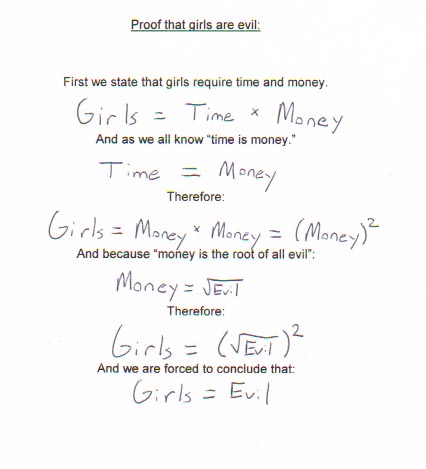
Girls = Evil proved (or maybe not)
From The Slasinski Log: A mathematical proof that Girls = Evil. And a rejoinder showing that girls can be either evil or -evil. Which, I suppose, just proves that Henry Wadsworth Longfellow was right.
From The Slasinski Log: A mathematical proof that Girls = Evil. And a rejoinder showing that girls can be either evil or -evil. Which, I suppose, just proves that Henry Wadsworth Longfellow was right.
W Ketchup?
Recently advertised in the pages of the magazine my brother refers to as the Weekly Republican: W Ketchup. Hey, with a handful of French -- er, freedom fries -- that makes two servings of fresh vegetables! (See here and here.)
Now... what about those unpatriotic traitors who are still eating the enemy's mustard?
But perhaps the bottle's label says more than its hucksters think it does. Look closely at the bottle. Don't the "colonial soldiers" look just a tad, er, menacing? And George Washington doesn't just look traditionally grumpy -- he actually appears to be blushing in shame at this latest indignity.
Recently advertised in the pages of the magazine my brother refers to as the Weekly Republican: W Ketchup. Hey, with a handful of French -- er, freedom fries -- that makes two servings of fresh vegetables! (See here and here.)
Now... what about those unpatriotic traitors who are still eating the enemy's mustard?
But perhaps the bottle's label says more than its hucksters think it does. Look closely at the bottle. Don't the "colonial soldiers" look just a tad, er, menacing? And George Washington doesn't just look traditionally grumpy -- he actually appears to be blushing in shame at this latest indignity.
You never know what you'll find in a book
Courtesy of Lady Crumpet's Armoire: the Wall Street Journal discusses the "unintended mysteries" of personal items left inside used books.
For the readers' delectation, here's a highly selective list of the most interesting debris of previous owners' lives that I've found inside secondhand (or library) books over the years:
* A pressed red rose resting upon the title page of that most chivalric of Chaucer's Canterbury Tales, the Knight's Tale.
* A long, phantasmagoric poem full of occult references, dedicated to the poet's One True Love and inscribed on the flyleaf of an ominous-looking, black-bound copy of Frazier's The Golden Bough.
* A $20 bill, used as a bookmark in a book of model-railroad plans.
* A cancelled check with Ernest Thompson Seton's signature, laid into an inscribed copy of one of his wife's books about southwestern Indians.
* In a long-ago library book sale: an inscription to a friend... from myself!
* Just yesterday, at Suburban Public Library: what appears to be a wallet-sized high-school yearbook photograph of "Kenny", with a note on the back indicating that "it's great to still be friends with you", and also noting that he thinks D. "is really GREAT" and he plans to marry her.
Courtesy of Lady Crumpet's Armoire: the Wall Street Journal discusses the "unintended mysteries" of personal items left inside used books.
For the readers' delectation, here's a highly selective list of the most interesting debris of previous owners' lives that I've found inside secondhand (or library) books over the years:
* A pressed red rose resting upon the title page of that most chivalric of Chaucer's Canterbury Tales, the Knight's Tale.
* A long, phantasmagoric poem full of occult references, dedicated to the poet's One True Love and inscribed on the flyleaf of an ominous-looking, black-bound copy of Frazier's The Golden Bough.
* A $20 bill, used as a bookmark in a book of model-railroad plans.
* A cancelled check with Ernest Thompson Seton's signature, laid into an inscribed copy of one of his wife's books about southwestern Indians.
* In a long-ago library book sale: an inscription to a friend... from myself!
* Just yesterday, at Suburban Public Library: what appears to be a wallet-sized high-school yearbook photograph of "Kenny", with a note on the back indicating that "it's great to still be friends with you", and also noting that he thinks D. "is really GREAT" and he plans to marry her.
Tuesday, June 22, 2004
Here's how bad the Bush Administration is:
It's making people nostalgic -- nostalgic! -- for the Clinton Administration, prompting adoring fans to stand in line for Clinton's recently-published autobiography despite horrible reviews. ("badly conceived, flatly written, poorly edited...." -- CNN). And good 'ol Bill is happy to cash in, of course....
The man was a lecher and a liar and a con artist. But at least he didn't go around starting unnecessary wars while his henchmen dismantled the Constitution.
It's making people nostalgic -- nostalgic! -- for the Clinton Administration, prompting adoring fans to stand in line for Clinton's recently-published autobiography despite horrible reviews. ("badly conceived, flatly written, poorly edited...." -- CNN). And good 'ol Bill is happy to cash in, of course....
The man was a lecher and a liar and a con artist. But at least he didn't go around starting unnecessary wars while his henchmen dismantled the Constitution.
Monday, June 21, 2004
Orrin Hatch wants to outlaw your VCR
Senator Orrin Hatch (Republican, representing the RIAA/MPAA) reportedly plans to introduce a bill cunningly titled the "INDUCE" Act of 2004 sometime in the near future. That's short for "Inducement Devolves into Unlawful Child Exploitation Act". Hatch is lying through his teeth by pretending that the bill has anything to do with "protecting the children". Nothing even remotely relevant to children appears anywhere in the text of the bill. (Also available here for anyone who doesn't like .pdf's.)
What the bill's all about is suppressing technological development and suppressing our Constitutional rights to free speech and legal representation, all for the benefit of the poor lil' ol' media industry, which just happens to have donated large amounts of money to Senator Hatch's slush fund. It seeks to do so by extending liability for any conceivable potential copyright infringement to anyone who "aids, abets, induces, counsels, or procures" such infringement. The past legal actions of the Hollywood IP barons (the Sony Betamax case, for example) have made it abundantly clear that producing hardware or software capable of copying anything they don't want copied will be considered to fall in this category, whether or not the product has legitimate non-infringing uses, whether or not any significant number of people actually use it for illegal activities. So will academic and technical discussions of encryption or copy-prevention technology -- remember the RIAA's legal threats against computer researcher Edward Felten? So will political and editorial statements "inducing" or "counseling" anything that Jack Valenti objects to. (You remember him -- the "What's Fair Use" fellow?) And one legal scholar even suggests that Hatch and Co. are stealing an idea from the Bush "Justice" Department's recent prosecutions of attorneys who represent government-targeted defendants, and, by including the word "counsel", seek to effectively outlaw legal representation of anyone accused of copyright infringement.
Don't take my word for it. See what Declan McCullagh, the Electronic Frontier Foundation , and the folks over at Copyfight have to say. (More assorted ranting and raving available via Slashdot.)
Senator Orrin Hatch (Republican, representing the RIAA/MPAA) reportedly plans to introduce a bill cunningly titled the "INDUCE" Act of 2004 sometime in the near future. That's short for "Inducement Devolves into Unlawful Child Exploitation Act". Hatch is lying through his teeth by pretending that the bill has anything to do with "protecting the children". Nothing even remotely relevant to children appears anywhere in the text of the bill. (Also available here for anyone who doesn't like .pdf's.)
What the bill's all about is suppressing technological development and suppressing our Constitutional rights to free speech and legal representation, all for the benefit of the poor lil' ol' media industry, which just happens to have donated large amounts of money to Senator Hatch's slush fund. It seeks to do so by extending liability for any conceivable potential copyright infringement to anyone who "aids, abets, induces, counsels, or procures" such infringement. The past legal actions of the Hollywood IP barons (the Sony Betamax case, for example) have made it abundantly clear that producing hardware or software capable of copying anything they don't want copied will be considered to fall in this category, whether or not the product has legitimate non-infringing uses, whether or not any significant number of people actually use it for illegal activities. So will academic and technical discussions of encryption or copy-prevention technology -- remember the RIAA's legal threats against computer researcher Edward Felten? So will political and editorial statements "inducing" or "counseling" anything that Jack Valenti objects to. (You remember him -- the "What's Fair Use" fellow?) And one legal scholar even suggests that Hatch and Co. are stealing an idea from the Bush "Justice" Department's recent prosecutions of attorneys who represent government-targeted defendants, and, by including the word "counsel", seek to effectively outlaw legal representation of anyone accused of copyright infringement.
Don't take my word for it. See what Declan McCullagh, the Electronic Frontier Foundation , and the folks over at Copyfight have to say. (More assorted ranting and raving available via Slashdot.)
Orphaned newspapers find a home
Nicholson Baker, in his 2001 book Double Fold, mercilessly excorciated librarians and archivists who, according to Baker, have abandoned their role as preservers of the published record, especially long print runs of old newspapers and magazines, in favor of flashy but flawed modern technologies such as microfilm and electronic "archives", or in many cases in favor of simply dumping everything that wasn't new and "sexy" into landfills with no attention whatsoever to the preservation of the historical record. Microfilmed copies are bedeviled by missing pages, poorly photographed images, loss of color information, and awkward means of access; electronic images may have all of the above problems, plus extortionately high subscription rates. Both have other problems as well.
Unlike many activists, though, Baker had both the will and the means to do something substantive about his bete noire, and when he heard of an extensive collection of 19th-century American newspapers that was being discarded by the British Library, he took action to acquire them and preserve them.
In thanks, the snobs of the library world sneered at him. He was roundly derided as a meddling outsider and a crank. Comfortably ensconced in their offices and committees and roundtables, the library administrators who have the time and job security to comment publicly upon such things snickered knowingly that he'd never find a home for them, that he was a mere dilettante who would soon lose interest, that he'd get tired of paying storage bills, that the newspapers would never be publicly accessible.
Wrong. (See also here, here, here.)
Nicholson Baker, in his 2001 book Double Fold, mercilessly excorciated librarians and archivists who, according to Baker, have abandoned their role as preservers of the published record, especially long print runs of old newspapers and magazines, in favor of flashy but flawed modern technologies such as microfilm and electronic "archives", or in many cases in favor of simply dumping everything that wasn't new and "sexy" into landfills with no attention whatsoever to the preservation of the historical record. Microfilmed copies are bedeviled by missing pages, poorly photographed images, loss of color information, and awkward means of access; electronic images may have all of the above problems, plus extortionately high subscription rates. Both have other problems as well.
Unlike many activists, though, Baker had both the will and the means to do something substantive about his bete noire, and when he heard of an extensive collection of 19th-century American newspapers that was being discarded by the British Library, he took action to acquire them and preserve them.
In thanks, the snobs of the library world sneered at him. He was roundly derided as a meddling outsider and a crank. Comfortably ensconced in their offices and committees and roundtables, the library administrators who have the time and job security to comment publicly upon such things snickered knowingly that he'd never find a home for them, that he was a mere dilettante who would soon lose interest, that he'd get tired of paying storage bills, that the newspapers would never be publicly accessible.
Wrong. (See also here, here, here.)
Nice work if you can get it
The library aboard Cunard's newest liner, the Queen Mary II, just below the bridge.
But -- gasp! -- according to the June 15 issue of Library Journal, they do not have an MLS-holding librarian!
Should I inquire, I wonder?
The library aboard Cunard's newest liner, the Queen Mary II, just below the bridge.
But -- gasp! -- according to the June 15 issue of Library Journal, they do not have an MLS-holding librarian!
Should I inquire, I wonder?
Libertarian campaign blog
Thanks to Carlos for sending me the link to the weblog for Michael Badnarik, the Libertarian presidential candidate. (More-or-less static campaign website here.) One of the blog posts is titled, forthrightly, "Libertarians hope to cost Bush the election", presumably by attracting the votes of fiscally responsible, small-government conservatives who can't stomach the abuses of the current Republican regime. More power to 'em.
Who else but a libertarian would be willing to appear on both the O'Reilly Factor *and* a Gay Pride parade? In the same week, no less?
From the Austin Chronicle:
Thanks to Carlos for sending me the link to the weblog for Michael Badnarik, the Libertarian presidential candidate. (More-or-less static campaign website here.) One of the blog posts is titled, forthrightly, "Libertarians hope to cost Bush the election", presumably by attracting the votes of fiscally responsible, small-government conservatives who can't stomach the abuses of the current Republican regime. More power to 'em.
Who else but a libertarian would be willing to appear on both the O'Reilly Factor *and* a Gay Pride parade? In the same week, no less?
From the Austin Chronicle:
If they can't win outright, the Libertarians are hoping that they can pressure President Bush from the right much in the way Ralph Nader is running to John Kerry's left, especially in battleground states like Wisconsin, Oregon, and Nevada. They hope to appeal to Republicans disaffected by the Bush administration's war in Iraq as well as its economic policies – many conservatives, like U.S. Rep. Ron Paul, R-Surfside (himself a former Libertarian presidential candidate), oppose both the war and the administration's willingness to engage in deficit spending on a massive scale.
Badnarik is on record strongly opposing the war in Iraq as imperial military adventurism, and the USA-PATRIOT Act as a dangerous restriction on constitutionally guaranteed liberties. He also opposes all gun laws – saying he moved from California to Texas largely because of his opposition to California restrictions on gun ownership....
Robert Heinlein would be proud
The world's first privately-funded manned spacecraft takes off in pursuit of the $10 million Ansari X Prize.
The world's first privately-funded manned spacecraft takes off in pursuit of the $10 million Ansari X Prize.
Friday, June 18, 2004
Mysterious Texana
An unidentified collector of materials about the early history of Texas died recently, and Sotheby's is putting his collection up for auction.
But where did they come from?
An unidentified collector of materials about the early history of Texas died recently, and Sotheby's is putting his collection up for auction.
But where did they come from?
Thursday, June 17, 2004
Of chat reference
In each of the academic libraries at which I've worked, the administration and staff have gone to significant effort to provide virtual or "chat" reference service. At each of those two libraries, the response from library users has been decidedly underwhelming. Now it is possible that the limited times during which the libraries have offered this service, or a lack of publicity, or technical glitches, could be partially responsible for this. But it leads me to wonder whether there's really any patron demand for such a service, or if it's just a service in search of an audience, something that libraries feel compelled to do just because they can, and because all the cool libraries are doing it.
An article from the Spring 2004 issue of Reference and User Services Quarterly appears to support my sour thoughts on the subject. (Johnson, Corey. "Online Chat Reference : Survey Results from Affiliates of Two Universities". Reference and User Services Quarterly 43 (2004): 237-247.) Those interested in reading all the gory details can look it up in print, but here are the statistics that caught my attention:
Percentage of students and faculty who have used chat reference: 3.3%
Percentage of students and faculty who cite chat as their first choice for reference service: 4.4%
One of the reasons frequently cited for chat reference service is that library users with only one dial-up telephone line cannot call the reference desk for in-person telephone assistance while connected to the internet (and, presumably, using library catalogs or databases.) Is this likely to be a factor in the future? More and more people are using broadband internet which does not interfere with their use of a landline telephone; more and more will likely start using voice-over-internet services which permit voice telephone service to co-exist with internet connectivity; and wireless or cellular voice communication seems to be increasingly ubiquitous. How many people actually prefer conducting reference inquiries via awkward, abbreviated chat messages instead of speaking in person, if both options are available?
The survey in the article also suggested that 35.6% of faculty and students thought chat reference service would be the most widely used library service in ten years, but given my experience with rarely-used chat services and the vanishingly small percentage of users who say they have in fact used such services, I'm skeptical.
In each of the academic libraries at which I've worked, the administration and staff have gone to significant effort to provide virtual or "chat" reference service. At each of those two libraries, the response from library users has been decidedly underwhelming. Now it is possible that the limited times during which the libraries have offered this service, or a lack of publicity, or technical glitches, could be partially responsible for this. But it leads me to wonder whether there's really any patron demand for such a service, or if it's just a service in search of an audience, something that libraries feel compelled to do just because they can, and because all the cool libraries are doing it.
An article from the Spring 2004 issue of Reference and User Services Quarterly appears to support my sour thoughts on the subject. (Johnson, Corey. "Online Chat Reference : Survey Results from Affiliates of Two Universities". Reference and User Services Quarterly 43 (2004): 237-247.) Those interested in reading all the gory details can look it up in print, but here are the statistics that caught my attention:
Percentage of students and faculty who have used chat reference: 3.3%
Percentage of students and faculty who cite chat as their first choice for reference service: 4.4%
One of the reasons frequently cited for chat reference service is that library users with only one dial-up telephone line cannot call the reference desk for in-person telephone assistance while connected to the internet (and, presumably, using library catalogs or databases.) Is this likely to be a factor in the future? More and more people are using broadband internet which does not interfere with their use of a landline telephone; more and more will likely start using voice-over-internet services which permit voice telephone service to co-exist with internet connectivity; and wireless or cellular voice communication seems to be increasingly ubiquitous. How many people actually prefer conducting reference inquiries via awkward, abbreviated chat messages instead of speaking in person, if both options are available?
The survey in the article also suggested that 35.6% of faculty and students thought chat reference service would be the most widely used library service in ten years, but given my experience with rarely-used chat services and the vanishingly small percentage of users who say they have in fact used such services, I'm skeptical.
Smoke on the water, a fire in the sky
Immediately after sending a message about this disaster off to a library listserv that was discussing cruise ship disasters, I received an Aurora Alert from the GSE-AA list:
*Sigh*. My life is turning into a Deep Purple song. That's scary.
Immediately after sending a message about this disaster off to a library listserv that was discussing cruise ship disasters, I received an Aurora Alert from the GSE-AA list:
Subject : [gse-aa] Auroral AlertGreenwich Mean Time-to-local-time conversion here (click on the appropriate flag).
Date : Thu, 17 Jun 2004 09:43:52 -0800
There was a solar flare on the 16th of June. The shock from this flare
should reach about midnight on the 17th GMT. This means that the
distortion in the solar wind that leads to auroral activity should occur
during the night over the USA. This prediction may be as much as 10
hours off, but it would be worth it to check the northern sky tonight if
you live in the northern half of the US.
*Sigh*. My life is turning into a Deep Purple song. That's scary.
Wednesday, June 16, 2004
Happy Bloomsday, everybody!
Although I have never made it through a single book by James Joyce, far be it from me to wish ill to his faithful followers.
Although I have never made it through a single book by James Joyce, far be it from me to wish ill to his faithful followers.
Tuesday, June 15, 2004
Toxic waste? What toxic waste?
Senator Inhofe, the Oklahoma blowhard best known for his spirited defense of torture, sadomasochistic pornography, and war crimes, has sneaked a little present into a highways appropriations bill, which could radically affect citizens', local governments', and other researchers' access to routine information about the transportation facilities in their midst. Details at ALAWON.
Just one more case of the current crop of Republicans' obsession with hiding information.
Senator Inhofe, the Oklahoma blowhard best known for his spirited defense of torture, sadomasochistic pornography, and war crimes, has sneaked a little present into a highways appropriations bill, which could radically affect citizens', local governments', and other researchers' access to routine information about the transportation facilities in their midst. Details at ALAWON.
Just one more case of the current crop of Republicans' obsession with hiding information.
Supremes dodge the Big Question on Newdow case
(and Justice Thomas goes Over the Rainbow)
It's old news by now, but since I mentioned the case when it was first argued, I should mention the Court's decision in Elk Grove Unified School District v. Newdow, the case in which an atheist parent sued to prevent his child's school district from requiring her to recite the Pledge of Allegiance on the grounds that the phrase "under God" constituted a governmental establishment of religion. Disappointingly for those who love legal Armageddons, the Court ruled against Newdow on the narrow, technical grounds that under the child custody agreement between him and his ex-wife, she had final legal custody of the daughter on whose behalf he filed the lawsuit, and that he therefore did not have standing to sue.
The interesting part of the opinion, after one wades through pages of minutiae about parental custody, is the concurring opinions. Rehnquist and O'Connor argue predictably that the "under God" phrase does not violate the First Amendment prohibition of establishment of religion because of its traditional and ceremonial nature. To tell the truth, their arguments sound a bit weaselly, but that's usual when judges try to navigate the dangerous waters between the words of the Constitution and the desires of themselves and a significant portion of the population. But then Justice Thomas, as this blogger puts it, goes "over the rainbow" and asserts a novel-to-me claim that the Fourteenth Amendment, although it does extend to the states the First Amendment right to individual religious free expression, somehow fails to correspondingly extend the federal ban on establishment of religion. Thus Thomas bluntly asserts that, under existing establishment-clause jurisprudence, requiring the Pledge of Allegiance with the words "under God" does violate the First Amendment -- but then argues that the existing jurisprudence should be abandoned in favor of his own novel theory that it doesn't matter because the "establishment" clause of the First Amendment, unlike every other part of it, doesn't apply to state governments.
Theoretically, his argument would permit every state to set up its own official, established church, and, presumably, use governmental power to promote that state church, so long as it didn't overtly infringe on individual free exercise of religion enough to attract federal attention. How'd you like to be an atheist living in Utah, or for that matter, a Mormon living in South Carolina, under this theory of law?
(and Justice Thomas goes Over the Rainbow)
It's old news by now, but since I mentioned the case when it was first argued, I should mention the Court's decision in Elk Grove Unified School District v. Newdow, the case in which an atheist parent sued to prevent his child's school district from requiring her to recite the Pledge of Allegiance on the grounds that the phrase "under God" constituted a governmental establishment of religion. Disappointingly for those who love legal Armageddons, the Court ruled against Newdow on the narrow, technical grounds that under the child custody agreement between him and his ex-wife, she had final legal custody of the daughter on whose behalf he filed the lawsuit, and that he therefore did not have standing to sue.
The interesting part of the opinion, after one wades through pages of minutiae about parental custody, is the concurring opinions. Rehnquist and O'Connor argue predictably that the "under God" phrase does not violate the First Amendment prohibition of establishment of religion because of its traditional and ceremonial nature. To tell the truth, their arguments sound a bit weaselly, but that's usual when judges try to navigate the dangerous waters between the words of the Constitution and the desires of themselves and a significant portion of the population. But then Justice Thomas, as this blogger puts it, goes "over the rainbow" and asserts a novel-to-me claim that the Fourteenth Amendment, although it does extend to the states the First Amendment right to individual religious free expression, somehow fails to correspondingly extend the federal ban on establishment of religion. Thus Thomas bluntly asserts that, under existing establishment-clause jurisprudence, requiring the Pledge of Allegiance with the words "under God" does violate the First Amendment -- but then argues that the existing jurisprudence should be abandoned in favor of his own novel theory that it doesn't matter because the "establishment" clause of the First Amendment, unlike every other part of it, doesn't apply to state governments.
Theoretically, his argument would permit every state to set up its own official, established church, and, presumably, use governmental power to promote that state church, so long as it didn't overtly infringe on individual free exercise of religion enough to attract federal attention. How'd you like to be an atheist living in Utah, or for that matter, a Mormon living in South Carolina, under this theory of law?
More Baptist battles
The Southern Baptist Convention, largest Baptist denomination in the U.S., has huffily taken its marbles and gone home rather than play nice with the Baptist World Alliance which it helped to found in 1905, according to this story from USATODAY. Also here, here, here, and here. (The SBC website, as of 8:00 p.m. this evening, apparently sees no reason to publicize this to its readers, preferring instead to push a legal proposal to seize centralized control of local Baptist institutions while evading financial responsibility for them.)
The vote to leave the worldwide Baptist organization reportedly is in response to a report which
I guess I forgot to read the part of the Bible where Jesus said that the purpose of his church was to be pro-American. Or pro-capitalist. Or that Caesar -- er, President Bush -- was the leader of the church. Is that somewhere in the Book of Republicans, maybe?
I may disagree with the Cooperative Baptist Fellowship about some things, but at least I'm reasonably sure that the moderate churches that make up their membership would at least be willing to talk with me if I showed up on their doorstep, shaggy hair, doubts and all. And that, not the increasingly Pharisaical Southern Baptist Convention, looks a whole lot more like the true ministry of the Son of Man. You remember, that shaggy-haired guy who ministered to thieves, lepers, criminals, and prostitutes? And chased the crooked moneychangers out of the Temple with a whip in his hand?
The Southern Baptist Convention, largest Baptist denomination in the U.S., has huffily taken its marbles and gone home rather than play nice with the Baptist World Alliance which it helped to found in 1905, according to this story from USATODAY. Also here, here, here, and here. (The SBC website, as of 8:00 p.m. this evening, apparently sees no reason to publicize this to its readers, preferring instead to push a legal proposal to seize centralized control of local Baptist institutions while evading financial responsibility for them.)
The vote to leave the worldwide Baptist organization reportedly is in response to a report which
"...complained that some in the alliance had questioned "the truthfulness of Holy Scripture," refused to affirm the necessity of conscious faith in Jesus Christ for salvation, promoted women preachers, criticized the SBC and its foreign mission board and adopted an "anti-American" tone.So much for "God so loved the world." Paige Patterson's God, and the God of the SBC, apparently only loves conservative Americans. Is it any wonder that the rate of baptism in the SBC continues to shrink, when its leaders are this determined to lash it to the mast of a sinking political ship? And when they display more interest in worldly powermongering and politically "punishing" anyone who criticizes them than they do in preaching the Good News of forgiveness, or doing the good works that Jesus advocated? So determined, in other words, to rigidly ossify themselves into ultimate irrelevance?
The last straw came in 2003, when the alliance accepted as a member the Cooperative Baptist Fellowship, a rival group to the SBC formed by moderates who oppose denominational leaders' conservative policies.
Prior to Tuesday's vote, Paige Patterson, president of Southwestern Baptist Theological Seminary in Fort Worth, said the SBC should not give money or endorsement to an organization that includes liberals. (AP via USATODAY)
I guess I forgot to read the part of the Bible where Jesus said that the purpose of his church was to be pro-American. Or pro-capitalist. Or that Caesar -- er, President Bush -- was the leader of the church. Is that somewhere in the Book of Republicans, maybe?
I may disagree with the Cooperative Baptist Fellowship about some things, but at least I'm reasonably sure that the moderate churches that make up their membership would at least be willing to talk with me if I showed up on their doorstep, shaggy hair, doubts and all. And that, not the increasingly Pharisaical Southern Baptist Convention, looks a whole lot more like the true ministry of the Son of Man. You remember, that shaggy-haired guy who ministered to thieves, lepers, criminals, and prostitutes? And chased the crooked moneychangers out of the Temple with a whip in his hand?
Sunday, June 13, 2004
Hearts of Darkness
One of the only truly insightful essays to appear in National Review lately was Theodore Dalrymple's "Hearts of Darkness", from the May 31 issue:
One of the only truly insightful essays to appear in National Review lately was Theodore Dalrymple's "Hearts of Darkness", from the May 31 issue:
"We all want to think that our boys are different, that they would never stoop to the vile practices of foreign despots, such as the abuse of captives of the torture of prisoners. But this is to forget the meaning of Original Sin: that there is within each and every one of us a capacity for wrongdoing and evil, awaiting only an opportunity to assert itself. And chief among these opportunities is the possession of unbridled power over others....."So, if this is true, why is NR so gung-ho about giving unbridled power, without any legal or moral restraints, to the Executive branch? (Sadly, the article is not available on line.)
The world's most expensive parking ticket?
From the July issue of Trains magazine:
From the July issue of Trains magazine:
A Union Pacific coal train blocked a grade crossing near Caledonia, Wis., for more than six hours April 18, and racked up more than $13,000 in fines, according to the Racine Journal Times.I'd feel more sympathetic toward the Yellow Borg if they didn't have such a track record (so to speak) of arrogance toward railfans, modelers, employees, and everybody else. Clearly the Caledonia cops were fed up with the repeat offenses.
The train was delivering coal to a nearby power plant. The crew parked the train, uncoupled the diesels, and left. The rear car of the train blocked the crossing from at least 4:33 to 10:33 p.m.
Caledonia police issued 20 tickets. Nineteen of them, written every 20 minutes, carry a fine of $660 for blocking the highway. The other, for $1280, was for being a public nuisance. It was the sixth time since October 2003 UP had been cited for similar violations.
Union Pacific said the crew had broken thetrain apart to open one crossing, but didn't realize it was blocking another.
The Stepford Wives
The version of the story that's now playing in theaters is more of a comedy than a paranoid thriller in the style of the book it's loosely based on. The cloying sweetness of Stepford -- the ultimate "gated community" -- is played to a point almost beyond satire, and scenes such as the extended closeup on the face of Nicole Kidman's character after she receives bad news early in the film, or a subsequent scene in which a Stepford Wife goes haywire in the middle of a dance floor, or the very strange gag about a oddly-located ATM machine, are so broadly comedic that it's difficult to feel any real sense of danger as the secrets of Stepford work their way closer to the surface. However, some of the comedic bits work on their own merits, and the film does have an entertaining surprise ending that has something to say about either sex regarding the other as a trophy or prize possession. The opening sequence, with its short, sharp parody of so-called "reality" shows, also says something about a culture in which people feel entitled or obliged to "conquer" the other. If all relationships must have a "winner" and a "loser" who is, at best, treated as a submissive possession, can anything but Stepford or some other dysfunctional social order be the result?
The version of the story that's now playing in theaters is more of a comedy than a paranoid thriller in the style of the book it's loosely based on. The cloying sweetness of Stepford -- the ultimate "gated community" -- is played to a point almost beyond satire, and scenes such as the extended closeup on the face of Nicole Kidman's character after she receives bad news early in the film, or a subsequent scene in which a Stepford Wife goes haywire in the middle of a dance floor, or the very strange gag about a oddly-located ATM machine, are so broadly comedic that it's difficult to feel any real sense of danger as the secrets of Stepford work their way closer to the surface. However, some of the comedic bits work on their own merits, and the film does have an entertaining surprise ending that has something to say about either sex regarding the other as a trophy or prize possession. The opening sequence, with its short, sharp parody of so-called "reality" shows, also says something about a culture in which people feel entitled or obliged to "conquer" the other. If all relationships must have a "winner" and a "loser" who is, at best, treated as a submissive possession, can anything but Stepford or some other dysfunctional social order be the result?
A lazy day
I had ambitious plans for Saturday. I was going to drive up to Owosso and go to the opening day of this group's railroad museum. What happened instead is that I slept late, and once I finally dragged my lazy self out of bed, I decided to spend the day reading A Tree Grows in Brooklyn instead. So I'll just have to check out the railroad museum at some later time. These upcoming "opportunities" look a little too expensive. Not to mention that paying good money to be fireman, i.e., shovel several tons of coal by hand, sounds just a bit too much like a certain famous literary prank. Fortunately, they seem to have a steam-powered excursion scheduled for later in the summer, when I'll have more time.
I started reading A Tree Grows in Brooklyn after it was recommended to me by a student worker at "Huron State". I'd heard of the book for years, of course, but never got around to reading it. It was a pleasant surprise.
The book really doesn't have much of a plot. There's no obvious didactic point to it, nor does it follow the standard rising-to-a-climax and falling-to-denoument pattern that most of us learned about in school. It meanders slowly from one chapter to the next, with a substantial part of the middle of the book being told out of chronological order. It begins with Francie, the central character, at the age of eleven, but then digresses into a lengthy account of her parent's lives and her earlier life. One major character's death "before the age of thirty" is asserted by the author long before she ever gets around to recounting that portion of the character's life. Exciting action and plot development are not good reasons to read this book; however, it has an incredible wealth of character development and detailed observation of life in the Brooklyn tenements in the early twentieth century. Stephen Crane turned a much more withering gaze on those same tenements in his short, bitter Maggie : a Girl of the Streets. Smith's book is a bit gentler in tone, but the same hazards are present.
The whole book reads as if the author had turned a microscope onto the lives of her characters in order to examine their lives and characters in a leisurely fashion, and it's somewhat to the reader's surprise that such ordinary people turn out to be so interesting. A good book to read on a slow, lazy Saturday. But may all the gods there be protect me and all others who toil in the stacks from becoming like the librarian in the book:
I had ambitious plans for Saturday. I was going to drive up to Owosso and go to the opening day of this group's railroad museum. What happened instead is that I slept late, and once I finally dragged my lazy self out of bed, I decided to spend the day reading A Tree Grows in Brooklyn instead. So I'll just have to check out the railroad museum at some later time. These upcoming "opportunities" look a little too expensive. Not to mention that paying good money to be fireman, i.e., shovel several tons of coal by hand, sounds just a bit too much like a certain famous literary prank. Fortunately, they seem to have a steam-powered excursion scheduled for later in the summer, when I'll have more time.
I started reading A Tree Grows in Brooklyn after it was recommended to me by a student worker at "Huron State". I'd heard of the book for years, of course, but never got around to reading it. It was a pleasant surprise.
The book really doesn't have much of a plot. There's no obvious didactic point to it, nor does it follow the standard rising-to-a-climax and falling-to-denoument pattern that most of us learned about in school. It meanders slowly from one chapter to the next, with a substantial part of the middle of the book being told out of chronological order. It begins with Francie, the central character, at the age of eleven, but then digresses into a lengthy account of her parent's lives and her earlier life. One major character's death "before the age of thirty" is asserted by the author long before she ever gets around to recounting that portion of the character's life. Exciting action and plot development are not good reasons to read this book; however, it has an incredible wealth of character development and detailed observation of life in the Brooklyn tenements in the early twentieth century. Stephen Crane turned a much more withering gaze on those same tenements in his short, bitter Maggie : a Girl of the Streets. Smith's book is a bit gentler in tone, but the same hazards are present.
The whole book reads as if the author had turned a microscope onto the lives of her characters in order to examine their lives and characters in a leisurely fashion, and it's somewhat to the reader's surprise that such ordinary people turn out to be so interesting. A good book to read on a slow, lazy Saturday. But may all the gods there be protect me and all others who toil in the stacks from becoming like the librarian in the book:
Each week Francie made the same request and each week the librarian asked the same question. A name on a card meant nothing to her and since she never looked up into a child's face, she never did get to know the little girl who took a book out every day and two on Saturday. A smile would have meant a lot to Francie and a friendly comment would have made her so happy. She loved the library and was anxious to worship the lady in charge. But the librarian had other things on her mind. She hated children anyhow. (p. 24)Later in the day, some co-workers drafted me to go see the current iteration of The Stepford Wives. More on that tomorrow.
Wednesday, June 09, 2004
Libertarians vs. Libraries
The Mackinac Center for Public Policy, a free-market libertarian thinktank best known for advocating homeschooling in Michigan and being sued on extremely dubious grounds by a Michigan teacher's union, now wants the state of Michigan to stop funding public libraries. "Libraries need not be public entities...."
This question has come up before, and I'm no closer to resolving the philosophical conflict between politically libertarian ideals and my love of libraries that don't try to hardsell their customers on the latest hype, carry only the highest-volume-selling items, summarily dump "unsold" backstock, or do any of the other less savory things that commercial entities do. ("Buy three Harry Potters, get a Nicholas Sparks free!") Or restrict their users to members of certain social/economic classes or organizations, as a private organization would be able to do.
It's unclear to me whether Mackinac's proposal would also eliminate services like the Michigan Electronic Library, a state consortium-purchasing plan that makes an impressive number of electronic databases available to individual state residents as well as libraries. Most rural libraries would be unable to pay for any significant number of these, and as small individual purchasers, what kind of bargaining power would they have in a database market that is rapidly being consolidated and dominated by a few very large corporate players, a market in which new entrants to the business are highly constrained by copyright laws?
It's also unclear to me whether Mackinac's homeschooling followers around the state would be pleased to have their public libraries, a potential major source of educational materials, have to cut back their operations.
I doubt that this proposal will be taken seriously outside of the MCPP's core team of ideological True Believers, but still....
The Mackinac Center for Public Policy, a free-market libertarian thinktank best known for advocating homeschooling in Michigan and being sued on extremely dubious grounds by a Michigan teacher's union, now wants the state of Michigan to stop funding public libraries. "Libraries need not be public entities...."
This question has come up before, and I'm no closer to resolving the philosophical conflict between politically libertarian ideals and my love of libraries that don't try to hardsell their customers on the latest hype, carry only the highest-volume-selling items, summarily dump "unsold" backstock, or do any of the other less savory things that commercial entities do. ("Buy three Harry Potters, get a Nicholas Sparks free!") Or restrict their users to members of certain social/economic classes or organizations, as a private organization would be able to do.
It's unclear to me whether Mackinac's proposal would also eliminate services like the Michigan Electronic Library, a state consortium-purchasing plan that makes an impressive number of electronic databases available to individual state residents as well as libraries. Most rural libraries would be unable to pay for any significant number of these, and as small individual purchasers, what kind of bargaining power would they have in a database market that is rapidly being consolidated and dominated by a few very large corporate players, a market in which new entrants to the business are highly constrained by copyright laws?
It's also unclear to me whether Mackinac's homeschooling followers around the state would be pleased to have their public libraries, a potential major source of educational materials, have to cut back their operations.
I doubt that this proposal will be taken seriously outside of the MCPP's core team of ideological True Believers, but still....
Parallels
A few days ago, I serendipitously noticed a book in "Huron State"'s return cart, and picked it up: The Stoning of Soraya M.. It's a horrifying and gruesomely detailed documentary account of an incident in which a 35-year-old woman in a rural village in Iran was stoned to death in 1986. What's particularly horrible about it, beyond the sheer brutality of such a punishment for "adultery", is the fact that she was very clearly innocent. Her husband (a petty crook) and the village's fraudulent "imam" (an educated embezzler on the run from the law) consciously and deliberately concocted a false accusation and manipulated village opinion so that her husband could free himself from the obligation of supporting her and afford to acquire a newer and younger wife in the city.
This is, as the author points out, only one of over a thousand such cases.
While I was reading it, certain aspects of the story began to sound extremely familiar. The references to the young girl accidentally losing a kite, the husband's preference for flashy cars and prostitutes over his wife and children, the reference to a stone representing the "pillar of Shayton" [i.e., Satan}, all sounded strangely familiar. Eventually, I realized why. One of Susan's poems bears a very close resemblance to this story. Close enough that she must have read it, or heard or read another source about the same case, even though she assigned a different name to the main character. It was an odd feeling to realize this -- that I was reading something she had read years ago, something that had impressed itself upon her mind strongly enough to become part of her own writing. It would have been fascinating to ask her about this and see what she had to say. But that's impossible.
A few days ago, I serendipitously noticed a book in "Huron State"'s return cart, and picked it up: The Stoning of Soraya M.. It's a horrifying and gruesomely detailed documentary account of an incident in which a 35-year-old woman in a rural village in Iran was stoned to death in 1986. What's particularly horrible about it, beyond the sheer brutality of such a punishment for "adultery", is the fact that she was very clearly innocent. Her husband (a petty crook) and the village's fraudulent "imam" (an educated embezzler on the run from the law) consciously and deliberately concocted a false accusation and manipulated village opinion so that her husband could free himself from the obligation of supporting her and afford to acquire a newer and younger wife in the city.
This is, as the author points out, only one of over a thousand such cases.
While I was reading it, certain aspects of the story began to sound extremely familiar. The references to the young girl accidentally losing a kite, the husband's preference for flashy cars and prostitutes over his wife and children, the reference to a stone representing the "pillar of Shayton" [i.e., Satan}, all sounded strangely familiar. Eventually, I realized why. One of Susan's poems bears a very close resemblance to this story. Close enough that she must have read it, or heard or read another source about the same case, even though she assigned a different name to the main character. It was an odd feeling to realize this -- that I was reading something she had read years ago, something that had impressed itself upon her mind strongly enough to become part of her own writing. It would have been fascinating to ask her about this and see what she had to say. But that's impossible.
O happy day!
While toiling away diligently at job #2, Suburban Public Library's reference desk, I inquired whether the person ordering the library's science fiction and fantasy materials would be interested in seeing the review sections from my subscriptions to Locus and The Magazine of Fantasy and Science Fiction. Instead, she said "Why don't you just take over ordering them?", and assigned an unexpectedly generous amount of money to last through November.
Happiness is... an acquisitions budget.
While toiling away diligently at job #2, Suburban Public Library's reference desk, I inquired whether the person ordering the library's science fiction and fantasy materials would be interested in seeing the review sections from my subscriptions to Locus and The Magazine of Fantasy and Science Fiction. Instead, she said "Why don't you just take over ordering them?", and assigned an unexpectedly generous amount of money to last through November.
Happiness is... an acquisitions budget.
Saturday, June 05, 2004
Wednesday, June 02, 2004
Holidays are wonderful things!
(Editorial note, 6/5: I wrote this post on Wednesday and haven't had time to post it since. Such is the life of a boomer librarian....)
Thanks to the Memorial Day holiday and some relaxing time with the Pablo the illustrious (but still Blogless) and M., I've been feeling rested and ready (if not yet tanned) since the past weekend. We'll see how long that lasts.
Summary of the weekend:
Saturday:
Lunch at the Sidetrack Bar & Grill. I never would have thought of french-frying sweet potatoes, but they're surprisingly good that way, especially with a little horseradish sauce. Sadly, despite its trackside location, not a single steel wheel was anywhere to be seen.
The Automotive Heritage Museum across the street was an interesting place to visit, with some real rarities on display. Multiple Corvairs were in evidence, in recognition of the fact that they were built just east of town at the Willow Run plant. (I doubt that Ralph Nader will ever garner many votes around here!) I found the working, cutaway model of the Corvair's unusual flat-six engine to be quite entertaining, and I wish the straight-six in my truck had the oomph of the ones that Hudson put in its stock-car racers in the early 1950s.
Off with Pablo and M. to the Real Seafood Company. Managed to get a table this time. Pricy, pricy, pricy! But good.
Off then with Pablo and M. to the next-to-last showing of the Threepenny Opera. I've commented about seeing this before. I enjoyed seeing it again. Some of the actors' mannerisms seemed a bit stagier than they did before, but this could have been just because they were more familiar. As usual, I found myself humming one of Weill's catchy little paeans to human depravity most of the way home.
Sunday, off with Pablo to Frankenmuth, Michigan, a town once settled by German immigrants which nowadays styles itself "Michigan's Little Bavaria". A bit touristy but entertaining. On the way back stopped off at the Junction Valley Railroad, the work of a man with a fascinating obsession to build his own quarter-size railroad... from scratch. I can't even imagine spending hundreds of thousands of hours in a machine shop building welded-steel cars and locomotives, each of which weighs several tons. Not to mention laying a spaghetti-bowl of miles of intertwining track for them to run on. It's safe to say that this guy is no longer a "model railroader". When your layout-construction tools are shovels and backhoes rather than hammers and nails, it ain't modeling!
Sunday evening: Finally got around to sampling the Dalat restaurant in downtown Y-ville. Excellently spicy. Spent evening discussing life, the universe and everything. Adjourned pending further discussion.
(Editorial note, 6/5: I wrote this post on Wednesday and haven't had time to post it since. Such is the life of a boomer librarian....)
Thanks to the Memorial Day holiday and some relaxing time with the Pablo the illustrious (but still Blogless) and M., I've been feeling rested and ready (if not yet tanned) since the past weekend. We'll see how long that lasts.
Summary of the weekend:
Saturday:
Lunch at the Sidetrack Bar & Grill. I never would have thought of french-frying sweet potatoes, but they're surprisingly good that way, especially with a little horseradish sauce. Sadly, despite its trackside location, not a single steel wheel was anywhere to be seen.
The Automotive Heritage Museum across the street was an interesting place to visit, with some real rarities on display. Multiple Corvairs were in evidence, in recognition of the fact that they were built just east of town at the Willow Run plant. (I doubt that Ralph Nader will ever garner many votes around here!) I found the working, cutaway model of the Corvair's unusual flat-six engine to be quite entertaining, and I wish the straight-six in my truck had the oomph of the ones that Hudson put in its stock-car racers in the early 1950s.


Off with Pablo and M. to the Real Seafood Company. Managed to get a table this time. Pricy, pricy, pricy! But good.
Off then with Pablo and M. to the next-to-last showing of the Threepenny Opera. I've commented about seeing this before. I enjoyed seeing it again. Some of the actors' mannerisms seemed a bit stagier than they did before, but this could have been just because they were more familiar. As usual, I found myself humming one of Weill's catchy little paeans to human depravity most of the way home.
Sunday, off with Pablo to Frankenmuth, Michigan, a town once settled by German immigrants which nowadays styles itself "Michigan's Little Bavaria". A bit touristy but entertaining. On the way back stopped off at the Junction Valley Railroad, the work of a man with a fascinating obsession to build his own quarter-size railroad... from scratch. I can't even imagine spending hundreds of thousands of hours in a machine shop building welded-steel cars and locomotives, each of which weighs several tons. Not to mention laying a spaghetti-bowl of miles of intertwining track for them to run on. It's safe to say that this guy is no longer a "model railroader". When your layout-construction tools are shovels and backhoes rather than hammers and nails, it ain't modeling!
Sunday evening: Finally got around to sampling the Dalat restaurant in downtown Y-ville. Excellently spicy. Spent evening discussing life, the universe and everything. Adjourned pending further discussion.
Things of Caesar and Things of God
A couple of news stories about clashes between religious belief and governmental power caught my eye lately.
In this story from CNN, park officials have decreed that a Baptist church group may not use the waters of a public park to do open-air baptisms a la John the Baptist. Fortunately, it seems that several religious and civil-liberties groups have weighed in on the side of the besieged Baptists. "Wade in the water, children, the courts gonna trouble the waters...."
In this case, the Michigan Department of Health has insisted that six Amish families in Gladwin county install large septic systems which the Amish say are not only unnecessary, due to their simple way of life, but against their religious principles. (Other articles here, and elsewhere.) Although the story dates from 2002/2003, I haven't yet found a record of a final decision.
Texas versus the Unitarians
Pablo, Louise, and others have brought to my attention the recent controversy over Texas Comptroller Carole Keeton Strayhorn's decision to revoke the tax-exempt status of a Unitarian Universalist church in Denison, Texas. (News stories here, here, here, and elsewhere.) The comptroller seems to have used two litmus tests, depending on which story you read. One requires that a "church" must have a single, unified system of belief; the other requires belief in a "God, Gods, or a supreme being". As Pablo points out, many Baptist churches arguably would not meet the first requirement because of the longstanding aversion of many Baptists to any formally written "creed". (Jokes about this are a dime-a-dozen. For example: Q: "If you put two Baptists in a room, how many intepretations of the Bible do you get?" A: "At least three!" Or, Q: "Do you belong to any organized religion?" A: "No sir, I'm a Baptist!") And others have pointed out that certain varieties of Buddhism, for example, do not mandate belief in a Supreme Being.
The cold, hard facts? Strayhorn's decisions seem to be motivated, more than anything else, by the amount of favorable media attention a church is able to muster up. Political pressure, not any kind of principle, seems to be the most important factor in the decisions made by her and prior Texas Comptrollers. Consider:
From the Houston Chronicle article linked above: "Shortly after Sharp's staff granted the Ethical Society of Austin its religious status, the Austin American-Statesman ran a story about it with the headline "Godless Group Gets Religious Exemption. That same morning, Sharp reversed his staff and ordered no organization be granted religious status unless it believes in "God, Gods or a higher power." In the Texas courts, this became known as the "Supreme Being test."
From the Baptist Standard: "Texas Comptroller Carole Keeton Strayhorn abruptly reversed course after her office's denial of tax-exempt status to a North Texas church because of its beliefs--or lack of them--attracted media attention."
No such favorable media attention has come to the rescue of North Texas Church of Freethought, wiccans in Copperas Cove, pagans in Bastrop. And so they remain officially "not religious".
I myself have mixed feelings about religious exemption from taxation. And I'm certainly aware that claims of religiosity can be frivolous. But there's got to be a better standard than mere political popularity.
A couple of news stories about clashes between religious belief and governmental power caught my eye lately.
In this story from CNN, park officials have decreed that a Baptist church group may not use the waters of a public park to do open-air baptisms a la John the Baptist. Fortunately, it seems that several religious and civil-liberties groups have weighed in on the side of the besieged Baptists. "Wade in the water, children, the courts gonna trouble the waters...."
In this case, the Michigan Department of Health has insisted that six Amish families in Gladwin county install large septic systems which the Amish say are not only unnecessary, due to their simple way of life, but against their religious principles. (Other articles here, and elsewhere.) Although the story dates from 2002/2003, I haven't yet found a record of a final decision.
Texas versus the Unitarians
Pablo, Louise, and others have brought to my attention the recent controversy over Texas Comptroller Carole Keeton Strayhorn's decision to revoke the tax-exempt status of a Unitarian Universalist church in Denison, Texas. (News stories here, here, here, and elsewhere.) The comptroller seems to have used two litmus tests, depending on which story you read. One requires that a "church" must have a single, unified system of belief; the other requires belief in a "God, Gods, or a supreme being". As Pablo points out, many Baptist churches arguably would not meet the first requirement because of the longstanding aversion of many Baptists to any formally written "creed". (Jokes about this are a dime-a-dozen. For example: Q: "If you put two Baptists in a room, how many intepretations of the Bible do you get?" A: "At least three!" Or, Q: "Do you belong to any organized religion?" A: "No sir, I'm a Baptist!") And others have pointed out that certain varieties of Buddhism, for example, do not mandate belief in a Supreme Being.
The cold, hard facts? Strayhorn's decisions seem to be motivated, more than anything else, by the amount of favorable media attention a church is able to muster up. Political pressure, not any kind of principle, seems to be the most important factor in the decisions made by her and prior Texas Comptrollers. Consider:
From the Houston Chronicle article linked above: "Shortly after Sharp's staff granted the Ethical Society of Austin its religious status, the Austin American-Statesman ran a story about it with the headline "Godless Group Gets Religious Exemption. That same morning, Sharp reversed his staff and ordered no organization be granted religious status unless it believes in "God, Gods or a higher power." In the Texas courts, this became known as the "Supreme Being test."
From the Baptist Standard: "Texas Comptroller Carole Keeton Strayhorn abruptly reversed course after her office's denial of tax-exempt status to a North Texas church because of its beliefs--or lack of them--attracted media attention."
No such favorable media attention has come to the rescue of North Texas Church of Freethought, wiccans in Copperas Cove, pagans in Bastrop. And so they remain officially "not religious".
I myself have mixed feelings about religious exemption from taxation. And I'm certainly aware that claims of religiosity can be frivolous. But there's got to be a better standard than mere political popularity.
"It's kind of like a sexy take on a librarian."
Ordinarily I have little interest in linking to stories about feminine fashion. But the statement above makes this story marginally blogworthy.
Ordinarily I have little interest in linking to stories about feminine fashion. But the statement above makes this story marginally blogworthy.
But what happened to the other half?
According to the Kansas City Star, the city of Blue Springs, Missouri, recently returned "almost half" -- $132,000 -- of a $273,000 federal grant which it received in 2002 "to fight a perceived growing Goth culture." Was the city was in imminent danger of being inundated with mopey, pasty-faced teens in black eyeliner?
Apparently not. Sadly, it seems that the city lacked any Goth culture to fight. And it only cost $141,000 to find this out.
Thanks to Neil Gaiman's blog/online journal for the link.
According to the Kansas City Star, the city of Blue Springs, Missouri, recently returned "almost half" -- $132,000 -- of a $273,000 federal grant which it received in 2002 "to fight a perceived growing Goth culture." Was the city was in imminent danger of being inundated with mopey, pasty-faced teens in black eyeliner?
Apparently not. Sadly, it seems that the city lacked any Goth culture to fight. And it only cost $141,000 to find this out.
Thanks to Neil Gaiman's blog/online journal for the link.
Harry, meet Lyra
The Boston Herald reports that a cinematic version of Phillip Pullman's His Dark Materials books is in the making. I expect a certain degree of controversy to ensue, unless the plot and characters of the books are significantly altered. Pullman's books have a much darker take on religion and the supernatural than J.K. Rowling's "Harry Potter" or C.S. Lewis's "Narnia" books.
Thanks to Miss Katherine for the link.
The Boston Herald reports that a cinematic version of Phillip Pullman's His Dark Materials books is in the making. I expect a certain degree of controversy to ensue, unless the plot and characters of the books are significantly altered. Pullman's books have a much darker take on religion and the supernatural than J.K. Rowling's "Harry Potter" or C.S. Lewis's "Narnia" books.
Thanks to Miss Katherine for the link.
A correction
It appears that the young woman who created the Chernobyl motorcycle-trip photostory that I linked to a while back may have indulged in some creative writing. (See this entry from Neil Gaiman's online journal and the Museum of Hoaxes' comment.)
The photos are still haunting, even if the accompanying prose was fictionalized.
(Also found through the Museum of Hoaxes: the Little-Known Attractions of a town that I can now openly identify as Lynchburg, Virginia. The grain silo of "Hugh Johnson" should look familiar to some readers.)
It appears that the young woman who created the Chernobyl motorcycle-trip photostory that I linked to a while back may have indulged in some creative writing. (See this entry from Neil Gaiman's online journal and the Museum of Hoaxes' comment.)
The photos are still haunting, even if the accompanying prose was fictionalized.
(Also found through the Museum of Hoaxes: the Little-Known Attractions of a town that I can now openly identify as Lynchburg, Virginia. The grain silo of "Hugh Johnson" should look familiar to some readers.)
Subscribe to:
Posts (Atom)