Recent Viewings
Flash Gordon: The Lure of Light and The Subworld Revenge
(1954 television series, with Steve Holland, Irene Champlin, and Joseph Nash)
That's right, kids, once more it's time for Flash Gordon, Dale Arden, and Dr. Zarkov! Time for rockets and rayguns, wobbly sets, weird science, and a warbly soundtrack full of frantically tootling trumpets!
In The Lure of Light, an Earth scientist discovers a way to "fly faster than light" [sic]. It seems to have something to do with turning on a Jacob's Ladder. No one knows what will happen to anyone who "breaks the light barrier". Maybe they'll be turned inside out! Or maybe time will go in reverse!
Unfortunately, Flash Gordon and Commissioner Herrig, a military officer with disturbingly bushy eyebrows, happen to be blabbing to each other about the top secret faster-than-light thingie when a megalomaniac evil space-queen happens to wander into their office. Oops! Our Hero comments that she's especially dangerous because she has the brain of a man. I think that's supposed to be a metaphor, but you never can tell.
Shortly thereafter, some goons kidnap Dale Arden. (Earth Central Command, or whatever it's called, apparently has pretty lax security.) They take her to the evil queen's planet, which seems to consist of a boudoir furnished in Late Victorian Chintz, one citizen (a housemaid), and an Elaborate Deathtrap. The evil queen wants The Secret of faster than light travel. Oh no! If she can reverse time, she can go back in time and conquer the galaxy! Unfortunately, she tries to force the information out of Our Heroine by having the Elaborate Deathtrap suck all the oxygen out of her air, which seems rather counterproductive if speech is desired. But then again, I don't know much about being an evil megalomaniac space-queen, so who am I to comment? After wavering a bit, Our Heroine bravely refuses to yield the information, and the evil queen drains the last bit of oxygen out of her air and kills her. Again, this seems rather counterproductive, but who am I, etc.
Meanwhile, Our Hero and Dr. Zarkov have been flying [sic] to the evil queen's planet. Fortunately her planet has pretty lousy security, too, since immediately after the planet appears in front of them, they burst into the Elaborate Deathtrap where the evil queen and her one subject have just offed Dale Arden.
Alas! If only there were some way to reverse time.... (Hint, hint.)
Actually, come to think of it, it's no sillier than Superman.
But in The Subworld Revenge, things get even goofier. The king of the "subworld" is back up to his old tricks, trying to find a way to burst out into the surface world and CONQUER THE WORLD! by releasing flows of lava. The actor playing the king of the subworld seems to enjoy hamming it up, and the result is something like Richard III as played by one of the Three Stooges. Apparently it doesn't take much to rule the Subworld, whose other inhabitants seem to be chubby morons in diapers, who grunt incoherently when not flailing around ineffectually with bullwhips that they clearly have no idea how to use.
Fortunately, Dr. Zarkov has just figured out a way to look through the mass of the Earth and watch what the Subworlders are up to. Also fortunately, Our Heroes still have the Earth-burrowing vessel called The Earthworm with which they defeated the Subworld in a previous episode. Now it's up to them to save the world again. They don't seem to be disturbed by the fact that the corrugated-metal walls of their ship visibly flap up and down whenever it's in motion.
The scientific terminology in this episode is a joy. Dr. Zarkov, before heading off the to subworld, packs a trip bag with useful things like Anti-Heat Serum, Atomic Demagnetizers and concentrated oxygen tubes. When Our Heroes head downward in The Earthworm, we find out that they cannot receive messages from the surface because the earth-burrowing vessel creates a strong electrostatic field that destroys all sound waves.
Which turns out to be important because... oh no! It's a trap!
The fun of Flash Gordon isn't in things like plausible plots. Nor the acting, which is somewhat stiffer than the framing for the sets. But there are other delights to be had. Consider, for example, the ease with which Flash Gordon's shiny blond pompadour defies gravity under all conditions! Or the sense of style displayed in his uniform! Has a white T-shirt with a cartoon lightning bolt sewn onto it ever looked better?
There are mysteries to contemplate as well. For example, why does one of Commissioner Herrig's disturbingly bushy eyebrows have a very visible hole in it, through which gleaming skin can be seen?
The visual effects, of course, are crude at best. It's tempting to laugh at them too, but on second thought I have to have a certain degree of grudging respect for anyone who even attempted to depict spaceships in motion given the primitive equipment available at the time. Some of them even have a certain naive retro charm. I mean, who can resist a space-speedometer with an analog dial?
Even so, the MST3K-style charm wears off after a couple of episodes, and I'm going to let my sense of humor recover a bit before delving into the two episodes of Rocky Jones, Space Ranger, that share the DVD.
PS. Noted in closing credits: "Filmed in West Berlin." Anybody have any idea why?
Wednesday, January 31, 2007
Recent viewings
Idiocracy. I wanted to like this movie. I really did. It's the work of Mike Judge, creator of Beavis and Butthead and King of the Hill, and it has a premise that's tailor-made to his satirical view of the human race.
Like C.M. Kornbluth's famous tale The Marching Morons, Idiocracy explores what might happen if stupid people reproduce faster than smart people. Unfortunately, the subtle wit and humanity that characterize King of the Hill (if not necessarily Beavis or Butthead) seem to have been jettisoned in favor of broad, blatant lampooning of human stupidity. The jokes in Idiocracy land with all the subtlety of a brick to the head. Even worse, an obsequious, overbearing and totally unnecessary voiceover tells us the plot instead of letting us figure it out for ourselves.
The protagonist, an average fellow who works in an unchallenging job in a military library, is drafted into a human-hibernation experiment which goes awry. Along with a prostitute drafted as a female subject, he wakes up in the 26th century.
Meanwhile, as our narrator has explained in a fruity baritone voice, the human race has become dramatically stupid due to the difference between the reproductive rates of intelligent people, who use contraception and wait until they're economically ready for children, and ignorant idiots, who don't, and consequently multiply like rabbits "in the absence of any natural predators". This is dramatized through a series of vignettes featuring a high-achieving yuppie couple, who finally fail to produce any offspring at all, and "Clevon, IQ 84", a trailer-park lothario who impregnates every dimwitted female within reach, and consequently produces a family tree that looks like the old Prell shampoo ad. ("And so on, and so on....") The vignettes would have been sufficient to convey the premise, unless of course the film's producers thought their audience was too stupid to figure out the implications. If so, this would be a whole new level of irony.
The dystopia into which our hero awakes in 2505 is a no-holds barred depiction of a society that is collapsing due to a lack of common sense. Grunting morons spend their lives dimly masturbating to 24-hour sex broadcasts or burbling idiotically at one-joke shows like "Ow, My Balls!", which consists entirely of a man getting racked in different ways. Meanwhile, uncollected trash piles up to the second and third story of the dismal housing projects in which most people appear to live, and the trash that is collected is piled into comically absurd mountains of garbage that tower over the landscape and occasionally collapse, pouring avalanches of junk that swirl around the teetering foundations of decrepit skyscrapers and cascade through the streets of the cities. Crops die because their water supplies have been replaced with sports drinks in a bid to boost consumption and boost the manufacturer's stock price.
There are some clever sight gags buried in the background. If you look closely, you'll notice things like leaning skyscrapers "reinforced" with what appear to be giant rubber bands binding them to each other. Various catastrophes occur in the background, and are duly ignored by all. Fuddruckers finally achieves what its name has always aspired to be. And there is a certain amount of subtle irony in the fact that many of the problems of this "stupid society" -- ever-growing mountains of trash accumulated with "no plan at all for disposing of it", and environmental contamination justified because it "creates jobs", for example -- are in fact policies that our present society is pursuing by default.
Unfortunately, most of the characters which Judge places in this dystopia are so repellent that it's difficult to care whether they live or die. The protagonist is tolerable in a bland, everyman kind of way, but his female counterpart, while attractive, gets practically no help from the script or the director, and everyone else is so obnoxious that by the time I was halfway through the movie I literally hoped they would all die. Perhaps anticipating that any normal human being would have the same reaction, the movie concocts a way to force Our Hero into attempting to save the dimwitted descendents of humanity from themselves in order to save himself. But to say anything more would be to spoil the surprises (such as they are).
Perhaps my standards are too high. Idiocracy does at least have one or two provocative ideas lurking under its vulgarity, and I did laugh with it, although more often at a minor sight gag in the background than in the vulgar excesses going on in the foreground. Recommended with reservations.
Idiocracy. I wanted to like this movie. I really did. It's the work of Mike Judge, creator of Beavis and Butthead and King of the Hill, and it has a premise that's tailor-made to his satirical view of the human race.
Like C.M. Kornbluth's famous tale The Marching Morons, Idiocracy explores what might happen if stupid people reproduce faster than smart people. Unfortunately, the subtle wit and humanity that characterize King of the Hill (if not necessarily Beavis or Butthead) seem to have been jettisoned in favor of broad, blatant lampooning of human stupidity. The jokes in Idiocracy land with all the subtlety of a brick to the head. Even worse, an obsequious, overbearing and totally unnecessary voiceover tells us the plot instead of letting us figure it out for ourselves.
The protagonist, an average fellow who works in an unchallenging job in a military library, is drafted into a human-hibernation experiment which goes awry. Along with a prostitute drafted as a female subject, he wakes up in the 26th century.
Meanwhile, as our narrator has explained in a fruity baritone voice, the human race has become dramatically stupid due to the difference between the reproductive rates of intelligent people, who use contraception and wait until they're economically ready for children, and ignorant idiots, who don't, and consequently multiply like rabbits "in the absence of any natural predators". This is dramatized through a series of vignettes featuring a high-achieving yuppie couple, who finally fail to produce any offspring at all, and "Clevon, IQ 84", a trailer-park lothario who impregnates every dimwitted female within reach, and consequently produces a family tree that looks like the old Prell shampoo ad. ("And so on, and so on....") The vignettes would have been sufficient to convey the premise, unless of course the film's producers thought their audience was too stupid to figure out the implications. If so, this would be a whole new level of irony.
The dystopia into which our hero awakes in 2505 is a no-holds barred depiction of a society that is collapsing due to a lack of common sense. Grunting morons spend their lives dimly masturbating to 24-hour sex broadcasts or burbling idiotically at one-joke shows like "Ow, My Balls!", which consists entirely of a man getting racked in different ways. Meanwhile, uncollected trash piles up to the second and third story of the dismal housing projects in which most people appear to live, and the trash that is collected is piled into comically absurd mountains of garbage that tower over the landscape and occasionally collapse, pouring avalanches of junk that swirl around the teetering foundations of decrepit skyscrapers and cascade through the streets of the cities. Crops die because their water supplies have been replaced with sports drinks in a bid to boost consumption and boost the manufacturer's stock price.
There are some clever sight gags buried in the background. If you look closely, you'll notice things like leaning skyscrapers "reinforced" with what appear to be giant rubber bands binding them to each other. Various catastrophes occur in the background, and are duly ignored by all. Fuddruckers finally achieves what its name has always aspired to be. And there is a certain amount of subtle irony in the fact that many of the problems of this "stupid society" -- ever-growing mountains of trash accumulated with "no plan at all for disposing of it", and environmental contamination justified because it "creates jobs", for example -- are in fact policies that our present society is pursuing by default.
Unfortunately, most of the characters which Judge places in this dystopia are so repellent that it's difficult to care whether they live or die. The protagonist is tolerable in a bland, everyman kind of way, but his female counterpart, while attractive, gets practically no help from the script or the director, and everyone else is so obnoxious that by the time I was halfway through the movie I literally hoped they would all die. Perhaps anticipating that any normal human being would have the same reaction, the movie concocts a way to force Our Hero into attempting to save the dimwitted descendents of humanity from themselves in order to save himself. But to say anything more would be to spoil the surprises (such as they are).
Perhaps my standards are too high. Idiocracy does at least have one or two provocative ideas lurking under its vulgarity, and I did laugh with it, although more often at a minor sight gag in the background than in the vulgar excesses going on in the foreground. Recommended with reservations.
Tuesday, January 30, 2007
Recent reads
The New York, Susquehanna and Western Railroad, by Robert E. Mohowski. The NYS&W is one of those railroads whose mythic stature among railfans far outweighs its economic importance. This is no doubt partially because its main line ran near the editorial headquarters of Railroad Model Craftsman and Railroad & Railfan magazines, prompting an unusual number of articles about the “Susie-Q” or “Suskie-Hannah” in those publications. But it does deserve much of the attention it receives. Its role in the Great Game between railroad empires vying for control of traffic entering and leaving New York City via northern New Jersey was as complex and tension-provoking as any high-stakes poker game, and its latter day visibility as a commuter route kept it in the forefront of public attention in its local area. It also passed through some extraordinarily striking scenery, especially on its western end, and made use of some unusual motive power including a dizzying variety of rail motor cars, ranging from early Brills with mechanical transmissions to EMC gas-electrics to streamlined ACF Motorailers to stainless-steel Budd Rail Diesel Cars, some of which remain in operation today on commuter railways such as the Trinity Rail Express in Texas.
Mohowski’s book concentrates on two periods of the railroad’s tumultuous history. The first few chapters detail its early business history, in which it was a pawn in the Great Game between established routes, like the Erie and the Lackawanna, and rambunctious latecomers like the New York, Oswego & Midland. The NYS&W’s predecessor, the New Jersey Midland, was cobbled together from railroads intended to serve purely local purposes, but it possessed one great advantage: a route connecting the ferries on the west side of the Hudson River, across from New York City, with the countryside to the west, and to the larger railroads which carried traffic from points further west. The NYO&M captured the NJM in order to use it as the final link in its bid to capture traffic between the Great Lakes and New York City. When the NYO&M’s high-stakes gamble collapsed in bankruptcy, the Susquehanna diverted its corporate attention westward, toward the lucrative anthracite coalfields of eastern Pennsylvania. Here, once again, it found itself an undercapitalized newcomer, attempting to use less-desirable routes over rough topography to siphon traffic away from established railroads, but its aggressive rate cutting won support from independent mine operators. In 1897 J.P. Morgan engineered a takeover by its competitor the Erie Railroad, which for the next forty years operated it as a secondary branchline and thereby eliminated its rate-cutting competition.
This era in the railroads’ history ended with bankruptcy and retrenchment in the late 1930s. The Pennsylvania extensions were abandoned, along with the declining market in anthracite, but the road was freed from Erie control. Mohowski’s coverage of the subsequent decades in the road’s history concentrates on its commuter operations, with particular attention to the variety of unorthodox self-propelled passenger equipment which it used for this service.
My only complaint: I would have liked to see more detailed coverage of the railroad’s freight operations, including employee timetables and description of day-to-day operating practices, and more photographs and specifications of the road’s equipment and facilities.
The New York, Susquehanna and Western Railroad, by Robert E. Mohowski. The NYS&W is one of those railroads whose mythic stature among railfans far outweighs its economic importance. This is no doubt partially because its main line ran near the editorial headquarters of Railroad Model Craftsman and Railroad & Railfan magazines, prompting an unusual number of articles about the “Susie-Q” or “Suskie-Hannah” in those publications. But it does deserve much of the attention it receives. Its role in the Great Game between railroad empires vying for control of traffic entering and leaving New York City via northern New Jersey was as complex and tension-provoking as any high-stakes poker game, and its latter day visibility as a commuter route kept it in the forefront of public attention in its local area. It also passed through some extraordinarily striking scenery, especially on its western end, and made use of some unusual motive power including a dizzying variety of rail motor cars, ranging from early Brills with mechanical transmissions to EMC gas-electrics to streamlined ACF Motorailers to stainless-steel Budd Rail Diesel Cars, some of which remain in operation today on commuter railways such as the Trinity Rail Express in Texas.
Mohowski’s book concentrates on two periods of the railroad’s tumultuous history. The first few chapters detail its early business history, in which it was a pawn in the Great Game between established routes, like the Erie and the Lackawanna, and rambunctious latecomers like the New York, Oswego & Midland. The NYS&W’s predecessor, the New Jersey Midland, was cobbled together from railroads intended to serve purely local purposes, but it possessed one great advantage: a route connecting the ferries on the west side of the Hudson River, across from New York City, with the countryside to the west, and to the larger railroads which carried traffic from points further west. The NYO&M captured the NJM in order to use it as the final link in its bid to capture traffic between the Great Lakes and New York City. When the NYO&M’s high-stakes gamble collapsed in bankruptcy, the Susquehanna diverted its corporate attention westward, toward the lucrative anthracite coalfields of eastern Pennsylvania. Here, once again, it found itself an undercapitalized newcomer, attempting to use less-desirable routes over rough topography to siphon traffic away from established railroads, but its aggressive rate cutting won support from independent mine operators. In 1897 J.P. Morgan engineered a takeover by its competitor the Erie Railroad, which for the next forty years operated it as a secondary branchline and thereby eliminated its rate-cutting competition.
This era in the railroads’ history ended with bankruptcy and retrenchment in the late 1930s. The Pennsylvania extensions were abandoned, along with the declining market in anthracite, but the road was freed from Erie control. Mohowski’s coverage of the subsequent decades in the road’s history concentrates on its commuter operations, with particular attention to the variety of unorthodox self-propelled passenger equipment which it used for this service.
My only complaint: I would have liked to see more detailed coverage of the railroad’s freight operations, including employee timetables and description of day-to-day operating practices, and more photographs and specifications of the road’s equipment and facilities.
Recent reads
The Dolphins at Sainte-Marie, by Sandra Sabatini. This collection of short stories by a Canadian author was recommended to me by Fiend, and I find that the two stories she particularly mentioned – the first and last ones in the book – are the ones that stick in my mind also.
The first, the title story of the collection, relates the thoughts of a young girl who eagerly anticipates a school trip to Marineland, an aquatic-life theme park that features performing dolphins. She’s also approaching adulthood in an environment that bodes ill for the expectations of childhood, and Sabatini effectively plays off the parallels between the two. The last story, “Maternal Instinct”, seems more muddled. The story of a suburban couple’s attempts to get rid of an unwelcome pair of nesting raccoons – and of the tragic outcome – is interspersed with a running account of the troubles encountered by the wife and the children at school and at home. Logic would suggest that Sabatini intends for there to be a link or parallel between the two, but it eluded me.
Many of the other stories, mostly set in rural Ontario’s cottage country, deal with the problems that beset children on the verge of adolescence, particularly teenage girls whose developing sexuality puts them in situations that they are not prepared to deal with. Sabatini has a brisk but emotive writing style that puts the reader inside the heads of her (mostly) adolescent protagonists. Her stories are best enjoyed, I think, in single doses. Her writing style is enjoyable, but reading a half dozen of these stories at once tends to emphasize the degree to which she frequently dwells on similar themes.
The Dolphins at Sainte-Marie, by Sandra Sabatini. This collection of short stories by a Canadian author was recommended to me by Fiend, and I find that the two stories she particularly mentioned – the first and last ones in the book – are the ones that stick in my mind also.
The first, the title story of the collection, relates the thoughts of a young girl who eagerly anticipates a school trip to Marineland, an aquatic-life theme park that features performing dolphins. She’s also approaching adulthood in an environment that bodes ill for the expectations of childhood, and Sabatini effectively plays off the parallels between the two. The last story, “Maternal Instinct”, seems more muddled. The story of a suburban couple’s attempts to get rid of an unwelcome pair of nesting raccoons – and of the tragic outcome – is interspersed with a running account of the troubles encountered by the wife and the children at school and at home. Logic would suggest that Sabatini intends for there to be a link or parallel between the two, but it eluded me.
Many of the other stories, mostly set in rural Ontario’s cottage country, deal with the problems that beset children on the verge of adolescence, particularly teenage girls whose developing sexuality puts them in situations that they are not prepared to deal with. Sabatini has a brisk but emotive writing style that puts the reader inside the heads of her (mostly) adolescent protagonists. Her stories are best enjoyed, I think, in single doses. Her writing style is enjoyable, but reading a half dozen of these stories at once tends to emphasize the degree to which she frequently dwells on similar themes.
Monday, January 29, 2007
Recent reads
Wolf Tower, by Tanith Lee. A fast-paced young-adult novel from a veteran fantasy and SF author. Claidi is a serving-girl in The House, an immense castle ruled by a cruel, decadent, self-absorbed aristocracy. There are distinct hints of Gormenghast here, although Lee does not imitate Peake's gnarled, baroque prose. The story we read is made up of Claidi's diary entries, and as such are in her own narrative voice. It's a rather modern-sounding voice, full of sarcasm and adolescent humor as well as occasional adolescent angst and self-doubt, but it's internally consistent throughout the story. The story moves quickly as Claidi's life is radically altered by an unprecedented visitor to The House. Adventures, danger, and deception follow, along with romantic longings and confusion. The cultures encountered are entertainingly strange, although Lee is clearly not aiming at the same level of anthropological sophistication as Ursula LeGuin. It's an entertaining story for YAs and others who enjoy light fantasy, and a promising start to a series.
Wolf Tower, by Tanith Lee. A fast-paced young-adult novel from a veteran fantasy and SF author. Claidi is a serving-girl in The House, an immense castle ruled by a cruel, decadent, self-absorbed aristocracy. There are distinct hints of Gormenghast here, although Lee does not imitate Peake's gnarled, baroque prose. The story we read is made up of Claidi's diary entries, and as such are in her own narrative voice. It's a rather modern-sounding voice, full of sarcasm and adolescent humor as well as occasional adolescent angst and self-doubt, but it's internally consistent throughout the story. The story moves quickly as Claidi's life is radically altered by an unprecedented visitor to The House. Adventures, danger, and deception follow, along with romantic longings and confusion. The cultures encountered are entertainingly strange, although Lee is clearly not aiming at the same level of anthropological sophistication as Ursula LeGuin. It's an entertaining story for YAs and others who enjoy light fantasy, and a promising start to a series.
Recent Reads
The Long Truce : How Toleration Made the World Safe for Power and Profit, by A.J. Conyers. Conyers, a professor at the George W. Truett Theological Seminary at Baylor University, examines the development of the western doctrine of religious toleration. He seems predisposed to find pragmatic, if not wholly cynical, reasons underlying this doctrine, and bemoans the creation of a so-called "bi-polar society in which the isolated citizen confronts the unmediated power of the state."
I will admit to skimming large portions of the book, as I found his ideas both unconvincing and unappealing. Would the prospects of an individual "confronting the unmediated power of the state" be helped or harmed by adding religious persecution to the weapons which the latter brings to bear against him?
The Long Truce : How Toleration Made the World Safe for Power and Profit, by A.J. Conyers. Conyers, a professor at the George W. Truett Theological Seminary at Baylor University, examines the development of the western doctrine of religious toleration. He seems predisposed to find pragmatic, if not wholly cynical, reasons underlying this doctrine, and bemoans the creation of a so-called "bi-polar society in which the isolated citizen confronts the unmediated power of the state."
I will admit to skimming large portions of the book, as I found his ideas both unconvincing and unappealing. Would the prospects of an individual "confronting the unmediated power of the state" be helped or harmed by adding religious persecution to the weapons which the latter brings to bear against him?
Recent Reads
SPV's Comprehensive Railroad Atlas of North America. An amazing and essential resource for any railfan or railroad historian. Each volume covers a different part of the country, which is then broken down into smaller sections for detailed coverage. The atlas attempts to show the route of every rail line constructed, with its original builder and current (or last) operator identified. Railroads currently in operation are designated by solid lines; abandoned railroads, with dashed lines. Indexes help identify specific railroads and guide the user to the pages depicting particular locations. I've noticed a few minor mistakes and omissions of minor and ephemeral operations such as logging railroads, but on the whole it's still a great source of information that can be very difficult to find elsewhere. Any library with any measurable degree of interest in railroad history or local history should consider getting a copy of the volume relevant to its area.
SPV's Comprehensive Railroad Atlas of North America. An amazing and essential resource for any railfan or railroad historian. Each volume covers a different part of the country, which is then broken down into smaller sections for detailed coverage. The atlas attempts to show the route of every rail line constructed, with its original builder and current (or last) operator identified. Railroads currently in operation are designated by solid lines; abandoned railroads, with dashed lines. Indexes help identify specific railroads and guide the user to the pages depicting particular locations. I've noticed a few minor mistakes and omissions of minor and ephemeral operations such as logging railroads, but on the whole it's still a great source of information that can be very difficult to find elsewhere. Any library with any measurable degree of interest in railroad history or local history should consider getting a copy of the volume relevant to its area.
To film the unfilmable book....
The Guardian reports that Atlas Shrugged is headed for a big screen near you, with Angelina Jolie as railroad boss Dagny Taggart. No word yet on whether John Galt's 60-page speech will be edited.
The Guardian reports that Atlas Shrugged is headed for a big screen near you, with Angelina Jolie as railroad boss Dagny Taggart. No word yet on whether John Galt's 60-page speech will be edited.
Sunday, January 28, 2007
Patent law and life (or, who owns your genes?)
The New York Times discusses the patentability of human genes and other aspects of genomic medicine.
I wouldn't be surprised any day to see a heavily-funded bribery/lobbying push to make patent protection "harmonize" with copyright protection, so that biotech and pharmaceutical corporations can stop depending on new research and instead, like Disney and the rest of the copyright barons, kick back and enjoy eternal monopoly profits from the works of the dead.
The New York Times discusses the patentability of human genes and other aspects of genomic medicine.
... From the moment the first biotech patents were granted in 1980, the industry was hailed as a new frontier — uncharted territory where a new generation of scientist-inventors could reap the traditional rewards of innovation.There is a silver lining, in the long term: the monopolies conferred by patent law, rightly or wrongly, last for a far shorter term than the eternally extensible copyrights granted by our current system. A U.S. patent with a term of "20 years from the earliest claimed filing date or 17 years from the issue date", will become void within one generation. Will this last?
But even as the gold rush began, critics as varied as scientists and human rights advocates declared that biotech’s new intellectual property frontier was already occupied. Claims of novelty and innovation as the basis for life patents, they said, disregarded the realities of not only nature, but also of research practices, democratic decision-making and global governance....
I wouldn't be surprised any day to see a heavily-funded bribery/lobbying push to make patent protection "harmonize" with copyright protection, so that biotech and pharmaceutical corporations can stop depending on new research and instead, like Disney and the rest of the copyright barons, kick back and enjoy eternal monopoly profits from the works of the dead.
Thursday, January 25, 2007
A place to live?
Business cars for sale. Starting at only $95000!
I might need a boxcar or two to store books, though.
Business cars for sale. Starting at only $95000!
I might need a boxcar or two to store books, though.
Adjuncts and graduation rates (and other measures of educational quality)
This article from InsideHigherEd strikes me as being applicable not just to teaching positions, but to all those professions where fulltime jobs, and the ability to devote full time attention to those jobs, are being abolished in favor of part time peonage.
This article from InsideHigherEd strikes me as being applicable not just to teaching positions, but to all those professions where fulltime jobs, and the ability to devote full time attention to those jobs, are being abolished in favor of part time peonage.
Wednesday, January 24, 2007
How interesting, in an otherworldly kind of way
The October 15 issue of Library Journal has eventually made its way down the pecking order to the level of peons like me. The cover story:
The October 15 issue of Library Journal has eventually made its way down the pecking order to the level of peons like me. The cover story:
Bring on the party hats and noisemakers; library and information science (LIS) graduates have a milestone to celebrate. While it took almost ten years since the last significant salary breakthrough in 1997, starting salaries for American Library Association (ALA)–accredited master’s degree graduates breached the $40,000 barrier. In 2005, the average annual starting salary for new LIS grads was $40,118. Additionally, it was a stellar year for minority graduates, with average starting salaries increasing a full 6%, to $42,333.
Tuesday, January 23, 2007
Poetry Tuesday
Slow Freight, by Karen Fiser
(from her collection Words Like Fate and Pain)
Swelling bone my boxcars
jolt down the steep track
of night. They click and sway
around the long deep curve
of the thirsty hours, then far
across pale rumpled sheets
of desert and slowly up into the aching
mountains, silvered face of rock
slanting away to the empty lairs
of animals who spend their nights
outside awake. The dry stars observe
from their freezing distances.
Slow Freight, by Karen Fiser
(from her collection Words Like Fate and Pain)
Swelling bone my boxcars
jolt down the steep track
of night. They click and sway
around the long deep curve
of the thirsty hours, then far
across pale rumpled sheets
of desert and slowly up into the aching
mountains, silvered face of rock
slanting away to the empty lairs
of animals who spend their nights
outside awake. The dry stars observe
from their freezing distances.
Recent viewings
The Librarian: Return to King Solomon's Mines. The previous installment in this series of TV movies was ineptly amusing. This one's just inept. Why are there Dead Sea Scrolls, produced in the first century AD, in King Solomon's super-secret treasure hoard from circa 1000 BC? How do two men on horseback survive a three-story plunge into five-foot-deep water? (And how do they avoid being sued by the makers of Butch Cassidy and the Sundance Kid?)
Bah. Who cares.
The Librarian: Return to King Solomon's Mines. The previous installment in this series of TV movies was ineptly amusing. This one's just inept. Why are there Dead Sea Scrolls, produced in the first century AD, in King Solomon's super-secret treasure hoard from circa 1000 BC? How do two men on horseback survive a three-story plunge into five-foot-deep water? (And how do they avoid being sued by the makers of Butch Cassidy and the Sundance Kid?)
Bah. Who cares.
The Decider Speaks
Since I can't hear tonight's epic state-of-the-union speech, I Decided to enjoy posting a link to Roddy Mccorley's sarcastically Seussian summary of Bushisms.
Since I can't hear tonight's epic state-of-the-union speech, I Decided to enjoy posting a link to Roddy Mccorley's sarcastically Seussian summary of Bushisms.
An unusual case in IP law
Unabomber Wages Legal Battle to Halt the Sale of Papers (NY Times)
Unabomber Wages Legal Battle to Halt the Sale of Papers (NY Times)
Nine years after he began serving a life sentence for the Unabomber crimes, Theodore J. Kaczynski is fighting to reclaim more than 40,000 pages of his writings and correspondence so he can preserve them in their rawest form for the public to read....
The journals contain blunt assessments of 16 mail bombings from 1978 to 1995 that killed 3 people and injured 28, as well as his musings on the suffering of victims and their families. The government wants to auction sanitized versions of the materials on the Internet to raise money for four of Mr. Kaczynski’s victims....
In the spirit of the Bulwer-Lytton award....
The Lionel Fanthorpe Write-Alike Contest
Sadly, it seems that the Flint Public Library has discontinued its annual Julia A. Moore Festival, which for many years .... honored.... the Sweet Singer of Michigan. A pity. I coulda beena contendah.
The Lionel Fanthorpe Write-Alike Contest
Sadly, it seems that the Flint Public Library has discontinued its annual Julia A. Moore Festival, which for many years .... honored.... the Sweet Singer of Michigan. A pity. I coulda beena contendah.
Monday, January 22, 2007
Recent reads
Cripple Creek! A quick history of the world's greatest gold camp, by Leland Feitz.
Of course my eyes turned first to the photographs depicting the fantastically convoluted tangle of railroad and interurban lines that once snaked through the hills between Cripple Creek and the nearby mining towns and linked the whole district to mainline connections at Colorado Springs and Florence. However, the author's anecdotes about Cripple Creek's early days also make interesting reading. There are the usual accounts of unlikely discoveries, such as the miner who located a rich lode by throwing his hat in the air and digging where it landed. There are tales of lucky/unlucky prospectors who discovered fantastic caches of gold only to lose it all to big-city sharpers and die in miserable poverty. And there's the story of Pearl DeVere, the notorious madame of the "Old Homestead Parlor House", whose body was accompanied to the cemetary by a solemnly respectful procession of town officials and police. Yep, things were different in those days. But I find it interesting that anecdotes about old mining towns seem to follow similar patterns, whether they take place in Colorado, Nevada, California or Alaska.
Cripple Creek! A quick history of the world's greatest gold camp, by Leland Feitz.
Of course my eyes turned first to the photographs depicting the fantastically convoluted tangle of railroad and interurban lines that once snaked through the hills between Cripple Creek and the nearby mining towns and linked the whole district to mainline connections at Colorado Springs and Florence. However, the author's anecdotes about Cripple Creek's early days also make interesting reading. There are the usual accounts of unlikely discoveries, such as the miner who located a rich lode by throwing his hat in the air and digging where it landed. There are tales of lucky/unlucky prospectors who discovered fantastic caches of gold only to lose it all to big-city sharpers and die in miserable poverty. And there's the story of Pearl DeVere, the notorious madame of the "Old Homestead Parlor House", whose body was accompanied to the cemetary by a solemnly respectful procession of town officials and police. Yep, things were different in those days. But I find it interesting that anecdotes about old mining towns seem to follow similar patterns, whether they take place in Colorado, Nevada, California or Alaska.
Recent reads
A Question of Identity, by Jonathan Rowe.
The publisher's imprint is from a publisher I'd never heard of, with a mailing address in Livonia, Michigan. I was predisposed to expect a story set in southeastern Michigan, with an assortment of mildly entertaining references to familiar places but no believable characters or plot and a grievous lack of copy editing.
Fortunately, my expectations were wrong. The story is indeed set in southeastern Michigan, and there are indeed plenty of references to Ann Arbor landmarks such as Zingerman's Deli, the university Quad, etc. But much to my surprise the book is also a well-written detective story with believable and sympathetic characters and a plausible, if convoluted, plot.
Our protagonist is David Fisher, a reporter for a sleazy tabloid that specializes in publishing embarrassing photographs of celebrities. While lurking outside a politician's office hoping for a chance to take a compromising photograph or two, Fisher witnesses the presentation of a strange gift, a bullet-scarred motorcycle helmet. One of the women present at the office clearly knows its history, and has some association with it. But he can't quite see who she is....
The helmet turns out to be a memento of a notorious act of violent activism that took place in the 1960s. It was worn by the only surviving participant of that crime, a woman who has been wanted by the police for thirty years. She disappeared without a trace... until now.
Of course no self-respecting fictional reporter can resist such a mystery, even a middle-aged hack working for a tabloid. Not even when the local cops have axes to grind. Not even when he's distracted by a troublesome attraction to an entirely inappropriate woman.
In addition to a satisfyingly twisty plot, the story has some moments of emotional resonance. Fisher's awkward and tentative romantic affair rings true, as do his rueful thoughts about it. So does the strange career of the fugitive woman, and the effect that her warped life has had on herself, her family, and everyone connected with her.
The publisher is small time, but Rowe's book is on a par with any mystery novel published by a large mainstream press.
A Question of Identity, by Jonathan Rowe.
The publisher's imprint is from a publisher I'd never heard of, with a mailing address in Livonia, Michigan. I was predisposed to expect a story set in southeastern Michigan, with an assortment of mildly entertaining references to familiar places but no believable characters or plot and a grievous lack of copy editing.
Fortunately, my expectations were wrong. The story is indeed set in southeastern Michigan, and there are indeed plenty of references to Ann Arbor landmarks such as Zingerman's Deli, the university Quad, etc. But much to my surprise the book is also a well-written detective story with believable and sympathetic characters and a plausible, if convoluted, plot.
Our protagonist is David Fisher, a reporter for a sleazy tabloid that specializes in publishing embarrassing photographs of celebrities. While lurking outside a politician's office hoping for a chance to take a compromising photograph or two, Fisher witnesses the presentation of a strange gift, a bullet-scarred motorcycle helmet. One of the women present at the office clearly knows its history, and has some association with it. But he can't quite see who she is....
The helmet turns out to be a memento of a notorious act of violent activism that took place in the 1960s. It was worn by the only surviving participant of that crime, a woman who has been wanted by the police for thirty years. She disappeared without a trace... until now.
Of course no self-respecting fictional reporter can resist such a mystery, even a middle-aged hack working for a tabloid. Not even when the local cops have axes to grind. Not even when he's distracted by a troublesome attraction to an entirely inappropriate woman.
In addition to a satisfyingly twisty plot, the story has some moments of emotional resonance. Fisher's awkward and tentative romantic affair rings true, as do his rueful thoughts about it. So does the strange career of the fugitive woman, and the effect that her warped life has had on herself, her family, and everyone connected with her.
The publisher is small time, but Rowe's book is on a par with any mystery novel published by a large mainstream press.
Poetry Monday
Across the Border, by Karen Fiser
(from her collection Words Like Fate and Pain)
For you there was no conscious departure,
no hurried packing for exile.
For you are here, anyway, in your own
minor archipelago of pain.
Do what every exile does. Tell stories.
Smuggle messages across the border.
Remember things back there
as simpler than they ever were.
Across the Border, by Karen Fiser
(from her collection Words Like Fate and Pain)
For you there was no conscious departure,
no hurried packing for exile.
For you are here, anyway, in your own
minor archipelago of pain.
Do what every exile does. Tell stories.
Smuggle messages across the border.
Remember things back there
as simpler than they ever were.
Stay away! Far away!
... says the ever-entertaining pseudonymous "Thomas H. Benton" in his assessment of the academic job market.
... says the ever-entertaining pseudonymous "Thomas H. Benton" in his assessment of the academic job market.
How to get rich in the library biz
Book depository funds misused for years
Manager allegedly took or resold $400,000 in electronics bought by BGSU
(Toledo Blade)
Book depository funds misused for years
Manager allegedly took or resold $400,000 in electronics bought by BGSU
(Toledo Blade)
Thursday, January 18, 2007
Recent viewings
Network (1976). This movie is perhaps best known in pop culture as the source of the catchphrase "I'm mad as hell and I'm not going to take it anymore!". But it's much more than that. It's a believable but brutal satire of the business of television broadcasting, which is capable of reducing anything and everything -- even the agonized trauma of a suicidal man or the impassioned rantings of a mad prophet -- into just another gutter-wallowing bid for lowest-common-denominator viewer ratings and advertising dollars.
Faye Dunaway is in classic neurotic-steel-butterfly mode as a bright but shallow upwardly mobile careerwoman. Robert Duvall is believably coarse as a philistine corporate hatchetman, and William Holden is sympathetic as an aging holdover from an earlier and more idealistic era. But Peter Finch steals the show as fading news anchorman Howard Beale, who, in despair, announces one night that he will "blow his brains out" on live TV.
The ratings soar. And the executives take notice.
What follows is both hilarious and pathetic, as clueless executives frantically try to control and replicate the kind of passion that the increasingly demented Beale inspires in his audience. One, presciently, proposes a kind of reality series in which the network will support a gang of criminals and film their crimes.
But the most harrowing moment in the movie, hands down, is the moment in which the prophetically-raving Beale is brought into the Holy of Holies, the corporate boardroom, and subjected to the brutally frank Revelation of the Gospel of International Business. The subsequent denouement of the film is almost anticlimactic.
Network (1976). This movie is perhaps best known in pop culture as the source of the catchphrase "I'm mad as hell and I'm not going to take it anymore!". But it's much more than that. It's a believable but brutal satire of the business of television broadcasting, which is capable of reducing anything and everything -- even the agonized trauma of a suicidal man or the impassioned rantings of a mad prophet -- into just another gutter-wallowing bid for lowest-common-denominator viewer ratings and advertising dollars.
Faye Dunaway is in classic neurotic-steel-butterfly mode as a bright but shallow upwardly mobile careerwoman. Robert Duvall is believably coarse as a philistine corporate hatchetman, and William Holden is sympathetic as an aging holdover from an earlier and more idealistic era. But Peter Finch steals the show as fading news anchorman Howard Beale, who, in despair, announces one night that he will "blow his brains out" on live TV.
The ratings soar. And the executives take notice.
What follows is both hilarious and pathetic, as clueless executives frantically try to control and replicate the kind of passion that the increasingly demented Beale inspires in his audience. One, presciently, proposes a kind of reality series in which the network will support a gang of criminals and film their crimes.
But the most harrowing moment in the movie, hands down, is the moment in which the prophetically-raving Beale is brought into the Holy of Holies, the corporate boardroom, and subjected to the brutally frank Revelation of the Gospel of International Business. The subsequent denouement of the film is almost anticlimactic.
Recent Reads
1001 Nights of Snowfall, by Bill Willingham, illustrated by divers hands.
I've greatly enjoyed the previous installments in Willingham's Fables. This series of graphic novels deals with the struggle and conflicts of various characters from folk tales who are forced to live in secret enclaves in our mundane world after having been driven out of their homelands by a mysterious and all-powerful Adversary. Some of them, like the rotund Old King Cole, haven't changed much from their pre-exile selves. Others, like Snow White, have been forced to change. After divorcing her unfaithful royal playboy husband and barely escaping with her life from the bloody disaster that wrecked her homeland, she's become a canny and hard-as-nails political operator. She's nominally second-in-command of the Fabletown government, but well known to be the real power behind Old King Cole's jovial rule.
One of the ongoing pleasures of the series is seeing Willingham point out the difficulties that these mythic characters would encounter in real life. Most obviously, those fables who cannot pass for mundane humans are exiled to a well-hidden rural "farm" which some regard as a prison. But what about Beauty and the Beast, for example? Her love removes his beastly curse and allows him to be human. But what if they have a fight? (Talk about codependency!) And what about Pinocchio, trapped forever in an immature boy's body by that irresponsible flibbertygibbet Blue Fairy?
But I digress.
This volume, which stands apart from the story sequence of the volumes so far, finds Our Heroine, Snow White, on a diplomatic mission to the Baghdad of the mythical Arabian Nights. She finds the sultan unreceptive to her repeated requests for an audience. When she does finally get an audience, she finds that the sultan has, shall we say, psychological issues with women. But of course if you've read the 1001 Arabian Nights, you already knew that, didn't you?
Poor Snow! How will she keep from joining the ranks of the Sultan's unfortunate wives? By telling stories, of course. And in those stories, illustrated by divers hands, we find out the backstories behind many of the Fables who appear in the other volumes of the series. (Although Willingham steals some of Scheherezade's thunder, his Snow White is at least gracious enough to return the reins to her at an appropriate point.)
This is not a comic for little kids, as several of the stories depict mature themes involving sex and violence. But it's a great collection of re-imagined fairy tales likely to be of interest to anyone who's enjoyed previous volumes in the series.
1001 Nights of Snowfall, by Bill Willingham, illustrated by divers hands.
I've greatly enjoyed the previous installments in Willingham's Fables. This series of graphic novels deals with the struggle and conflicts of various characters from folk tales who are forced to live in secret enclaves in our mundane world after having been driven out of their homelands by a mysterious and all-powerful Adversary. Some of them, like the rotund Old King Cole, haven't changed much from their pre-exile selves. Others, like Snow White, have been forced to change. After divorcing her unfaithful royal playboy husband and barely escaping with her life from the bloody disaster that wrecked her homeland, she's become a canny and hard-as-nails political operator. She's nominally second-in-command of the Fabletown government, but well known to be the real power behind Old King Cole's jovial rule.
One of the ongoing pleasures of the series is seeing Willingham point out the difficulties that these mythic characters would encounter in real life. Most obviously, those fables who cannot pass for mundane humans are exiled to a well-hidden rural "farm" which some regard as a prison. But what about Beauty and the Beast, for example? Her love removes his beastly curse and allows him to be human. But what if they have a fight? (Talk about codependency!) And what about Pinocchio, trapped forever in an immature boy's body by that irresponsible flibbertygibbet Blue Fairy?
But I digress.
This volume, which stands apart from the story sequence of the volumes so far, finds Our Heroine, Snow White, on a diplomatic mission to the Baghdad of the mythical Arabian Nights. She finds the sultan unreceptive to her repeated requests for an audience. When she does finally get an audience, she finds that the sultan has, shall we say, psychological issues with women. But of course if you've read the 1001 Arabian Nights, you already knew that, didn't you?
Poor Snow! How will she keep from joining the ranks of the Sultan's unfortunate wives? By telling stories, of course. And in those stories, illustrated by divers hands, we find out the backstories behind many of the Fables who appear in the other volumes of the series. (Although Willingham steals some of Scheherezade's thunder, his Snow White is at least gracious enough to return the reins to her at an appropriate point.)
This is not a comic for little kids, as several of the stories depict mature themes involving sex and violence. But it's a great collection of re-imagined fairy tales likely to be of interest to anyone who's enjoyed previous volumes in the series.
Tuesday, January 16, 2007
Swords & Dark Horses
Dark Horse Press are reportedly reprinting some early Fafhrd & Grey Mouser comics that have been hard to find in recent years. Also, there's some discussion of a movie. Casting suggestions?
Dark Horse Press are reportedly reprinting some early Fafhrd & Grey Mouser comics that have been hard to find in recent years. Also, there's some discussion of a movie. Casting suggestions?
Meanwhile, in Hollywoodland
A hissy-fit between New Line Studios and Peter Jackson reportedly means that Jackson will not, no way, no how, direct the film adaptation of The Hobbit. Maybe we'll see the Jerry Bruckheimer version after all.
Meanwhile, William Shatner spills SFnal beans about the upcoming Star Trek XI.
A hissy-fit between New Line Studios and Peter Jackson reportedly means that Jackson will not, no way, no how, direct the film adaptation of The Hobbit. Maybe we'll see the Jerry Bruckheimer version after all.
Meanwhile, William Shatner spills SFnal beans about the upcoming Star Trek XI.
The man best known as the Capt. James T. Kirk says the rumors on the Web have been right all along: J.J. Abrams is working on a story for "Star Trek XI" that will bring Kirk and Spock back to the franchise with much younger actors. And if Shatner has his way, he'll have some part in the whole thing.Seems to me the most logical solution would be to cast Shatner as the father of the young Kirk, but it sounds like Mr. Shatner's aiming for a bigger role than that. Perhaps "leaking" it to the press is his way of applying pressure to the scriptwriters, as well as trying to attract media attention to himself?
"I met with J.J., and they told me they would like me to be a part of their film, but they have to write the role," Shatner recently told SciFi Wire. "We know the story is based on young Kirk. They need to figure out how to put the dead catpain in with the young captain. It's a very complex, technical problem of how to write the character in, and I'm not sure how they will solve it."
A business strategy for survival
If anyone needs a three-story building "built to withstand nuclear attack", check out Building B10-B at the industrial park near Marquette County's Sawyer Airport. (Noticed while looking up mailing address to pay old airport parking fee from 2003.)
If anyone needs a three-story building "built to withstand nuclear attack", check out Building B10-B at the industrial park near Marquette County's Sawyer Airport. (Noticed while looking up mailing address to pay old airport parking fee from 2003.)
Golden Helmet of Mambrino

Golden Helmet of Mambrino!
there can be no
hat like thee!

Thee and I now
ere I die now
shall make golden history!

You can hear the cuckoo singing in the cuckoo-berry tree.
But if I say that it's a helmet, I suggest that you agree.
I know it is not old and was not made by the C.P.
but at least I'll find it useful if I ever need to pee.

Golden Helmet of Mambrino!
there can be no
hat like thee!

Thee and I now
ere I die now
shall make golden history!

You can hear the cuckoo singing in the cuckoo-berry tree.
But if I say that it's a helmet, I suggest that you agree.
I know it is not old and was not made by the C.P.
but at least I'll find it useful if I ever need to pee.


Monday, January 15, 2007

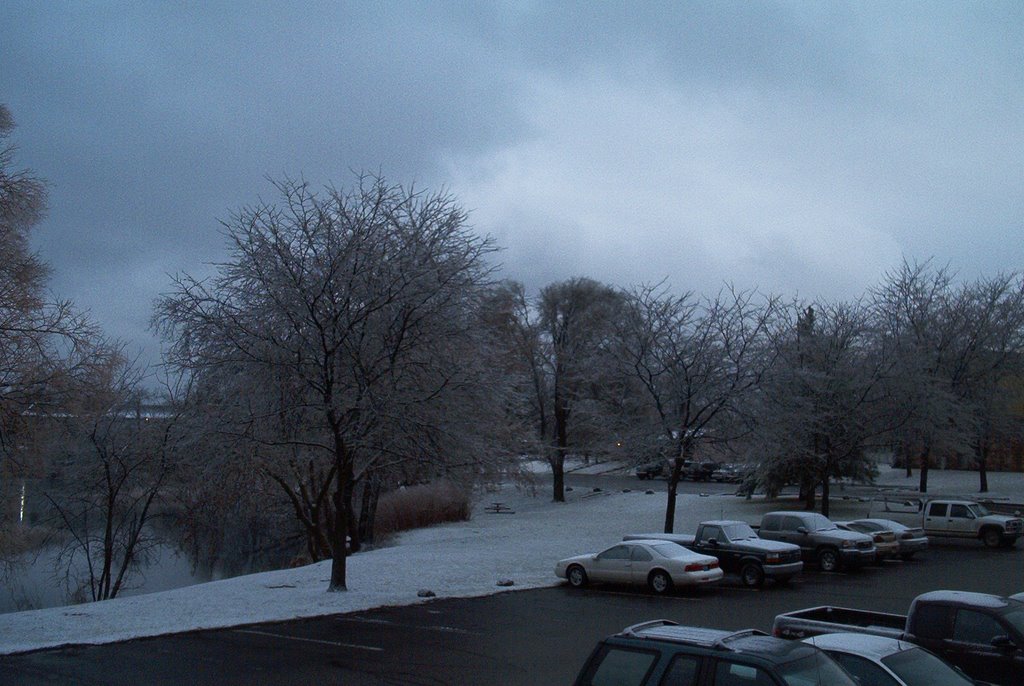
Christmas Swag!
My doggerel is not quite up to the level of the immortal and inimitable Ted Giesel, but here goes.
There were ciders and cookies to be had
Presents for mom and presents for dad.

Presents for Steph, and presents for B.
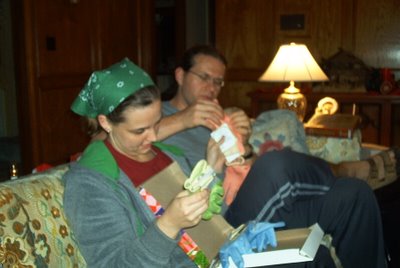
Presents for dogs.

And presents for me.
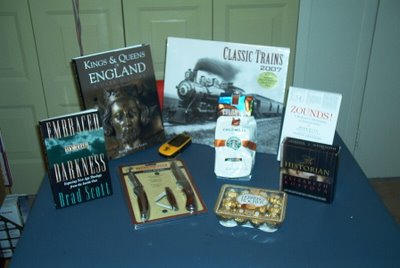
Thanks to Pablo The Stubbornly Blogless for noticing the work of that oddly-named fellow whose book appears on the left.
Not shown: An Alphabetical Life, in which Wendy Werris relates tales of the booktrade from the wild & crazy days of the 1970s (thanks, Carlos) and From Jihad to Jesus, by Jerry Rassamini.
And, last but not least... the Golden Helmet of Mambrino! (About which more later)
My doggerel is not quite up to the level of the immortal and inimitable Ted Giesel, but here goes.
There were ciders and cookies to be had
Presents for mom and presents for dad.
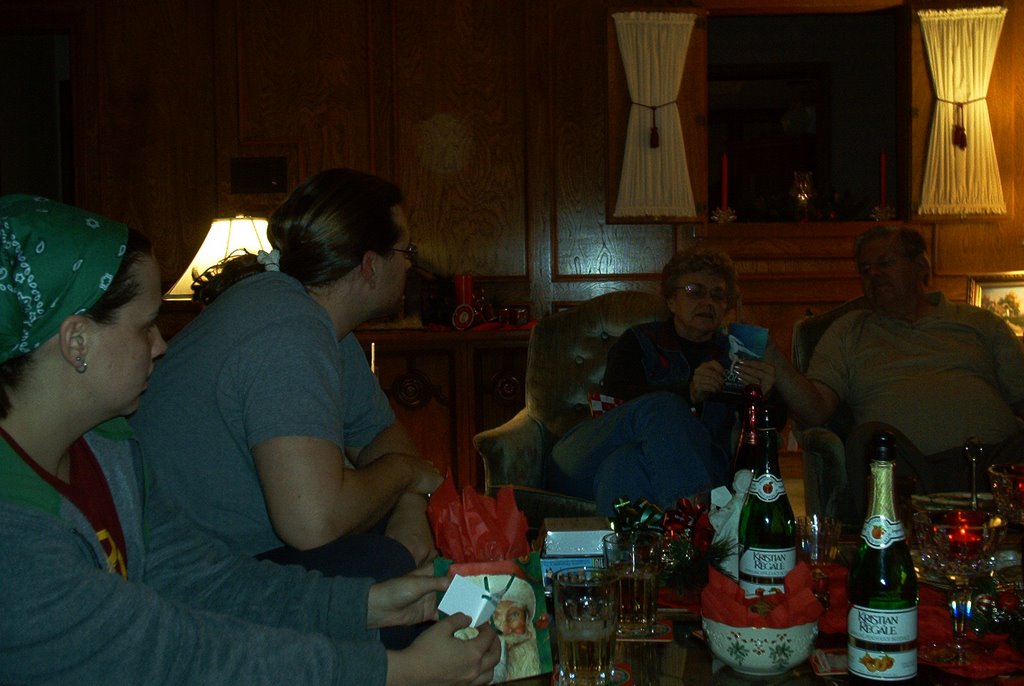
Presents for Steph, and presents for B.
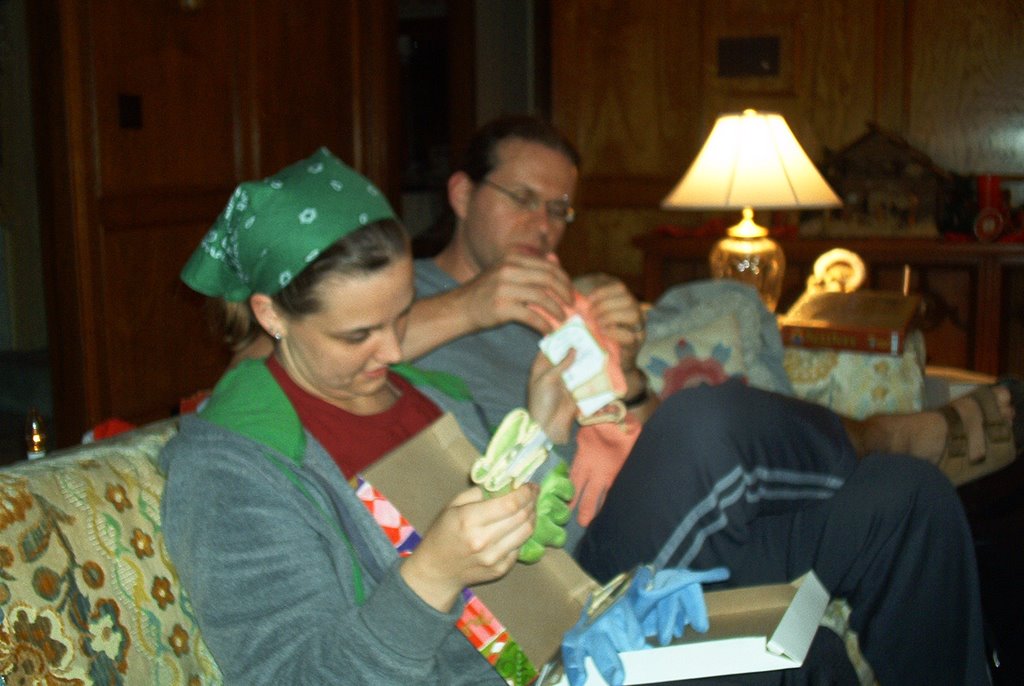
Presents for dogs.

And presents for me.
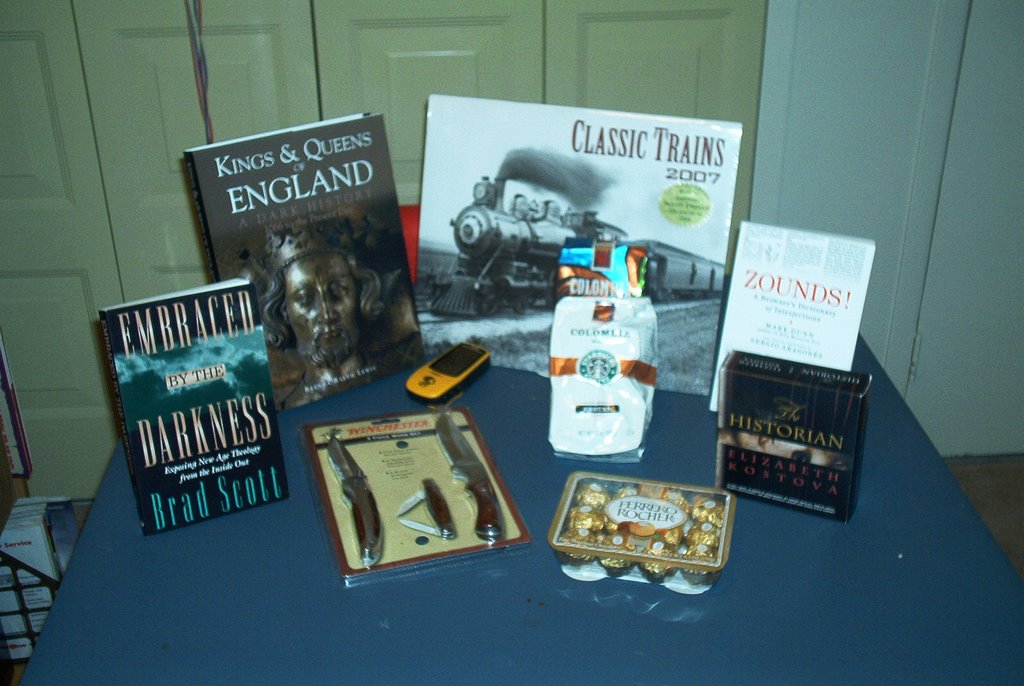
Thanks to Pablo The Stubbornly Blogless for noticing the work of that oddly-named fellow whose book appears on the left.
Not shown: An Alphabetical Life, in which Wendy Werris relates tales of the booktrade from the wild & crazy days of the 1970s (thanks, Carlos) and From Jihad to Jesus, by Jerry Rassamini.
And, last but not least... the Golden Helmet of Mambrino! (About which more later)
Sunday, January 14, 2007
Here, There, and Everywhere
(The belated Christmas Road Trip Report.)
This year's barnstorming tour of the Midwest took place by car, rather than by overpriced, luggage-losing, connection-missing airlines. Fortunately, there were no last minute snowstorms, no clueless coeds blundering into traffic to create unavoidable collisions, no mysterious steaming puddles of coolant or suddenly immovable gearshift levers on the day before scheduled departure. It was a refreshingly novel experience. Traveller performed his duty admirably, cruising endlessly down the fourlane for three thousand miles with nary a hiccup. The Historian on CD kept me entertained and intrigued across the long miles of Illinois cornfield, as Elizabeth Kostova's genteelly relentless researchers worked there way through the debris of history, generation after generation, toward the dark secret they sought. (Thanks, Fiend!).
On the way south, I stopped off at The University Formerly Known As SMS, where the archives department has recently acquired an incredible treasure trove of documents from the Frisco Railroad and its subsidiaries. The story behind this is rather interesting in its own right. The documents were at one time the property of the Frisco Museum, which had a small museum of railroad memorabilia, equipment and documents in a former railroad building in Springfield. Unfortunately, the Museum fell on hard times about 2003. Louis Greisemer, a local businessman and model railroader, stepped in to acquire the documents and keep them from being irretrievably dispersed. The right man at the right time, since in addition to having an interest in railroads and the financial resources to step in, he also ran Springfield Underground, a storage company that uses the hollowed-out caverns left over from his family's limestone quarry. Since that time, he's passed portions of those documents along to the Springfield-Greene County Library, which has digitized a nearly complete run of the Frisco's employee magazines, and to The University Formerly Known As SMS, which makes its holdings available to researchers.
It should surprise no one that I spent more time than originally planned digging through the dusty blue folders of valuation reports, track diagrams, maintenance and alteration reports, and other documents from the files of the Frisco and its elusive corporate stepchild the Kansas City, Clinton and Springfield Railway, the so-called "Leaky Roof Line". The phrase "I can't believe I'm seeing this" was heard at least once. Mucho photocopies were made and ordered.
And so to Texas, still enjoying sunny skies. Christmas with the folks, augmented by a welcome chance to chat with brother B. and sis-in-law Steph. The convivial chatting did not keep us from devising many devious and sinister strategies against one another in Scrabble, Munchkin, or Settlers of Catan.
Christmas Swag shall be dealt with in a separate post, because that's the way I want it.
Visited also with Pablo The Still Blogless, who allowed me to tag along on an intriguingly different horror-themed roleplaying adventure in which matters of chance were resolved by making players pull blocks from a Jenga Tower, rather than by rolling dice. It's an interesting novelty, which effectively creates an atmosphere of mounting dread as the tower becomes progressively more unstable and players' actions become progressively more unlikely to succeed.
Went to Christmas Eve service at FBCP, which has for inexplicable reasons renamed itself a "worship center".

Sadly, I did not get to experience the new upscale boutique-WalMart that has recently opened in Plano. It occurs to me that if WalMart thinks Plano is typical of a large segment of the marketplace, they are sadly mistaken.
Stopped by the local Interurban Museum for a quick photo shoot. Note the interurban car's modern descendents in the background. Beyond that is an exercise in New Urbanism, as downtown Plano appears to be trying to remake itself as a condominium-rich haven for prosperous yuppies and suburban hipsters.

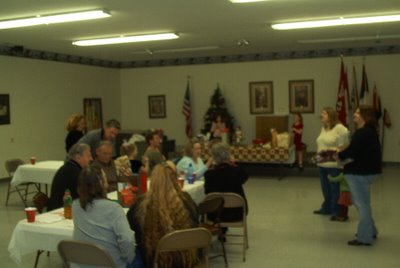
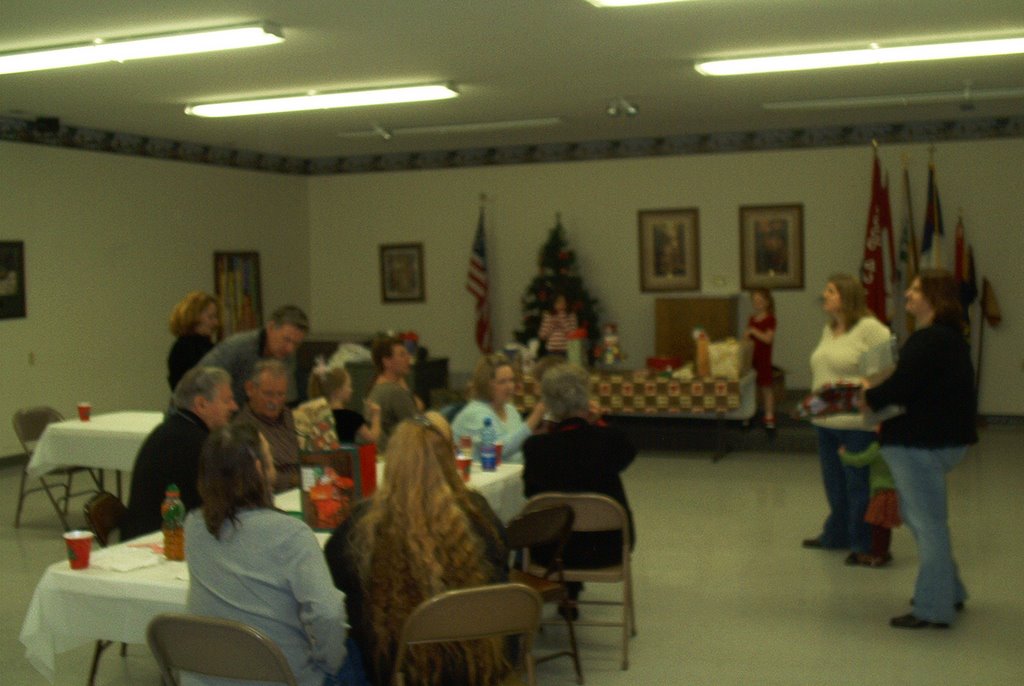
Off to Missouri! The family Christmas Gathering, over the past few years, has ballooned from a relatively informal gathering for dinner and gift-exchanging into an Organized Event involving upward of twenty people. This year's model took place at a hall rented from a local Boy Scout troop.
Spent a few days driving about southwestern Missouri in search of abandoned railroad roadbeds and other historical relics. My new favorite roadsign:
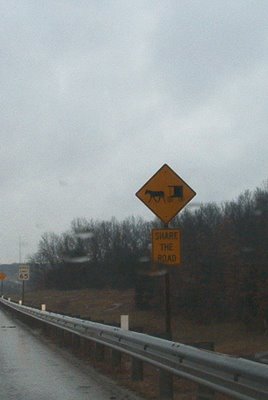
They're not kidding.


Drove by and photographed a rural general store still operated by a distant relative. Unfortunately, there was no time, per family cell-phone directive, to stop and get a pizza or any other delectable goodies. Subsequently went hungry for several hours before food could be obtained.

Front porch of Granddad B.'s current residence:

Note blue "Tobacco Free" sign. There's a mildly amusing anecdote there. Shortly before the trip, a mutual acquaintance told mom that she should check up on Grand-dad B.'s condition. He was reportedly feeling nauseous. Mom dutifully called the home. The nurse just chuckled. "He's not sick. He just swallowed three chaws of his chewing tobacco, plus a mouthful of candy and a big swig of Dr. Pepper. It'd be enough to make a horse sick!"
For the record, I approve of a certain amount of flexibility in the administration of rules. If an old man can't enjoy a bit of chaw that doesn't disturb anyone but himself, what's the world coming to?
Also went down to the Wilson's Creek Battlefield, where a knowledgeable park ranger told us all about how unconstitutional and wicked the Union commander was. (To be fair, Nathaniel Lyon does sound like a troublemaker, perhaps even a bit of a psycho.)
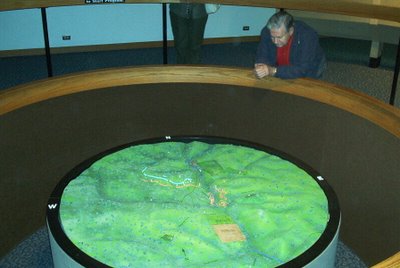
A three-dimensional map of the battle site, with animated lights showing the sequence of troop movements, is examined:
Also examined the actual battlefield, despite the growing cold and damp and rising winds. Noted that the commander's name mentioned in this sign seemed quite appropriate, although Missouri and Confederate troops in 1861 failed to heed it.

The road leading over the hilltop, by the way, is the old Wire Road or Military Road, the primary thoroughfare of the area at the time of the Civil War.
Watched big shiny gaudy New York ball on a pole descend to mark the beginning of the New Year. Gaudy or not, it was an improvement over watching the Fox News "documentary" which purported to show that the Founding Fathers intended to make the United States a Christian theocracy.
Failed to completely dispose of garage full of stored books and furniture still left over from my hurried departure to meet a job offer deadline in 2001, but Traveller was well loaded down on the return trip. It appears that this will be an incremental process, one load at a time. At that rate I'll be done sometime in the next decade.
Traveller, loaded down and decorated with frosty bits:

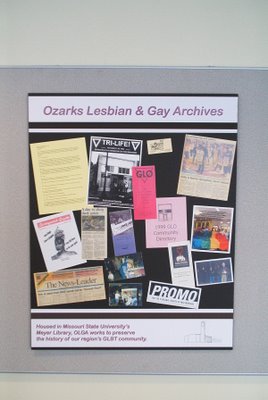
En route back to Michigan, I stopped off and frantically dug through more railroad documents. More photocopies were ordered. Noted a rather surprising display for this part of the country:
Noted that the Frisco Building, home to Springfield Underground and local BNSF offices, contains a restaurant with some obvious railroad allusions.



Sadly, there was no time to sample its offerings.
The weather held good until I was back in Michigan. Cats were clean and fat, thanks to the efforts of a catsitter who probably gave them more attention than I do.
And so the new year begins.
(The belated Christmas Road Trip Report.)
This year's barnstorming tour of the Midwest took place by car, rather than by overpriced, luggage-losing, connection-missing airlines. Fortunately, there were no last minute snowstorms, no clueless coeds blundering into traffic to create unavoidable collisions, no mysterious steaming puddles of coolant or suddenly immovable gearshift levers on the day before scheduled departure. It was a refreshingly novel experience. Traveller performed his duty admirably, cruising endlessly down the fourlane for three thousand miles with nary a hiccup. The Historian on CD kept me entertained and intrigued across the long miles of Illinois cornfield, as Elizabeth Kostova's genteelly relentless researchers worked there way through the debris of history, generation after generation, toward the dark secret they sought. (Thanks, Fiend!).
On the way south, I stopped off at The University Formerly Known As SMS, where the archives department has recently acquired an incredible treasure trove of documents from the Frisco Railroad and its subsidiaries. The story behind this is rather interesting in its own right. The documents were at one time the property of the Frisco Museum, which had a small museum of railroad memorabilia, equipment and documents in a former railroad building in Springfield. Unfortunately, the Museum fell on hard times about 2003. Louis Greisemer, a local businessman and model railroader, stepped in to acquire the documents and keep them from being irretrievably dispersed. The right man at the right time, since in addition to having an interest in railroads and the financial resources to step in, he also ran Springfield Underground, a storage company that uses the hollowed-out caverns left over from his family's limestone quarry. Since that time, he's passed portions of those documents along to the Springfield-Greene County Library, which has digitized a nearly complete run of the Frisco's employee magazines, and to The University Formerly Known As SMS, which makes its holdings available to researchers.
It should surprise no one that I spent more time than originally planned digging through the dusty blue folders of valuation reports, track diagrams, maintenance and alteration reports, and other documents from the files of the Frisco and its elusive corporate stepchild the Kansas City, Clinton and Springfield Railway, the so-called "Leaky Roof Line". The phrase "I can't believe I'm seeing this" was heard at least once. Mucho photocopies were made and ordered.
And so to Texas, still enjoying sunny skies. Christmas with the folks, augmented by a welcome chance to chat with brother B. and sis-in-law Steph. The convivial chatting did not keep us from devising many devious and sinister strategies against one another in Scrabble, Munchkin, or Settlers of Catan.
Christmas Swag shall be dealt with in a separate post, because that's the way I want it.
Visited also with Pablo The Still Blogless, who allowed me to tag along on an intriguingly different horror-themed roleplaying adventure in which matters of chance were resolved by making players pull blocks from a Jenga Tower, rather than by rolling dice. It's an interesting novelty, which effectively creates an atmosphere of mounting dread as the tower becomes progressively more unstable and players' actions become progressively more unlikely to succeed.
Went to Christmas Eve service at FBCP, which has for inexplicable reasons renamed itself a "worship center".

Sadly, I did not get to experience the new upscale boutique-WalMart that has recently opened in Plano. It occurs to me that if WalMart thinks Plano is typical of a large segment of the marketplace, they are sadly mistaken.
Stopped by the local Interurban Museum for a quick photo shoot. Note the interurban car's modern descendents in the background. Beyond that is an exercise in New Urbanism, as downtown Plano appears to be trying to remake itself as a condominium-rich haven for prosperous yuppies and suburban hipsters.

Off to Missouri! The family Christmas Gathering, over the past few years, has ballooned from a relatively informal gathering for dinner and gift-exchanging into an Organized Event involving upward of twenty people. This year's model took place at a hall rented from a local Boy Scout troop.
Spent a few days driving about southwestern Missouri in search of abandoned railroad roadbeds and other historical relics. My new favorite roadsign:

They're not kidding.
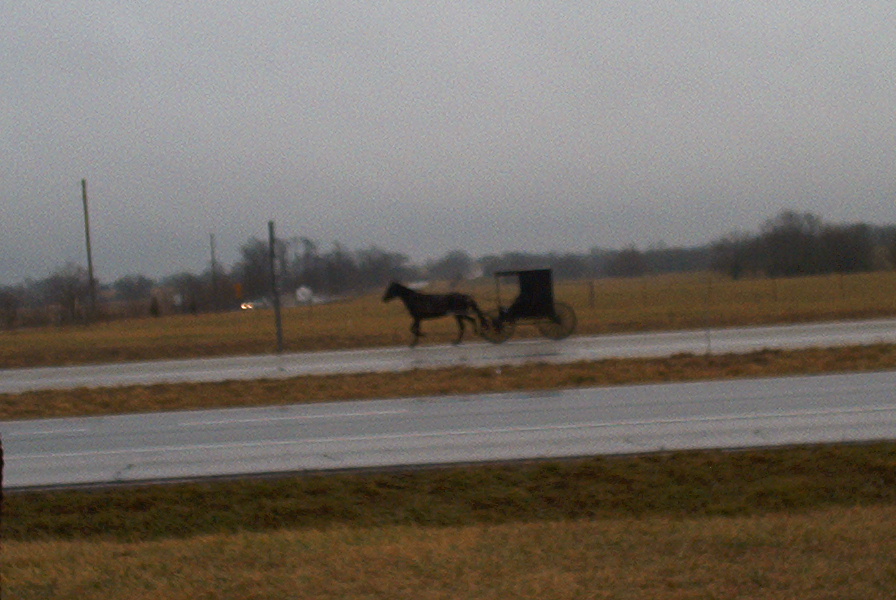

Drove by and photographed a rural general store still operated by a distant relative. Unfortunately, there was no time, per family cell-phone directive, to stop and get a pizza or any other delectable goodies. Subsequently went hungry for several hours before food could be obtained.

Front porch of Granddad B.'s current residence:

Note blue "Tobacco Free" sign. There's a mildly amusing anecdote there. Shortly before the trip, a mutual acquaintance told mom that she should check up on Grand-dad B.'s condition. He was reportedly feeling nauseous. Mom dutifully called the home. The nurse just chuckled. "He's not sick. He just swallowed three chaws of his chewing tobacco, plus a mouthful of candy and a big swig of Dr. Pepper. It'd be enough to make a horse sick!"
For the record, I approve of a certain amount of flexibility in the administration of rules. If an old man can't enjoy a bit of chaw that doesn't disturb anyone but himself, what's the world coming to?
Also went down to the Wilson's Creek Battlefield, where a knowledgeable park ranger told us all about how unconstitutional and wicked the Union commander was. (To be fair, Nathaniel Lyon does sound like a troublemaker, perhaps even a bit of a psycho.)
A three-dimensional map of the battle site, with animated lights showing the sequence of troop movements, is examined:

Also examined the actual battlefield, despite the growing cold and damp and rising winds. Noted that the commander's name mentioned in this sign seemed quite appropriate, although Missouri and Confederate troops in 1861 failed to heed it.

The road leading over the hilltop, by the way, is the old Wire Road or Military Road, the primary thoroughfare of the area at the time of the Civil War.
Watched big shiny gaudy New York ball on a pole descend to mark the beginning of the New Year. Gaudy or not, it was an improvement over watching the Fox News "documentary" which purported to show that the Founding Fathers intended to make the United States a Christian theocracy.
Failed to completely dispose of garage full of stored books and furniture still left over from my hurried departure to meet a job offer deadline in 2001, but Traveller was well loaded down on the return trip. It appears that this will be an incremental process, one load at a time. At that rate I'll be done sometime in the next decade.
Traveller, loaded down and decorated with frosty bits:

En route back to Michigan, I stopped off and frantically dug through more railroad documents. More photocopies were ordered. Noted a rather surprising display for this part of the country:

Noted that the Frisco Building, home to Springfield Underground and local BNSF offices, contains a restaurant with some obvious railroad allusions.



Sadly, there was no time to sample its offerings.
The weather held good until I was back in Michigan. Cats were clean and fat, thanks to the efforts of a catsitter who probably gave them more attention than I do.
And so the new year begins.
Saturday, January 13, 2007
Fnord
Robert Anton Wilson has departed the mundane world. Or at least that's what They want us to believe.
His thoughts on the subject here.
Robert Anton Wilson has departed the mundane world. Or at least that's what They want us to believe.
His thoughts on the subject here.
News noted
Pentagon official calls for corporate boycott of law firms that defend Constitutional rights. He goes on to falsely insinuate that such law firms are "receiving moneys from who knows where", and demands that they "explain that." Somewhere, Joe McCarthy, Joseph Goebbels, Maximilien Robespierre, and other advocates of government through intimidation and insinuation are nodding approvingly.
Meanwhile, Reason associate editor David Weigel opines in the LA Times about a recent spate of right-wing futuristic thrillers. Look out! If those dirty libruls have their way, President Chelsea Clinton and Vice President Michael Moore will fete Osama bin Ladin in the White House while sharia law is imposed on American citizens and heroic conservative talkshow hosts are driven into hiding! Or, more positively, perhaps a righteous conservative president will nuke Baghdad and go to war against Iran and Russia in order to "fulfill Scripture."
But not to worry. Business is going just fine back home, as American citizens follow Fearless Leader's advice to fight the War on Terra by going shopping on credit, at 30% interest. Perhaps someday soon we will see a return to that good old fashioned Protestant work ethic, as embodied in debtors' prisons?
Pentagon official calls for corporate boycott of law firms that defend Constitutional rights. He goes on to falsely insinuate that such law firms are "receiving moneys from who knows where", and demands that they "explain that." Somewhere, Joe McCarthy, Joseph Goebbels, Maximilien Robespierre, and other advocates of government through intimidation and insinuation are nodding approvingly.
Meanwhile, Reason associate editor David Weigel opines in the LA Times about a recent spate of right-wing futuristic thrillers. Look out! If those dirty libruls have their way, President Chelsea Clinton and Vice President Michael Moore will fete Osama bin Ladin in the White House while sharia law is imposed on American citizens and heroic conservative talkshow hosts are driven into hiding! Or, more positively, perhaps a righteous conservative president will nuke Baghdad and go to war against Iran and Russia in order to "fulfill Scripture."
But not to worry. Business is going just fine back home, as American citizens follow Fearless Leader's advice to fight the War on Terra by going shopping on credit, at 30% interest. Perhaps someday soon we will see a return to that good old fashioned Protestant work ethic, as embodied in debtors' prisons?
Thursday, January 11, 2007
Recent viewings
Read or Die. This three-part anime miniseries starts out promisingly. A mysterious figure armed with crackling bolts of electricity attacks the White House, wreaking destruction. Oddly, he seems to have mistaken it for a library.
Our Heroine, Yomiko Readman, is introduced lying sprawled asleep among countless piles of books in her cramped apartment. Much like myself, she must dig through this biblio-debris in order to locate vital household items such as ringing telephones. Unlike myself, she is not just a humble biblioholic. She is Agent Paper, an operative of a mysterious organization with a secret base underneath the British Library. And as we see in the show's second action sequence, her skills with paper go well beyond those of your everyday researcher.
It turns out that she, as well as other mysterious and supernaturally-gifted folks, are all in pursuit of a lost book written by Ludwig von Beethoven. Through most of the show, this book is a McGuffin pursued by good and evil, the goal of repeated battles between superpowered adversaries. Along the way there's some goofy comedy, hints at girlish freindship or romance, and a healthy slug of anti-Americanism directed at a rather Bushlike President who wants to launch "nukyular" weapons at the slightest provocation. Agent Paper -- or, as she's sometimes called, just The Paper -- doggedly pursues her beloved book despite adversaries who breathe fire, fly, ride giant insects, and perform all manner of bizarre feats. Inevitably, there's the James Bondian scene in which the Boss Monster -- er, I mean, head supervillian -- ties her down in an Elaborate Deathtrap(TM) and then saunters off. Because, you know, desperate heroes can never escape from Elaborate Deathtraps(TM)! (Bwahahaha!)
Yes, it's silly, but the silliness is enjoyable, and punctuated with moments of wit. The Beethoven connection is eventually explained, although I must confess I never did figure out exactly why that much-sought-after book was needed. There's plenty of cartoonic hyperviolence, plenty of improbable acrobatics by improbably-proportioned anime women, a smattering of humor, and just enough pathos to keep it from seeming entirely frivolous. An enjoyable light diversion.
Read or Die. This three-part anime miniseries starts out promisingly. A mysterious figure armed with crackling bolts of electricity attacks the White House, wreaking destruction. Oddly, he seems to have mistaken it for a library.
Our Heroine, Yomiko Readman, is introduced lying sprawled asleep among countless piles of books in her cramped apartment. Much like myself, she must dig through this biblio-debris in order to locate vital household items such as ringing telephones. Unlike myself, she is not just a humble biblioholic. She is Agent Paper, an operative of a mysterious organization with a secret base underneath the British Library. And as we see in the show's second action sequence, her skills with paper go well beyond those of your everyday researcher.
It turns out that she, as well as other mysterious and supernaturally-gifted folks, are all in pursuit of a lost book written by Ludwig von Beethoven. Through most of the show, this book is a McGuffin pursued by good and evil, the goal of repeated battles between superpowered adversaries. Along the way there's some goofy comedy, hints at girlish freindship or romance, and a healthy slug of anti-Americanism directed at a rather Bushlike President who wants to launch "nukyular" weapons at the slightest provocation. Agent Paper -- or, as she's sometimes called, just The Paper -- doggedly pursues her beloved book despite adversaries who breathe fire, fly, ride giant insects, and perform all manner of bizarre feats. Inevitably, there's the James Bondian scene in which the Boss Monster -- er, I mean, head supervillian -- ties her down in an Elaborate Deathtrap(TM) and then saunters off. Because, you know, desperate heroes can never escape from Elaborate Deathtraps(TM)! (Bwahahaha!)
Yes, it's silly, but the silliness is enjoyable, and punctuated with moments of wit. The Beethoven connection is eventually explained, although I must confess I never did figure out exactly why that much-sought-after book was needed. There's plenty of cartoonic hyperviolence, plenty of improbable acrobatics by improbably-proportioned anime women, a smattering of humor, and just enough pathos to keep it from seeming entirely frivolous. An enjoyable light diversion.
Recent viewings
Good night and good luck. An atmospheric tale of the confrontation between hardnosed newsman Edward R. Murrow and Red-baiting Senator Josephy McCarthy. Clooney & Co. beautifully replicate the moody, high-contrast black-and-white look of a period when broadcast newsrooms were still inhabited by men in white shirts with suspenders and ties and fedoras, rarely without a Scotch in hand or a cigarette sending a luxuriant plume of smoke climbing in elegant curves toward the ceiling. Unfortunately, the drama never develops quite as much heat as those ubiquitous glowing cigarettes.
Good night and good luck. An atmospheric tale of the confrontation between hardnosed newsman Edward R. Murrow and Red-baiting Senator Josephy McCarthy. Clooney & Co. beautifully replicate the moody, high-contrast black-and-white look of a period when broadcast newsrooms were still inhabited by men in white shirts with suspenders and ties and fedoras, rarely without a Scotch in hand or a cigarette sending a luxuriant plume of smoke climbing in elegant curves toward the ceiling. Unfortunately, the drama never develops quite as much heat as those ubiquitous glowing cigarettes.
Recent viewings
Who Killed the Electric Car? It's hardly unbiased, but this documentary about the electric cars that were produced in the late 1990s as a response to a 1990 California law requiring production of zero-emissions vehicles does an effective job of suggesting that the vehicles had far more potential than they were given credit for. The all-electric General Motors EV-1, and the hamfisted way that GM handled its discontinuance of the model, get the bulk of the moviemakers' attention.
The EV-1, in its most advanced incarnation, reportedly had a driving range of 75-150 miles, with acceleration comparable to many small gas-powered cars of today and a top speed of 80 mph. People who drove them seemed to like them, and of course the car required no gasoline at all, only a nightly battery recharge. GM's marketing support was skimpy, though, and it refused to allow anyone to purchase the cars outright, instead offering them only on closed-end leases which it refused to renew when California's government caved in to corporate pressure and revoked the zero-emissions law. GM then collected all the leased cars, ignored the lessors' pleas to be allowed to purchase them or extend the leases, and in extraordinarily arrogant and tone-deaf fashion crammed them all into a bunch of Darth Vader-black trailers in front of a crowd of indignant supporters, hauled them to a junkyard in the desert and systematically crushed them all, except for a very small number that were merely gutted of their mechanical components and allowed to exist as shells in museums.
Car companies, oil companies, wishy-washy California politicians and a cynical, oil-pushing White House are all tagged "guilty" by the filmmaker. The movie may give short shrift to some of the real technical problems that obstruct wide acceptance of electric cars, such as the problem of making batteries equal to the task of propelling them down the highway for hundreds of miles, recharging quickly, and not degrading as a result of daily charging and discharging. But as gasoline prices continue to rise, environmental problems continue to escalate, and the oil-rich middle East continues to seethe with violence funded by American petrodollars, it becomes more clear every year that the strategy followed by GM and other US automakers, of building ever-bigger, ever-thirstier multi-ton road battleships like the Hummer, cannot continue indefinitely. Vehicles inspired by the EV-1, such as the electric Tesla roadster and the successful hybrids from Toyota and Honda, appear be the cars of the future for commuters and everyone else who doesn't actually need a half-ton of cargo-hauling capacity.
GM recently made a big splash at a Detroit auto show by announcing the Chevy Volt, a flashily-designed hybrid concept car that promises to go 40 miles on electric power, then supplement its batteries with a small gas engine. Its production schedule? Someday. Maybe. At a fancy price.
Meanwhile, the Toyota Priuses and Honda hybrids continue to proliferate, and GM's market share continues to plunge along with its public image. Will GM actually follow through on building the Volt? Or is it just one more vaguely promised concept car, a tease to tantalize gullible consumers and hype-hungry reporters, never to be built? Will the dinosaurs of GM management treat it like the EV-1, producing it for a few years only to yank it back out of their customers' hands a year or two later when gas prices drop momentarily and GM thinks it can go back to making massive markups on equally massive 12-mpg SUVs? Who knows? The history isn't encouraging.
By strangling its own infant in the crib, GM may have fatally sabotaged the survival of its family of brands. Who Killed the Electric Car may, eventually, be viewed as a documentary about the means by which a once-great business initiated its own destruction.
Who Killed the Electric Car? It's hardly unbiased, but this documentary about the electric cars that were produced in the late 1990s as a response to a 1990 California law requiring production of zero-emissions vehicles does an effective job of suggesting that the vehicles had far more potential than they were given credit for. The all-electric General Motors EV-1, and the hamfisted way that GM handled its discontinuance of the model, get the bulk of the moviemakers' attention.
The EV-1, in its most advanced incarnation, reportedly had a driving range of 75-150 miles, with acceleration comparable to many small gas-powered cars of today and a top speed of 80 mph. People who drove them seemed to like them, and of course the car required no gasoline at all, only a nightly battery recharge. GM's marketing support was skimpy, though, and it refused to allow anyone to purchase the cars outright, instead offering them only on closed-end leases which it refused to renew when California's government caved in to corporate pressure and revoked the zero-emissions law. GM then collected all the leased cars, ignored the lessors' pleas to be allowed to purchase them or extend the leases, and in extraordinarily arrogant and tone-deaf fashion crammed them all into a bunch of Darth Vader-black trailers in front of a crowd of indignant supporters, hauled them to a junkyard in the desert and systematically crushed them all, except for a very small number that were merely gutted of their mechanical components and allowed to exist as shells in museums.
Car companies, oil companies, wishy-washy California politicians and a cynical, oil-pushing White House are all tagged "guilty" by the filmmaker. The movie may give short shrift to some of the real technical problems that obstruct wide acceptance of electric cars, such as the problem of making batteries equal to the task of propelling them down the highway for hundreds of miles, recharging quickly, and not degrading as a result of daily charging and discharging. But as gasoline prices continue to rise, environmental problems continue to escalate, and the oil-rich middle East continues to seethe with violence funded by American petrodollars, it becomes more clear every year that the strategy followed by GM and other US automakers, of building ever-bigger, ever-thirstier multi-ton road battleships like the Hummer, cannot continue indefinitely. Vehicles inspired by the EV-1, such as the electric Tesla roadster and the successful hybrids from Toyota and Honda, appear be the cars of the future for commuters and everyone else who doesn't actually need a half-ton of cargo-hauling capacity.
GM recently made a big splash at a Detroit auto show by announcing the Chevy Volt, a flashily-designed hybrid concept car that promises to go 40 miles on electric power, then supplement its batteries with a small gas engine. Its production schedule? Someday. Maybe. At a fancy price.
Meanwhile, the Toyota Priuses and Honda hybrids continue to proliferate, and GM's market share continues to plunge along with its public image. Will GM actually follow through on building the Volt? Or is it just one more vaguely promised concept car, a tease to tantalize gullible consumers and hype-hungry reporters, never to be built? Will the dinosaurs of GM management treat it like the EV-1, producing it for a few years only to yank it back out of their customers' hands a year or two later when gas prices drop momentarily and GM thinks it can go back to making massive markups on equally massive 12-mpg SUVs? Who knows? The history isn't encouraging.
By strangling its own infant in the crib, GM may have fatally sabotaged the survival of its family of brands. Who Killed the Electric Car may, eventually, be viewed as a documentary about the means by which a once-great business initiated its own destruction.
Coincidence?
Mysterious stinks in New York. Birds dead in the street in Austin, TX. And now a reported massive bird die-off in Australia.
If this were a 1950's style B-movie, we'd be nearing the end of the first reel right now. The hero -- an earnest researcher, perhaps, or an idealistic news reporter, or maybe just an improbably handsome teenager who happened to see a glowing saucer land in the spooky valley behind the Old Jones Place -- would be vainly trying to get someone to act on his critically-important information that links it all together. The Authority Figures would have pooh-poohed him as an alarmist. And it would be just about time for the big catastrophe featured on the movie poster.
Mysterious stinks in New York. Birds dead in the street in Austin, TX. And now a reported massive bird die-off in Australia.
If this were a 1950's style B-movie, we'd be nearing the end of the first reel right now. The hero -- an earnest researcher, perhaps, or an idealistic news reporter, or maybe just an improbably handsome teenager who happened to see a glowing saucer land in the spooky valley behind the Old Jones Place -- would be vainly trying to get someone to act on his critically-important information that links it all together. The Authority Figures would have pooh-poohed him as an alarmist. And it would be just about time for the big catastrophe featured on the movie poster.
Privatizing the library?
Bedford, Texas, a small city near Dallas/Fort Worth, considers the concept.
(Also linked, irresistably, from that page: an amusing editorial commentary on Baptists, beer, and the Bible. These arguments will sound familiar to certain readers!)
Bedford, Texas, a small city near Dallas/Fort Worth, considers the concept.
(Also linked, irresistably, from that page: an amusing editorial commentary on Baptists, beer, and the Bible. These arguments will sound familiar to certain readers!)
Variation on a theme
Sara Woods' 1973 mystery novel Yet She Must Die offers a different
version of the fiction authors' standard disclaimer, which perhaps
says more than the author intended:
Sara Woods' 1973 mystery novel Yet She Must Die offers a different
version of the fiction authors' standard disclaimer, which perhaps
says more than the author intended:
Any work of fiction whose characters were of a uniform excellence would rightly be condemned -- by that fact if by no other -- as being incredibly dull. Therefore no excuse can be considered necessary for the villainy or folly of the people in this book. It seems extremely unlikely that any one of them should resemble a real person alive or dead. Any such resemblance is completely unintentional and without malice.
Wednesday, January 10, 2007
Ask the Headhunter
I figure at least two or three people who read this blog might enjoy this website. Since two or three readers represents approximately half of my total readership, it's a good use of pixels to post a link.
The "articles" link leads to an interesting set of editorials conveying advice for jobseeking, interviewing, and most importantly avoiding the obstructionist tendencies of corporate HR departments.
I figure at least two or three people who read this blog might enjoy this website. Since two or three readers represents approximately half of my total readership, it's a good use of pixels to post a link.
The "articles" link leads to an interesting set of editorials conveying advice for jobseeking, interviewing, and most importantly avoiding the obstructionist tendencies of corporate HR departments.
How to be a successful book reviewer
I have often wondered how book reviewers find the time to read all those books and write their reviews on deadline. I guess this answers that question.
Reviewer slams book that was never written
I have often wondered how book reviewers find the time to read all those books and write their reviews on deadline. I guess this answers that question.
Reviewer slams book that was never written
Published: 15th December 2006 16:54 CET
Online: http://www.thelocal.se/5818/
A book reviewer on a Swedish newspaper has got himself into hot water for writing a review of a book that has not been written. To make matters worse, Kristian Lundberg claimed the book's plot was "predictable" and said the characterisations were one-dimensional.
Lundberg made the comments in Helsingborgs Daglad, in an article about recently published thrillers, reports Dagens Nyheter. Among those he reviewed were Britt-Marie Mattsson's novel 'Fruktans Makt' (The Power of Fear).
Unfortunately for Lundberg, while the book had been advertised in publisher Piratförlaget's autumn catalogue, Mattsson never actually got round to writing it.
The newspaper has made an "unreserved apology" to Mattsson. Lundberg's apology was more qualified. He told Svensk Bokhandel magazine that he had "got worked up in advance about Britt-Marie Mattsson because I detest her so very greatly. But let's hope the book is published so I get the chance to say it for real."
Mattsson has not yet made her views on the subject known. But Piratförlaget's spokesman Mattias Boström said it confirmed what they'd suspected about reviewers.
"We've known for a long time that reviewers skim-read books, but know we know what really happens," he told Dagens Nyheter.
James Savage
Tuesday, January 09, 2007
Couldn't have said it better myself
John J. Miller, in the Wall Street Journal:
Should Libraries' Target Audience Be Cheapskates With Mass-Market Tastes?
Selected passages:
John J. Miller, in the Wall Street Journal:
Should Libraries' Target Audience Be Cheapskates With Mass-Market Tastes?
Selected passages:
... Library officials explain, not unreasonably, that their shelf space is limited and that they want to satisfy the demands of the public. Every unpopular book that's removed from circulation, after all, creates room for a new page-turner by John Grisham, David Baldacci, or James Patterson -- the authors of the three most checked-out books in Fairfax County last month.Mr. Miller's concluding example may not be the best one he could have chosen, since the text of Faustus is available online from Project Gutenberg and other sources. But his point applies very powerfully to all those post-1923 works that are not legally available online, and never will be, because they are captives in the dungeon of eternal copyright.
But this raises a fundamental question: What are libraries for? Are they cultural storehouses that contain the best that has been thought and said? Or are they more like actual stores, responding to whatever fickle taste or Mitch Albom tearjerker is all the rage at this very moment?
If the answer is the latter, then why must we have government-run libraries at all? (emphasis added) There's a fine line between an institution that aims to edify the public and one that merely uses tax dollars to subsidize the recreational habits of bookworms
....
The bottom line is that it has never been easier or cheaper to read a book, and the costs of reading probably will do nothing but drop further.
If public libraries attempt to compete in this environment, they will increasingly be seen for what Fairfax County apparently envisions them to be: welfare programs for middle-class readers who would rather borrow Nelson DeMille's newest potboiler than spend a few dollars for it at their local Wal-Mart.
Instead of embracing this doomed model, libraries might seek to differentiate themselves among the many options readers now have, using a good dictionary as the model. Such a dictionary doesn't merely describe the words of a language -- it provides proper spelling, pronunciation and usage. New words come in and old ones go out, but a reliable lexicon becomes a foundation of linguistic stability and coherence. Likewise, libraries should seek to shore up the culture against the eroding force of trends.
The particulars of this task will fall upon the shoulders of individual librarians, who should welcome the opportunity to discriminate between the good and the bad, the timeless and the ephemeral, as librarians traditionally have done. They ought to regard themselves as not just experts in the arcane ways of the Dewey Decimal System, but as teachers, advisers and guardians of an intellectual inheritance.
The alternative is for them to morph into clerks who fill their shelves with whatever their "customers" want, much as stock boys at grocery stores do. Both libraries and the public, however, would be ill-served by such a Faustian bargain.
That's a reference, by the way, to one of literature's great antiheroes. Good luck finding Christopher Marlowe's play about him in a Fairfax County library: "Doctor Faustus" has survived for more than four centuries, but it apparently hasn't been checked out in the past 24 months.
Monday, January 08, 2007
Friday, January 05, 2007
Lots of stuff to do with books
BookLust has featured several photos of sculptures representing books and/or made from books lately. I just hope they didn't destroy anything I wanted to read in the process.
BookLust has featured several photos of sculptures representing books and/or made from books lately. I just hope they didn't destroy anything I wanted to read in the process.
Wednesday, January 03, 2007
Happy (slightly belated) new year!
...even though I share a certain degree of sympathy with these protestors.
...even though I share a certain degree of sympathy with these protestors.
Sunday, December 24, 2006
News noted
* Sharecropping the Long Tail. A short but interesting observation on the economic system created by web services based on user-provided content.
* The Robert A. Heinlein Centennial conference will be held in Kansas City on July 6-8 of 2007. Anyone interested in going? It may be a very strange gathering, considering all the widely divergent interest groups to which RAH has some significance. Will the armchair anarchists who loved The Moon Is A Harsh Mistress mount a campaign of guerrilla warfare against the pro-military Starship Troopers faction? And what will the Lazarus Long-inspired polyamorists be doing meanwhile? (Do we want to know?)
* Sharecropping the Long Tail. A short but interesting observation on the economic system created by web services based on user-provided content.
* The Robert A. Heinlein Centennial conference will be held in Kansas City on July 6-8 of 2007. Anyone interested in going? It may be a very strange gathering, considering all the widely divergent interest groups to which RAH has some significance. Will the armchair anarchists who loved The Moon Is A Harsh Mistress mount a campaign of guerrilla warfare against the pro-military Starship Troopers faction? And what will the Lazarus Long-inspired polyamorists be doing meanwhile? (Do we want to know?)
No Christmas cards this year
Sorry, folks. There wasn't any time! Best wishes for a merry Christmas and a wonderful new year go out to all.
If you simply must have something to read on Christmas Eve, take a look at this webpage about the Christmas cards that famed early SF editor Hugo Gernsback used to send out each year, complete with scientifictional predictions about the coming years and decades.
Charles de Lint and Aloise Buckley Heath are also famous (at least in certain circles) for their annual Christmas writings to family and friends. Where do they get the time?
Sorry, folks. There wasn't any time! Best wishes for a merry Christmas and a wonderful new year go out to all.
If you simply must have something to read on Christmas Eve, take a look at this webpage about the Christmas cards that famed early SF editor Hugo Gernsback used to send out each year, complete with scientifictional predictions about the coming years and decades.
Charles de Lint and Aloise Buckley Heath are also famous (at least in certain circles) for their annual Christmas writings to family and friends. Where do they get the time?
On Demand Books
It's been the Next Big Thing in the book trade for several years now. Will the print-on-demand kiosks proposed by On Demand Books finally revolutionize the industry?
Right now, it sounds like the inventory of the pricy kiosks is limited to public-domain materials. But I can see this becoming a great boon for scholars, collectors, and readers of authors who works are no longer considered fashionable, even as it decimates the value of secondhand sellers' inventories of previously scarce books.
The dead hand of copyright law, and the ever-lengthening reach of its arm, will be the biggest obstacles to extending this kind of ready accessibility to books published in the last eighty years. Ironically, the books most likely to remain inaccessible are the ones not associated with the giant megapublishers who most vigorously push for ever-lengthening and ever-more-draconian copyright protection. Random House, Knopf, Viking, et al, will no doubt jump on board the print-on-demand train once its fiscal viability is established, either by licensing books to outside vendors like Books On Demand or by setting up similar services of their own. The books whose authors are dead or incommunicado, whose publishers have disappeared or forgotten about their existence, will remain trapped in a legal limbo with no known rightsholder to contact for reprinting rights, and no print-on-demand service whose legal department will allow them to expose themselves to liability should such a rightsholder choose to leap out of the woodwork at some time in the future.
It's been the Next Big Thing in the book trade for several years now. Will the print-on-demand kiosks proposed by On Demand Books finally revolutionize the industry?
Right now, it sounds like the inventory of the pricy kiosks is limited to public-domain materials. But I can see this becoming a great boon for scholars, collectors, and readers of authors who works are no longer considered fashionable, even as it decimates the value of secondhand sellers' inventories of previously scarce books.
The dead hand of copyright law, and the ever-lengthening reach of its arm, will be the biggest obstacles to extending this kind of ready accessibility to books published in the last eighty years. Ironically, the books most likely to remain inaccessible are the ones not associated with the giant megapublishers who most vigorously push for ever-lengthening and ever-more-draconian copyright protection. Random House, Knopf, Viking, et al, will no doubt jump on board the print-on-demand train once its fiscal viability is established, either by licensing books to outside vendors like Books On Demand or by setting up similar services of their own. The books whose authors are dead or incommunicado, whose publishers have disappeared or forgotten about their existence, will remain trapped in a legal limbo with no known rightsholder to contact for reprinting rights, and no print-on-demand service whose legal department will allow them to expose themselves to liability should such a rightsholder choose to leap out of the woodwork at some time in the future.
Wednesday, December 20, 2006
Poetry Wednesday
The Cool Web
Robert Graves (1895-1985)
Children are dumb to say how hot the day is,
How hot the scent is of the summer rose,
How dreadful the black wastes of evening sky,
How dreadful the tall soldiers drumming by.
But we have speech, to chill the angry day,
And speech, to dull the roses's cruel scent.
We spell away the overhanging night,
We spell away the soldiers and the fright.
There's a cool web of language winds us in,
Retreat from too much joy or too much fear:
We grow sea-green at last and coldly die
In brininess and volubility.
But if we let our tongues lose self-possession,
Throwing off language and its watery clasp
Before our death, instead of when death comes,
Facing the wide glare of the children's day,
Facing the rose, the dark sky and the drums,
We shall go mad, no doubt, and die that way.
The Cool Web
Robert Graves (1895-1985)
Children are dumb to say how hot the day is,
How hot the scent is of the summer rose,
How dreadful the black wastes of evening sky,
How dreadful the tall soldiers drumming by.
But we have speech, to chill the angry day,
And speech, to dull the roses's cruel scent.
We spell away the overhanging night,
We spell away the soldiers and the fright.
There's a cool web of language winds us in,
Retreat from too much joy or too much fear:
We grow sea-green at last and coldly die
In brininess and volubility.
But if we let our tongues lose self-possession,
Throwing off language and its watery clasp
Before our death, instead of when death comes,
Facing the wide glare of the children's day,
Facing the rose, the dark sky and the drums,
We shall go mad, no doubt, and die that way.
Saturday, December 16, 2006
Recent (partial) reads
Living Walden Two : B.F. Skinner's Behaviorist Utopia and Experimental Communities, by Hilke Kuhlmann.
Skinner is, of course, best known for his advocacy of behaviorism, a theory of psychology which proposes that, given the right combination of rewards and other stimuli, the behavior of humans and other living beings can (and should) be shaped according to predictable patterns. Walden Two, his only work of fiction, proposes a kind of communal utopia which has been carefully organized for the purpose of guiding its inhabitants into socially harmonious and usefully productive patterns of behavior.
Unfortunately, real-world attempts to create such Utopian communities, from the 1960s to the present day, have rarely succeeded. Motivating people to do useful and necessary work has been a recurrent problem. Furthermore, as the book jacket points out, "Among the real-world communities, a recurrent problem in moving past the planning stages was the nearly ubiquitous desire among members to be gentle guides, coupled with strong resistance to being guided."
Kuhlmann in this book briefly surveys a selection of Walden Two-inspired communes which have failed or dissolved, and then focuses on two which have survived to the present day. Twin Oaks, in Virginia, began as a deliberate attempt to follow Skinner's template. It has, according to Kuhlman, slowly but surely morphed away from that initial vision in the succeeding decades. Twin Oaks' relatively open membership requirements and their labor-credit system for requiring/motivating useful work are examined in some detail, but not as much so as in the various books and other writings of Twin Oaks co-founder Kat Kinkaid. The other community studied, Los Horcones in Mexico, seems to be a far more closed system made up primarily of members of two or three closely-related families. Despite its founders' overt insistence that all members be trained behaviorists, Los Horcones seems more akin to a close-knit extended family than to the kind of intellectually-organized community described by Skinner. Unfortunately, Kuhlman apparently had little access to interviews with current members of Los Horcones, and this section of the book is somewhat more sketchy than the discussion of Twin Oaks.
Sadly, Skinner himself seems to have had little interest in attempts to bring his visions to life. His sole contribution to the 1966 Waldenwoods conference, in which people inspired by his book sought to thrash out ideas for intentionally-designed communes based on similar principles, was a taped message. Somehow this seems highly, but unfortunately, appropriate to his intellectually ambitious but emotionally and spiritually cold view of humanity.
Living Walden Two : B.F. Skinner's Behaviorist Utopia and Experimental Communities, by Hilke Kuhlmann.
Skinner is, of course, best known for his advocacy of behaviorism, a theory of psychology which proposes that, given the right combination of rewards and other stimuli, the behavior of humans and other living beings can (and should) be shaped according to predictable patterns. Walden Two, his only work of fiction, proposes a kind of communal utopia which has been carefully organized for the purpose of guiding its inhabitants into socially harmonious and usefully productive patterns of behavior.
Unfortunately, real-world attempts to create such Utopian communities, from the 1960s to the present day, have rarely succeeded. Motivating people to do useful and necessary work has been a recurrent problem. Furthermore, as the book jacket points out, "Among the real-world communities, a recurrent problem in moving past the planning stages was the nearly ubiquitous desire among members to be gentle guides, coupled with strong resistance to being guided."
Kuhlmann in this book briefly surveys a selection of Walden Two-inspired communes which have failed or dissolved, and then focuses on two which have survived to the present day. Twin Oaks, in Virginia, began as a deliberate attempt to follow Skinner's template. It has, according to Kuhlman, slowly but surely morphed away from that initial vision in the succeeding decades. Twin Oaks' relatively open membership requirements and their labor-credit system for requiring/motivating useful work are examined in some detail, but not as much so as in the various books and other writings of Twin Oaks co-founder Kat Kinkaid. The other community studied, Los Horcones in Mexico, seems to be a far more closed system made up primarily of members of two or three closely-related families. Despite its founders' overt insistence that all members be trained behaviorists, Los Horcones seems more akin to a close-knit extended family than to the kind of intellectually-organized community described by Skinner. Unfortunately, Kuhlman apparently had little access to interviews with current members of Los Horcones, and this section of the book is somewhat more sketchy than the discussion of Twin Oaks.
Sadly, Skinner himself seems to have had little interest in attempts to bring his visions to life. His sole contribution to the 1966 Waldenwoods conference, in which people inspired by his book sought to thrash out ideas for intentionally-designed communes based on similar principles, was a taped message. Somehow this seems highly, but unfortunately, appropriate to his intellectually ambitious but emotionally and spiritually cold view of humanity.
Employed people need not apply
The mandatory online job application form used by the Human Resources department of Southern Methodist University requires applicants to state an "end date" for all reported employment, including current employment. N/A, "still employed", etc. are automatically rejected as incorrect entries.
Job seekers who have the misfortune of still being employed in good standing can either make up false information, or not apply for jobs at SMU.
The mandatory online job application form used by the Human Resources department of Southern Methodist University requires applicants to state an "end date" for all reported employment, including current employment. N/A, "still employed", etc. are automatically rejected as incorrect entries.
Job seekers who have the misfortune of still being employed in good standing can either make up false information, or not apply for jobs at SMU.
Thursday, December 14, 2006
Eighth level positivist versus sixth level rationalist.... Who Will Win?
The current issue of webcomic Dresden Codak is a lot of fun. Earlier archived issues are interesting, if occasionally incomprehensible.
PS. The October 7th issue is also good.
The current issue of webcomic Dresden Codak is a lot of fun. Earlier archived issues are interesting, if occasionally incomprehensible.
PS. The October 7th issue is also good.
Update
... on the legal proceedings following from US soldiers' rape and murder of civilians in Mahmoudiya in Iraq.
... on the legal proceedings following from US soldiers' rape and murder of civilians in Mahmoudiya in Iraq.
Caught the westbound train
Steamtrain Maury is gone. His 1989 book Tales of the Iron Road: My Life as King of the Hobos provides a glimpse into a vanished subculture... if you can find a copy.
Steamtrain Maury is gone. His 1989 book Tales of the Iron Road: My Life as King of the Hobos provides a glimpse into a vanished subculture... if you can find a copy.
Pass it along to any Mozarteans you know
Scores to all of W.A. Mozart's musical works are now freely available online from the International Mozart Foundation.
Scores to all of W.A. Mozart's musical works are now freely available online from the International Mozart Foundation.
Wednesday, December 13, 2006
Left Behind, again
Thanks to Fiend for a link to this story.
Christian game sparks call for ban (Reuters, via Toronto Star.)
Thanks to Fiend for a link to this story.
Christian game sparks call for ban (Reuters, via Toronto Star.)
Tuesday, December 12, 2006
News flash
How can The Onion possibly compete with this?
Lohan: I haven't had a drink in a week (from CNN)
How can The Onion possibly compete with this?
Lohan: I haven't had a drink in a week (from CNN)
NEW YORK (AP) -- Lindsay Lohan says she's been going to Alcoholics Anonymous meetings for a year, but hasn't talked about it because "it's no one's business."
"I just left an AA meeting," the 20-year-old actress tells People magazine in a story posted Tuesday on its Web site.
"I haven't had a drink in seven days. Or anything," she says. "I'm not even legal to, so why would I? I don't drink when I go to clubs. I drink with my friends at home, but there's no need to. I feel better not drinking. It's more fun. I have Red Bull."
"I've been going to AA for a year by the way," Lohan adds. When asked why didn't she say so until recently, she replies: "Well it's no one's business. That's why it's anonymous!...."
Thursday, December 07, 2006
Experimental Poetry Thursday
Stealing an idea from S. over at Apartment Carpet.
I've been somewhat disappointed in the contents of Poetry magazine since I started subscribing a couple of months ago, but a few poems have grabbed my attention favorably. This is one of them:
Primitive Road, by Lucas Howell.
Stealing an idea from S. over at Apartment Carpet.
I've been somewhat disappointed in the contents of Poetry magazine since I started subscribing a couple of months ago, but a few poems have grabbed my attention favorably. This is one of them:
Primitive Road, by Lucas Howell.
Wednesday, December 06, 2006


Recent Reads
The Temple Dancer, by John Speed. This novel, like Kara Dalkey's Blood of the Goddess series discussed earlier, is set in India in the early 1600s, when the Portuguese colony at Goa, the Muslim Mughal rulers, and the native Hindus co-existed uneasily in an atmosphere of mutual distrust, religious squabbling, Machiavellian politics, and mercantile greed. Speed, a professional historian, provides plenty of historical detail and discussion of the ways in which the various castes of this class-ridden society interact with each other.
The story focuses on two women. Maya, a young Hindu woman, is an extraordinarily talented and beautiful ritual dancer, or "nautch girl". According to Speed, the socially-approved duties of her position include sexually servicing the priests or holy men of the temple, as well as some secular patrons of the temple. (Note: Your correspondent does not know whether this is accurate or not.) As the story begins, she has been sold to a group of Portuguese who have, in turn, traded her to a political ruler in Bijapur as part of a trade pact.
Also in the caravan which is transporting Maya to Bijapur is Lucinda, a young Goanese heiress with an unfortunately complicated family history. Also along for the ride are her wastrel, mercenary cousin; a noble native-born soldier; a sly and secretive eunuch; and an aging Portuguese "settlement man", or debt-collection thug, who has begun to wonder what he will do with the aging years that he never expected to reach. Along the way they will meet people of myriad different cultures: a blind, eccentric Sultana; lowborn Hindus trying to elevate themselves by adopting a foreign religion; pitiable "untouchables"; arrogant Mughal aristocrats; vicious bandits; scheming Portuguege merchants. Some of these will have sinister plans for our innocent young heiress and her not-so-innocent travelling companion.
Can you see where this is going? Well, of course you can. The back cover copy tells you, right off: "A sweeping page-turner filled with sex, violence, and adventure". It's a potboiler, the kind of story that in the 1920s would have been made into a Cecille B. DeMille extravaganza with Rudolf Valentino, or Douglas Fairbanks Jr., or maybe Errol Flynn leaping from tables to tapestries with sword in hand. But its an above-average potboiler with exciting conflicts, sympathetic characters, and more than the usual amount of attention to historical detail. The eunuchs, in particular, are granted more attention here than in most historical fiction. Rather than serving merely as exotic props or convenient go-betweens, they are here portrayed as a kind of sinister secret society, in which conventional sexual and generational longings are twisted into an all-encompassing lust for the kind of political power that comes from knowing secrets and whispering them into receptive ears at opportune moments.
The Temple Dancer is reportedly the first of a trilogy. I don't know whether I will actively seek out the future volumes, but it was a reasonably enjoyable read.
The Temple Dancer, by John Speed. This novel, like Kara Dalkey's Blood of the Goddess series discussed earlier, is set in India in the early 1600s, when the Portuguese colony at Goa, the Muslim Mughal rulers, and the native Hindus co-existed uneasily in an atmosphere of mutual distrust, religious squabbling, Machiavellian politics, and mercantile greed. Speed, a professional historian, provides plenty of historical detail and discussion of the ways in which the various castes of this class-ridden society interact with each other.
The story focuses on two women. Maya, a young Hindu woman, is an extraordinarily talented and beautiful ritual dancer, or "nautch girl". According to Speed, the socially-approved duties of her position include sexually servicing the priests or holy men of the temple, as well as some secular patrons of the temple. (Note: Your correspondent does not know whether this is accurate or not.) As the story begins, she has been sold to a group of Portuguese who have, in turn, traded her to a political ruler in Bijapur as part of a trade pact.
Also in the caravan which is transporting Maya to Bijapur is Lucinda, a young Goanese heiress with an unfortunately complicated family history. Also along for the ride are her wastrel, mercenary cousin; a noble native-born soldier; a sly and secretive eunuch; and an aging Portuguese "settlement man", or debt-collection thug, who has begun to wonder what he will do with the aging years that he never expected to reach. Along the way they will meet people of myriad different cultures: a blind, eccentric Sultana; lowborn Hindus trying to elevate themselves by adopting a foreign religion; pitiable "untouchables"; arrogant Mughal aristocrats; vicious bandits; scheming Portuguege merchants. Some of these will have sinister plans for our innocent young heiress and her not-so-innocent travelling companion.
Can you see where this is going? Well, of course you can. The back cover copy tells you, right off: "A sweeping page-turner filled with sex, violence, and adventure". It's a potboiler, the kind of story that in the 1920s would have been made into a Cecille B. DeMille extravaganza with Rudolf Valentino, or Douglas Fairbanks Jr., or maybe Errol Flynn leaping from tables to tapestries with sword in hand. But its an above-average potboiler with exciting conflicts, sympathetic characters, and more than the usual amount of attention to historical detail. The eunuchs, in particular, are granted more attention here than in most historical fiction. Rather than serving merely as exotic props or convenient go-betweens, they are here portrayed as a kind of sinister secret society, in which conventional sexual and generational longings are twisted into an all-encompassing lust for the kind of political power that comes from knowing secrets and whispering them into receptive ears at opportune moments.
The Temple Dancer is reportedly the first of a trilogy. I don't know whether I will actively seek out the future volumes, but it was a reasonably enjoyable read.
Tuesday, December 05, 2006
Recent Reads
Eli, by Bill Myers. Myers postulates that in a parallel universe, Jesus comes to earth in the modern era rather than in the time of the Roman empire. His protagonist -- an aging, morally flawed newsman -- encounters "Eli", the Messiah of this alternate-universe, while his body lies in a coma back home in his own universe. The story of the Messiah's ministry proceeds in a fashion directly paralleling the one we know in "our" universe, and this makes the story more than a little predictable to anyone who's familiar with the Gospel story. Myers gets in some amusing and insightful digs at evangelical megachurches and "respectable churchgoing folks" and their all-too-frequent social biases, and he slightly reshapes some of Jesus's parables to apply them to twentieth-century situations. He even manages to show, to some degree, just how fundamentally radical basic Christianity is. But he never does explain how western civilization managed to develop in a nearly identical form without the influence of Christianity, nor does he ever explain exactly what God the hypocritical churchmen in his alternate universe are worshiping. We know it's not the God of Judaism, since Myers hints that Jews are an ethnic and religious minority in this parallel universe., and some of Eli's listeners harbor anti-Jewish prejudices. Nor do the hypocritical megachurches seem to worship Zeus, Jupiter, Mithra, or Mammon.
Well, maybe the latter.
Interesting, but I wish that the author had gone further in developing his alternate universe. A world in which Christianity and all related developments did not occur could have gone in a thousand different directions, and I wish he had been more adventurous in exploring them.
Eli, by Bill Myers. Myers postulates that in a parallel universe, Jesus comes to earth in the modern era rather than in the time of the Roman empire. His protagonist -- an aging, morally flawed newsman -- encounters "Eli", the Messiah of this alternate-universe, while his body lies in a coma back home in his own universe. The story of the Messiah's ministry proceeds in a fashion directly paralleling the one we know in "our" universe, and this makes the story more than a little predictable to anyone who's familiar with the Gospel story. Myers gets in some amusing and insightful digs at evangelical megachurches and "respectable churchgoing folks" and their all-too-frequent social biases, and he slightly reshapes some of Jesus's parables to apply them to twentieth-century situations. He even manages to show, to some degree, just how fundamentally radical basic Christianity is. But he never does explain how western civilization managed to develop in a nearly identical form without the influence of Christianity, nor does he ever explain exactly what God the hypocritical churchmen in his alternate universe are worshiping. We know it's not the God of Judaism, since Myers hints that Jews are an ethnic and religious minority in this parallel universe., and some of Eli's listeners harbor anti-Jewish prejudices. Nor do the hypocritical megachurches seem to worship Zeus, Jupiter, Mithra, or Mammon.
Well, maybe the latter.
Interesting, but I wish that the author had gone further in developing his alternate universe. A world in which Christianity and all related developments did not occur could have gone in a thousand different directions, and I wish he had been more adventurous in exploring them.
It's for your own good
New York City bravely sallies forth into the exciting new world of micromanaging everybody's diets.
NYC health board bans trans fats at restaurants (CNN)
So far, the ban appears to apply only to restaurants; people are free to cook up unhealthy stuff at home. But for how long?
I have a sudden prophetic vision of junk-food addicts furtively ducking into back alleys and abandoned houses to get their fixes. Will Lou Reed's immortal I'm Waitin' for the Man be rewritten as I'm Waitin' for my Fries?
New York City bravely sallies forth into the exciting new world of micromanaging everybody's diets.
NYC health board bans trans fats at restaurants (CNN)
So far, the ban appears to apply only to restaurants; people are free to cook up unhealthy stuff at home. But for how long?
I have a sudden prophetic vision of junk-food addicts furtively ducking into back alleys and abandoned houses to get their fixes. Will Lou Reed's immortal I'm Waitin' for the Man be rewritten as I'm Waitin' for my Fries?
Monday, December 04, 2006
Recent viewings
Blow Dry. A movie that can't quite decide what it wants to be. On the one hand, its setting -- the world championship of hairstyling, which takes place in a small British town -- is eccentric enough for any deadpan, sardonic Christopher Guest mockumentary. The exaggerated theatricality of the stylists, and the bizarre bad taste of their avante-garde creations, are quite amusing. But running parallel to their wackiness are at least four other plot threads of completely different character. On the one hand, we a comic villain in the person of an egomaniac hair stylist who quite transparently schemes to sabotage other contestants using strategems somewhat less convincing than the bad guys' plots on old episodes of Scooby Doo. On the other hand, we have Alan Rickman exuding his trademarked air of slightly annoyed British gravitas as a small-town barber who was once the toast of the hairstyling world before he suddenly gave it all up. (Will he be lured back into competition? Go on, take a guess....) On the third, fourth and fifth hands, if they existed, we would have his estranged ex-wife, who has just learned that her cancer is terminal; her lesbian lover, who used to be his hairstyling model; and his son, who in between practicing hairstyling on cadavers, develops a tentative romance with the cute daughter of the above-mentioned egomaniac.
Got that?
I enjoyed the comic elements of the movie. But terminal cancer tends to silence hilarity, as do very awkward and serious family situations. Still, the satirical take on "high style" is amusing, even if the rest of the movie seems to be doing its best to fly apart in all directions at once.
Blow Dry. A movie that can't quite decide what it wants to be. On the one hand, its setting -- the world championship of hairstyling, which takes place in a small British town -- is eccentric enough for any deadpan, sardonic Christopher Guest mockumentary. The exaggerated theatricality of the stylists, and the bizarre bad taste of their avante-garde creations, are quite amusing. But running parallel to their wackiness are at least four other plot threads of completely different character. On the one hand, we a comic villain in the person of an egomaniac hair stylist who quite transparently schemes to sabotage other contestants using strategems somewhat less convincing than the bad guys' plots on old episodes of Scooby Doo. On the other hand, we have Alan Rickman exuding his trademarked air of slightly annoyed British gravitas as a small-town barber who was once the toast of the hairstyling world before he suddenly gave it all up. (Will he be lured back into competition? Go on, take a guess....) On the third, fourth and fifth hands, if they existed, we would have his estranged ex-wife, who has just learned that her cancer is terminal; her lesbian lover, who used to be his hairstyling model; and his son, who in between practicing hairstyling on cadavers, develops a tentative romance with the cute daughter of the above-mentioned egomaniac.
Got that?
I enjoyed the comic elements of the movie. But terminal cancer tends to silence hilarity, as do very awkward and serious family situations. Still, the satirical take on "high style" is amusing, even if the rest of the movie seems to be doing its best to fly apart in all directions at once.
Missed it by that much
As usual, I found out about the sequel to 2004's The Librarian: Quest for the Spear one day after it aired. Did anyone else happen to catch it? According to Amazon, it will be out on DVD within two weeks.
As usual, I found out about the sequel to 2004's The Librarian: Quest for the Spear one day after it aired. Did anyone else happen to catch it? According to Amazon, it will be out on DVD within two weeks.
News noted
* Democrats in Congress pressure EPA to retain environmental-research libraries.
* The always-entertaining pseudonymous "Thomas H. Benton" opines about diversity in the academic world.
* Democrats in Congress pressure EPA to retain environmental-research libraries.
* The always-entertaining pseudonymous "Thomas H. Benton" opines about diversity in the academic world.
Saturday, December 02, 2006
News noted
* Looks like the Texas State Railroad will stay open through next August. Yet another nail-biting last minute budgetary cliffhanger had newspapers all around the state reporting that its popular, steam-powered trains through the Piney Woods would be mothballed before the end of 2006. I think the state government must have hired the same people to write their budget that used to write the old Perils of Pauline serials.
* It's a commotion of grunts and squeaks!.... It's a boiling cauldron of some seething nameless brew!.... It's... it's.... the Bad Sex Awards!
* Looks like the Texas State Railroad will stay open through next August. Yet another nail-biting last minute budgetary cliffhanger had newspapers all around the state reporting that its popular, steam-powered trains through the Piney Woods would be mothballed before the end of 2006. I think the state government must have hired the same people to write their budget that used to write the old Perils of Pauline serials.
* It's a commotion of grunts and squeaks!.... It's a boiling cauldron of some seething nameless brew!.... It's... it's.... the Bad Sex Awards!
"Because Hollingshead is a first-time writer, we wished to discourage him from further attempts," the judges said in a statement. "Heavyweights like Thomas Pynchon and Will Self are beyond help at this point."I suppose everyone is entitled have *some* ambition.
Hollingshead, 25, who received his award from rock singer Courtney Love at a London ceremony, said he was delighted to become the prize's youngest-ever winner.
"I hope to win it every year," said Hollingshead, who receives a statuette and a bottle of champagne.
Subscribe to:
Comments (Atom)